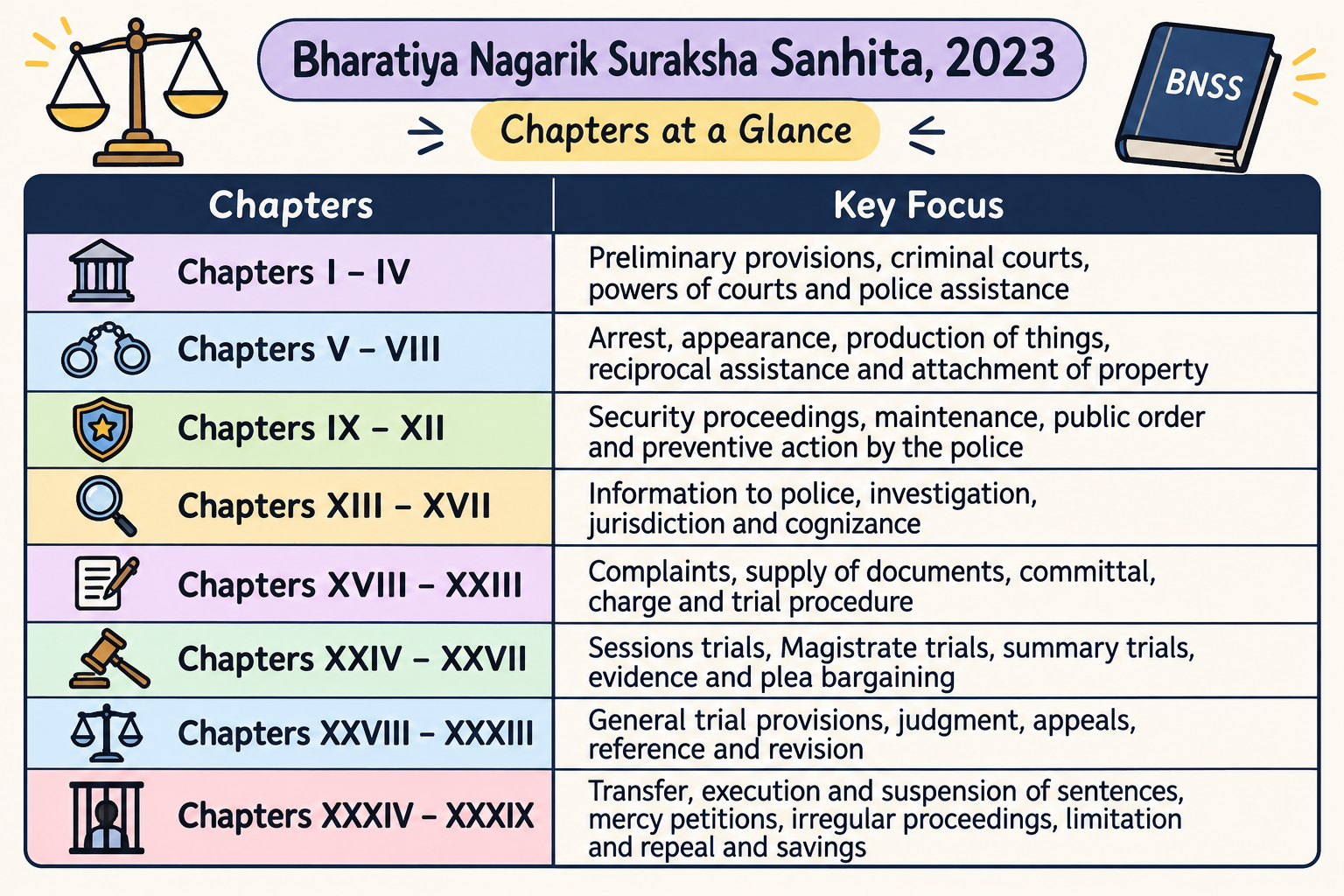
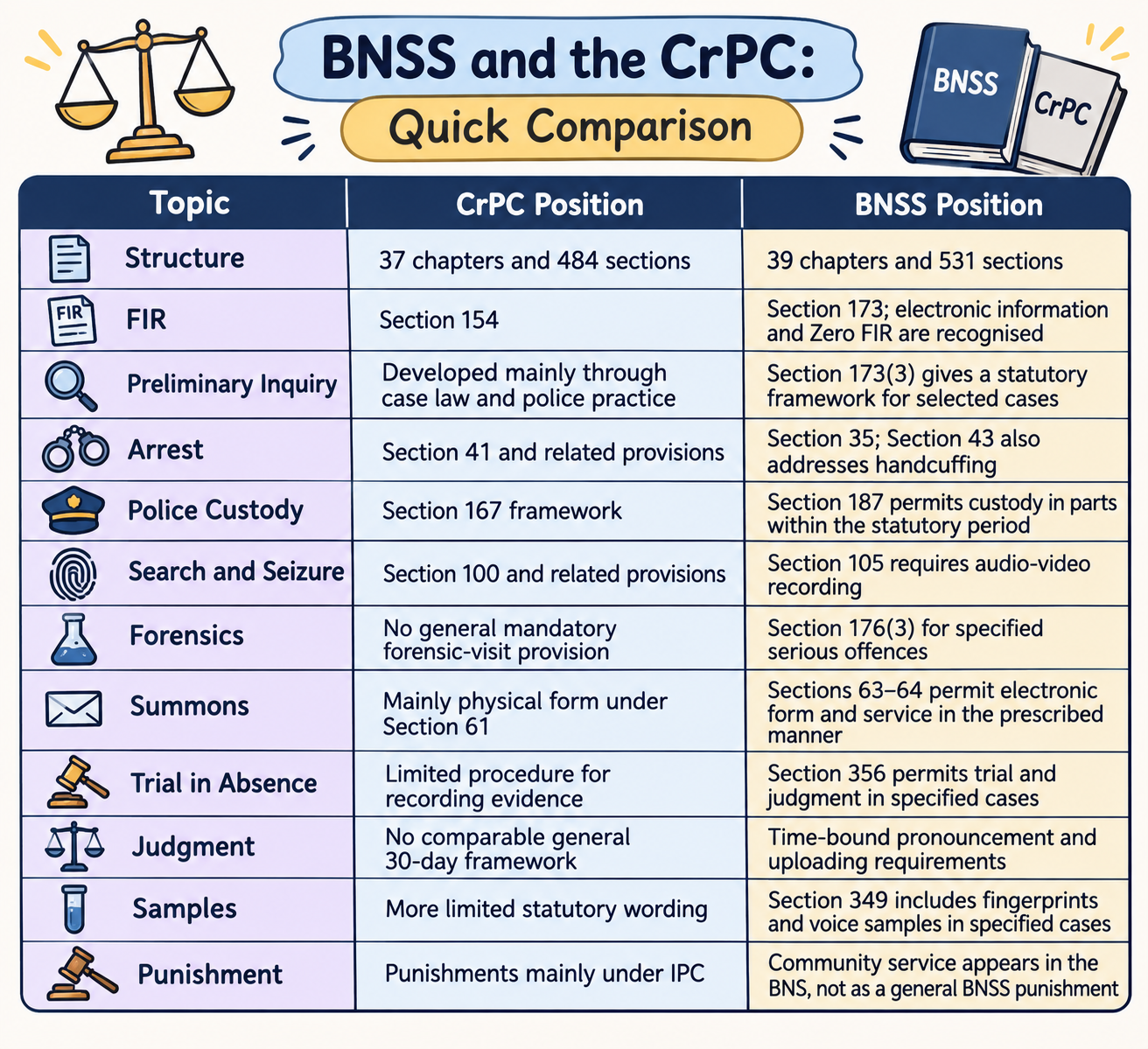
What happens after a crime is reported? Who can arrest an accused? When must the police register an FIR? How does a court grant bail, conduct a trial or hear an appeal? These questions are answered by criminal procedure law. The Bharatiya Nagarik Suraksha Sanhita, 2023, commonly called the BNSS, is India’s current law on criminal procedure. It replaced the Code of Criminal Procedure, 1973, or the CrPC, from 1 July 2024. The BNSS is Act 46 of 2023. It contains 531 sections arranged in 39 chapters and two Schedules. This article contains the quick BNSS revision notes for CLAT PG students.
The BNSS is a procedural statute. It does not generally define crimes or prescribe the main punishments for offences. Those subjects are mainly dealt with by the BNS and special criminal laws. BNSS explains the process followed by the police, Magistrates, Sessions Courts and appellate courts.
It covers:
registration and investigation of offences,
arrest, search, seizure and remand,
summons, warrants and proclamation,
jurisdiction and powers of criminal courts,
complaints and charge sheets,
trials, judgments and sentencing procedure,
bail, bonds and undertrial release,
BNSS structure: Chapter-wise overview
BNSS Revision Notes : Chapters and Sections
Chapter I : Preliminary Provisions (Sections 1 to 5)
Short title, extent and commencement of the act is mentioned under section 1. It states that the BNSS came into force on 1 July 2024.
Section 2 contains definitions. Words such as “audio-video electronic means”, “bail”, “bail bond”, “bond”, “complaint”, “investigation” and “victim” are important. The definition of a victim includes a person who suffers loss or injury and also includes the guardian or legal heir in appropriate cases.
Section 3 deals with the construction of references. It helps read references to Magistrates, police officers and other authorities in the new statutory framework.
Sections 4 and 5 deal with the trial of offences under the BNS and other laws and preserve special or local laws unless the BNSS specifically changes their operation.
Chapters II and III: Criminal courts and powers (Sections 6 to 29)
Section 6 recognises the main classes of criminal courts i.e. Courts of Session, Judicial Magistrates of the First Class, Judicial Magistrates of the Second Class and Executive Magistrates, in addition to High Courts and courts created under special laws.
Sections 8 to 20 deal with Sessions Courts, Judicial Magistrates, Executive Magistrates, Public Prosecutors, Assistant Public Prosecutors and the Directorate of Prosecution.
Section 21 states which courts may try offences. The First Schedule and the relevant offence-creating statute help determine whether a case is triable by a Magistrate or a Sessions Court.
Sections 22 and 23 deal with the sentences that High Courts, Sessions Judges and Magistrates may pass. A Magistrate’s sentencing power is limited by the statute.
Section 29 allows powers of a Judge or Magistrate to be exercised by a successor in office, subject to the law.
Although A.K. Kraipak v. Union of India is not a criminal-procedure case, its principle of fairness is useful. Whenever a statutory authority exercises power affecting liberty, the procedure must be fair, reasonable and free from bias.
Chapter V: Arrest of persons (Sections 35 to 62)
Section 35: When police may arrest without warrant
Section 35 is one of the most important BNSS provisions. It deals with arrest without a warrant. Arrest is not meant to be automatic merely because an FIR has been registered or an allegation has been made. The police must apply the statutory conditions and record reasons where required.
For offences punishable with imprisonment up to seven years, the police must consider whether arrest is necessary for proper investigation, preventing further offences, preventing tampering with evidence, stopping threats to witnesses or ensuring the accused’s presence in court.
Sections 36 to 38: Duties after arrest and access to a lawyer
Section 36 lays down the procedure and duties of the arresting officer. The officer must identify himself and prepare the arrest memorandum as required. Section 37 deals with the designation of a police officer responsible for maintaining arrest information. Section 38 recognises the right of an arrested person to meet an advocate during interrogation, though not throughout interrogation.
Section 43: Manner of arrest and handcuffing
Section 43 allows handcuffing in specified serious situations, including certain cases involving habitual or repeat offenders, organised crime, terrorist acts, drug offences, murder, rape, acid attacks, offences against the State and offences involving serious economic offences. This power must be exercised carefully so that it may not infringe Article 14 and 21.
Sections 47-60 : Rights and safeguards
These include medical examination, communication of grounds of arrest, protection against unnecessary detention, information about the right to bail, and production before a Magistrate. They provide that a person arrested should not be detained beyond the constitutional and statutory limit without judicial authority.
Case laws : Arrest
D.K. Basu v. State of West Bengal: Established strict rules for police behaviour during an arrest to prevent custody violence. Officers must wear clear identification badges, prepare a proper arrest memo, inform a relative or friend immediately, and ensure the detained person receives regular medical checkups.
Joginder Kumar v. State of Uttar Pradesh: Held that having the legal power to arrest someone does not mean the police should arrest them automatically. Police officers must justify why an arrest is necessary rather than doing it routinely or out of habit.
Arnesh Kumar v. State of Bihar: Mandates strict limits to prevent arbitrary, automatic arrests for lesser crimes. Magistrate and police must strictly verify that the arrest meets proper legal criteria instead of jailing someone by default.
Vihaan Kumar v. State of Haryana: Simply informing a family member or completing an arrest memo is not enough to satisfy constitutional rights. The specific reasons and facts behind the arrest must be clearly communicated directly to the person being arrested in a language they fully understand.
Chapter VI: Processes to compel appearance (Sections 63 to 93)
This chapter deals with summons, warrants, proclamation and attachment. Sections 63 to 71 cover summons. Section 63 allows a summons to be issued in writing or in an encrypted or other electronic form bearing the required seal or digital signature. Section 64 provides for service, including electronic service in the manner prescribed by law.
Sections 72 to 83 deal with warrants of arrest. A warrant must be properly issued and executed. The person arrested under a warrant must be informed of its substance and produced before the appropriate court without unnecessary delay.
Sections 84 to 89 deal with proclamation and attachment of property of a person who absconds. Proclamation is not a shortcut. The statutory conditions and publication requirements must be followed.
Sections 90 to 93 contain other rules relating to processes and appearance.
The Supreme Court held that arrest warrants should not be issued mechanically. Courts should first consider whether a summons or a bailable warrant can secure appearance. A non-bailable warrant is a serious step affecting liberty.
Chapter VII: Production of things and search and seizure (Sections 94 to 110)
Section 94 empowers a court or police officer to require production of a document or other thing necessary for investigation, inquiry or trial. This includes material held in electronic form where the statutory conditions are satisfied.
Sections 96 to 103 deal with search warrants and searches. The procedure must protect the integrity of the investigation and the rights of persons whose premises or belongings are searched.
Section 105 : Audio-video recording of search and seizure
A major BNSS change is the requirement that the process of search and seizure, including the preparation and signing of the seizure list, be recorded through audio-video electronic means, preferably by mobile phone. This helps courts examine whether the recovery was real and properly documented and maintains transparency.
Section 106: Police seizure of property
Police may seize property suspected to be connected with an offence. The seizure must be reported and handled according to the statutory procedure.
Section 107: Attachment, forfeiture and restoration of property
Section 107 provides a mechanism for attachment and related action concerning property derived from criminal activity. Because attachment may affect property before the conclusion of trial, reasons, notice and judicial supervision are important.
Case law connections
Pooran Mal v. Director of Inspection: held that the manner of obtaining evidence and the admissibility of evidence are distinct questions, though later constitutional privacy jurisprudence must also be considered.
K.S. Puttaswamy v. Union of India : The Right to Privacy Test This landmark ruling mandates that any state action invading personal privacy must strictly fulfill the test of legality, a legitimate state objective, proportionality, and robust procedural safeguards.
Vijay Madanlal Choudhary v. Union of India: This decision provides the foundational framework for property attachment under the PMLA, illustrating why strict adherence to statutory safeguards is vital to protect against arbitrary state action.
Chapter VIII: Reciprocal arrangements and property attachment (Sections 111 to 124)
This chapter deals with assistance between India and foreign countries, service of processes outside India and attachment or forfeiture of property connected with criminal activity. It is particularly relevant to cases involving absconding accused, cross-border evidence and proceeds of crime.
This chapter should be read with special laws such as the PMLA and the Fugitive Economic Offenders Act.
Chapter IX: Security for keeping peace and good behaviour (Sections 125 to 143)
A Magistrate may require a person to show cause why they should not be ordered to execute a bond for keeping the peace or maintaining good behaviour. These are preventive proceedings. They are not a substitute for a criminal trial or punishment for an offence already proved.
The person must receive notice of the substance of the information, an opportunity to respond and a fair inquiry.
Chapter X: Maintenance of wives, children and parents (Sections 144 to 147)
Section 144 provides a summary remedy for maintenance of a wife, child or parent who is unable to maintain themselves. It is a social-justice provision. The remedy is separate from rights under personal law and other statutes.
Section 145 deals with the procedure. The claim is generally filed where the person resides or where the parties fall within the statutory jurisdiction.
Important case laws
Bhagwan Dutt v. Kamla Devi : maintenance proceedings are intended to prevent destitution and should receive a practical interpretation.
Rajnesh v. Neha : laid down guidelines on disclosure of assets and liabilities, the date from which maintenance may be awarded, adjustment of overlapping claims and enforcement.
Chaturbhuj v. Sita Bai : a wife need not be completely without resources. The question is whether she can maintain herself in the manner contemplated by law.
Chapters XI and XII: Public Order and Preventive Action by Police (Sections 148 to 172)
These chapters deal with unlawful assemblies, public nuisances, urgent cases of nuisance or apprehended danger and preventive action by the police.
Section 163, corresponding broadly to the former Section 144 CrPC, empowers a Magistrate to issue written orders in urgent cases of nuisance or apprehended danger. The power is preventive and temporary. It cannot be used to suppress lawful disagreement or to avoid constitutional scrutiny.
Preventive police action and duty to prevent cognizable offences are dealt under sections 168 to 172.
The Supreme Court held that restrictions affecting speech and the internet must satisfy legality, necessity and proportionality. Orders under preventive powers must be reasoned, accessible and subject to review.
Chapter XIII: Information to the police and investigation powers (Sections 173 to 196)
Section 173: Information in cognizable cases and Zero FIR
Section 173 is one of the most important BNSS provisions. Information about a cognizable offence may be given orally or through electronic communication. An electronically submitted information must be signed by the informant within the prescribed period.
The section gives statutory recognition to Zero FIR. A police station must register information about a cognizable offence even when the offence occurred outside its territorial jurisdiction. The FIR can later be transferred to the police station having jurisdiction.
Section 173(3) : Preliminary Inquiry
For cognizable offences punishable with imprisonment of three to seven years, an investigating officer can conduct a preliminary inquiry after obtaining prior authorization from a senior officer, with a strict 14 day deadline to determine if a prima facie case exists. This statutory provision must be closely related with the landmark ruling of Lalita Kumari v. Government of Uttar Pradesh. In Lalita Kumari, the Supreme Court held that registration of an FIR is mandatory when information discloses a cognizable offence, while a limited preliminary inquiry may be permissible in the categories identified by the judgment.
Sections 174 and 175
Section 174 deals with information relating to non-cognizable cases. Police generally require an order of a Magistrate before investigating a non-cognizable case. Section 175 deals with investigation of cognizable cases and the power of a Magistrate to order investigation where the police have failed to act.
Section 176 : Procedure for Investigation
This section states that the police must investigate the crime, examine witnesses and collect relevant materials. For offences punishable with seven years or more, the provision introduces a forensic-science requirement, subject to implementation and notification requirements. The crime scene should be visited and the process recorded electronically.
Section 193: Police report and investigation updates
The investigating officer submits the final police report after completing the investigation. The BNSS also emphasises informing the informant or victim about the progress of investigation within the statutory period.
Important case laws on FIR and investigation
Lalita Kumari v. Government of Uttar Pradesh : FIR registration is mandatory when the information discloses a cognizable offence, subject to the limited preliminary inquiry principle stated by the Court.
Sakiri Vasu v. State of Uttar Pradesh : a person can approach the Magistrate for directions where the police fail to register or investigate properly.
For a detailed discussion of Zero FIR, preliminary inquiry and property attachment, read CLATalogue’sBNSS Part I article.
Chapters XIV to XVII: Jurisdiction, cognizance and complaints (Sections 197 to 222)
These provisions deal with the place of inquiry and trial, conditions required before taking cognizance, complaints to Magistrates and examination of complainants and witnesses.
A court must have territorial and subject-matter jurisdiction. Some offences can be tried where the act occurred, where the consequence occurred or where the law specifically permits. Special statutes may create a different forum.
A Magistrate taking cognizance must apply the statutory conditions. Cognizance is not the same as the issuing process, framing a charge or finding guilt. These are separate procedural stages.
The Supreme Court explained that cognizance is taken when a Magistrate applies judicial mind to the suspected commission of an offence for proceeding under the Code. It is not necessarily taken merely by receiving a police report.
Chapters XVIII to XXIII: Complaints, supply of documents, committal and charge (Sections 223 to 247)
Section 223 deals with examination of the complainant and witnesses in a complaint case, subject to the statutory exceptions. The Magistrate must examine the complaint carefully before issuing it.
Supply of relevant documents to the accused and right to know the material relied on by the prosecution and supports an effective defence is protected under sections 230 and 231.
Section 232 deals with commitment of a case to the Court of Session when the offence is exclusively triable by that court.
The provisions on discharge and framing of charge require the court to examine whether the prosecution material discloses a sufficient ground to proceed. At this stage, the court does not conduct a full trial, but it also cannot act mechanically.
Important case laws
State of Bihar v. Ramesh Singh: The court established that when framing charges, the judiciary must evaluate whether a strong suspicion or sufficient ground to proceed exists, rather than assessing whether the evidence is enough to guarantee a certain conviction.
Chapters XXIV to XXVII: Trials, evidence and plea bargaining (Sections 248 to 300)
Sessions trials : Sections 248 to 260
These provisions cover opening of the prosecution case, discharge, framing of charge, prosecution evidence, defence, arguments and judgment in Sessions cases.
Warrant cases by Magistrates : Sections 261 to 273
These provisions distinguish cases instituted on a police report from cases instituted otherwise than on a police report. The procedure protects the accused while allowing the prosecution to present its evidence.
Summons cases : Sections 274 to 282
Summons cases involve less serious offences. The procedure is simple but essentials of notice, hearing and a fair opportunity to defend remains with the accused..
Summary trials : Sections 283 to 288
Summary trials are designed for certain less serious offences and use a simplified procedure. The court must remain within the statutory limits and record the required particulars.
Evidence and general trial provisions : Sections 337 onwards
The court must follow rules of examination, cross-examination, identification and recording of evidence. The BSA now governs the substantive law of evidence, while BNSS governs the procedure by which evidence is recorded and used at trial.
Plea bargaining : Sections 289 to 300
Plea bargaining allows an accused to seek a negotiated resolution in eligible cases, subject to statutory exclusions and judicial supervision. It is not available for every offence. The court must ensure that the request is voluntary and informed.
State of Punjab v. Gurmit Singh : courts must approach testimony in sexual-offence cases with sensitivity and should not demand unnecessary corroboration as an inflexible rule.
Khatri v. State of Bihar : free legal aid is a constitutional requirement where the accused cannot afford representation.
Under this provision, a proclaimed offender who has absconded and cannot be brought before the court may still be tried. Provided specific statutory safeguards and conditions are met.
This provision is intended to prevent absconding accused from permanently stopping a trial. However, it raises important fair-trial questions. Therefore the court must ensure proper proclamation, legal representation where required, preservation of evidence and compliance with the statutory steps.
Case law connection: N. K. Vasudevan v. State
Older decisions on trial in the absence of an accused emphasise that personal presence is an important part of a fair trial. Students should therefore read section 356 together with Article 21 and the specific safeguards in the BNSS.
Chapter XXVIII: Judgment and sentencing procedure (Sections 392 to 406)
Section 392 deals with the manner of pronouncing judgment. The BNSS aims to reduce delay by requiring the judgment to be pronounced within the prescribed period after arguments are completed, subject to the statutory extension and reasons.
The judgment must address the issues necessary for deciding guilt, innocence and sentence. Assuring that a sentencing order should not be a mechanical formality.
The Supreme Court’s “rarest of rare” doctrine applies to death sentencing. A court must consider both aggravating and mitigating circumstances and give meaningful reasons for choosing the death penalty rather than life imprisonment.
Chapters XXX to XXXIII: Appeals, reference and revision (Sections 413 to 445)
Sections 413 to 435 deal with appeals. A right of appeal is created by statute, so the accused or State must identify the provision granting the appeal.
Sections 436 to 445 deal with reference and revision. Revision is narrower than an appeal. A revisional court generally does not reappreciate evidence as if it were hearing a full appeal, unless interference is necessary to correct a jurisdictional or serious legal error.
Chapters XXXIV and XXXV (Sections 446 to 477) : Transfer, execution, suspension and remission of sentences
These chapters outline the statutory framework governing the transfer of criminal cases, the execution of legal sentences, and the processes for their suspension, remission, and commutation. The authority to suspend or remit a sentence is strictly regulated by constitutional and statutory laws. It must be applied equitably, based on objective and relevant criteria, and completely free from discrimination.
Important Case Laws
Epuru Sudhakar v. Government of Andhra Pradesh : Affirms that executive decisions regarding remission and clemency are subject to judicial review if they are found to be arbitrary, discriminatory, malafide, or influenced by irrelevant factors.
Sriharan v. Union of India : Clarifies the legal interplay between life imprisonment, the executive powers of remission, and the boundaries set by statutory law.
Shatrughan Chauhan v. Union of India : Establishes guidelines for evaluating mercy petitions, particularly concerning the commutation of a sentence.
Chapter XXXVI: Mercy petitions (Sections 453 to 477)
The BNSS provides a statutory process for mercy petitions in death-sentence cases. Such petitions can be formally initiated by the prisoner, their legal heir or relative following a prescribed procedure. The appropriate government is mandated to route and process these through the specified statute.
Chapter XXXVII (Sections 506 to 512) : Irregular Proceedings
A procedural mistake does not automatically invalidate or nullify a trial. Courts are required to evaluate whether the error can be legally corrected or if it has resulted in a miscarriage of justice. This chapter explicitly categorizes different types of irregularities and outlines the specific conditions under which legal proceedings may be overturned.
Chapter XXXVIII: Limitation for taking cognizance (Sections 513 to 519)
These provisions prescribe limitation periods for taking cognizance of certain offences. The period depends on the maximum punishment. The Code also contains rules on commencement, exclusion of time and extension in appropriate circumstances.
Limitation does not generally erase the offence itself. It restricts the court’s power to take cognizance after the prescribed period unless the statute permits extension or condonation.
Chapter XXXIX: Repeal and savings : Section 531
Section 531 repeals the CrPC but saves previous operations, rights, liabilities, penalties, investigations, inquiries and proceedings in appropriate cases. The transition provision is important because criminal cases may have begun under the CrPC before 1 July 2024.