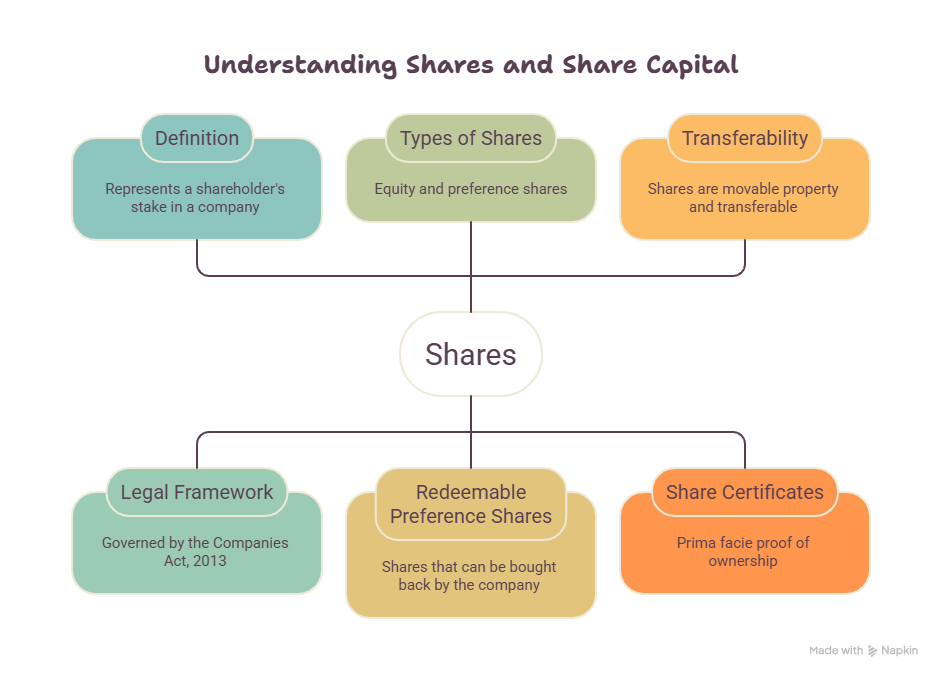
A share represents a shareholder's stake in a company, measured against the total capital the company is entitled to receive. It falls under the broader category of "securities" and reflects the proportion of money a shareholder has contributed relative to the whole. Read completely about share capital and shareholders right.
The Companies Act, 2013 treats a share as part of the company's share capital, while "authorised capital" refers to the maximum capital a company's memorandum permits it to raise. Chapter IV of the Act governs the entire framework around shares and share capital.
Types and Nature of Shares
Under Section 43, a company limited by shares can issue two kinds of capital: equity share capital and preference share capital. Equity shares may carry ordinary voting rights or differential rights concerning dividend and voting, depending on prescribed rules. Preference share capital, by contrast, gives its holders a priority claim over dividend payment and capital repayment.
According to Section 55(2) of the Companies Act, 2013, the Articles of Association (AoA) must authorize the issue of redeemable preference shares in the first place, but the articles cannot simply extend the 20-year limit for ordinary companies. Instead, the law provides a specific statutory exception:
Infrastructure Projects: A company engaged in setting up and dealing with infrastructure projects (as specified in Schedule VI of the Act) may issue preference shares for a period exceeding 20 years but not exceeding 30 years.
Condition: This is subject to the redemption of a minimum of 10% of such preference shares per year from the 21st year onwards, at the option of the preference shareholders.
Shares are legally classified as movable property under Section 44, transferable only in the manner the company's articles set out. Section 45 further requires every share to carry a distinctive number, except where a depository record already identifies the beneficial owner.
Once shares are allotted, Section 46entitles the shareholder to a share certificate, which acts as prima facie proof of ownership. If this certificate gets lost, damaged, or destroyed, the company can issue a duplicate once the original is surrendered or proof of loss is furnished.
Private Placement and Allotment Rules
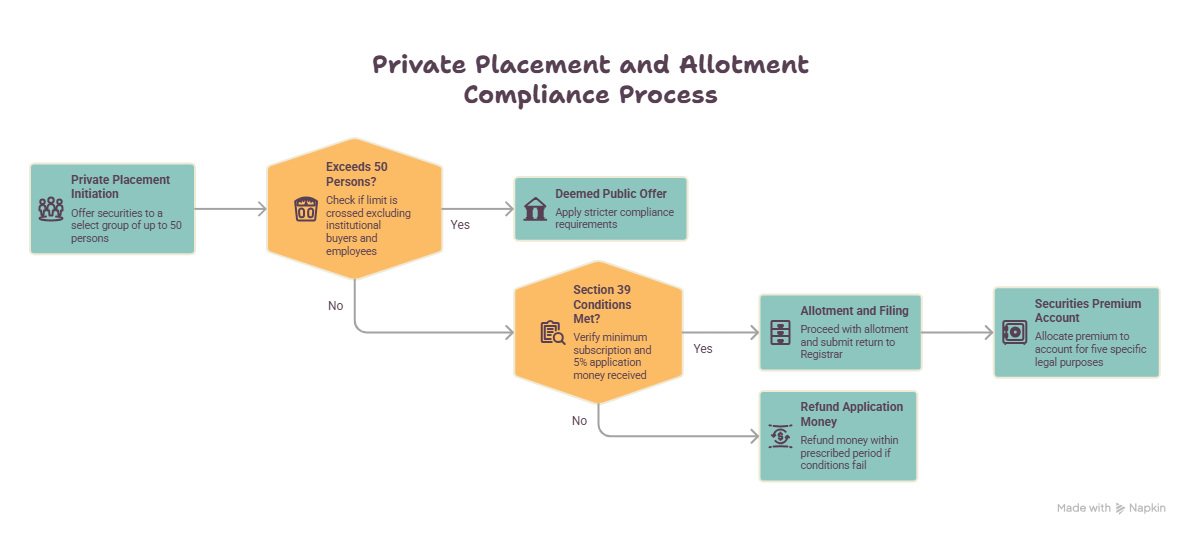
Companies can also raise capital through private placement, offering securities to a select group rather than the public at large. This route is capped at fifty persons, or a higher number as may be prescribed, excluding institutional buyers and employees, within a single financial year.
Crossing this limit converts the offer into a deemed public offer, bringing stricter compliance requirements along with it.
Before any allotment takes effect, several statutory conditions must be satisfied. Under Section 39,allotment can only proceed once the minimum subscription stated in the prospectus is met and the application money, at least five percent of the security's nominal value, has actually been received.
If these conditions remain unfulfilled within thirty days of the prospectus, the company must refund the application money within the prescribed period. Every allotment also triggers a filing requirement, since the company must submit a return of allotment to the Registrar.
Public offers additionally require companies to secure listing permission from a recognised stock exchange before the offer opens, with application money held in a separate account earmarked only for adjustment or refund.
When shares are issued at a premium, the premium amount must go into a securities premium account, usable strictly for five defined purposes via Section 52(2):
Issuing fully paid bonus shares.
Writing off preliminary expenses.
Writing off the expenses, commission paid, or discount allowed on any issue of securities or debentures.
Providing for the premium payable on the redemption of any redeemable preference shares or debentures.
Funding the buy-back of its own shares or other securities under Section 68
Companies retain some flexibility too: Companies (including start-ups) are now legally allowed to issue sweat equity shares immediately after incorporation
Bonus shares remain permissible under Section 63, and while a company generally cannot buy back its own shares without reducing capital, Sections 67, 68, and 70 carve out specific exceptions allowing buybacks funded through free reserves, the securities premium account, or fresh share proceeds.
Transfer of Shares
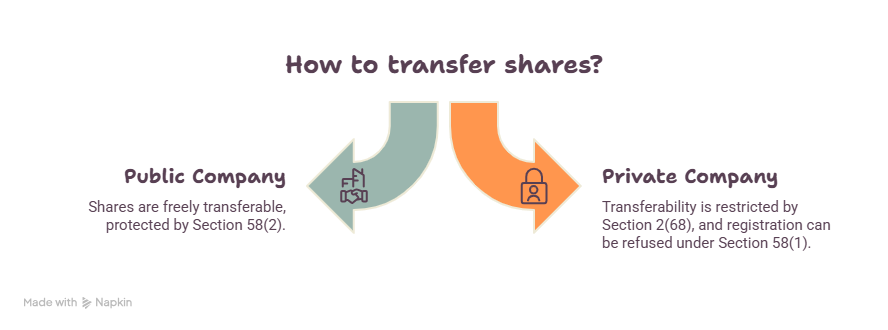
Shares being freely transferable property, shareholders in a public company enjoy an unrestricted right to transfer them, a position Section 58(2)explicitly protects. Any agreement between parties concerning such a transfer is treated as enforceable.
Private companies, however, work differently, since Section 2(68) requires them to restrict transferability by definition, and Section 58(1)permits them to refuse registration of a transfer, provided they notify both parties with reasons within thirty days.
For a transfer to be valid, Section 56 lays down a clear procedure. The transfer instrument must be signed by both transferor and transferee, carrying their names, addresses, and occupations, and it must be properly stamped and dated.
This instrument, along with the share certificate, needs to reach the company within sixty days of execution; where no certificate exists yet, the allotment letter serves the same purpose instead.
Shareholders' Rights
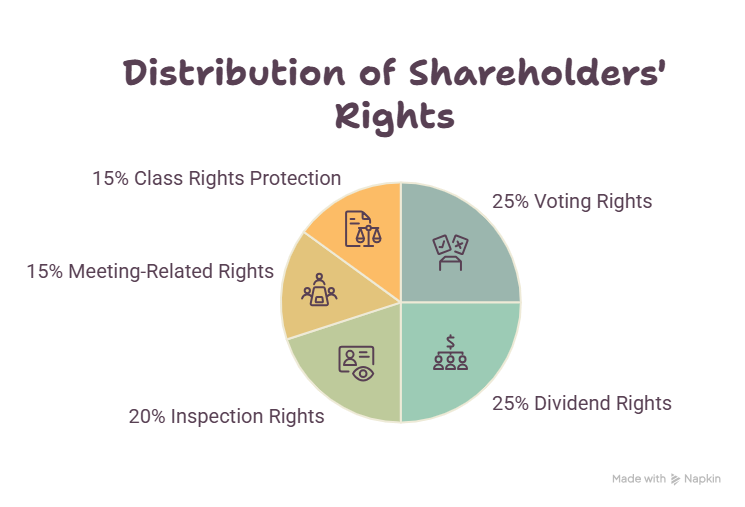
Ownership of shares comes bundled with a set of rights that go well beyond capital contribution. Voting rights sit at the core of this bundle, and Section 47 entitles every equity shareholder to one vote per share held on every resolution, while preference shareholders vote only on matters directly affecting their class, such as winding up or capital reduction.
This voting power gives shareholders real influence over company decisions taken at general meetings.
Dividend rights follow closely behind. Section 123 governs how dividends are declared and paid, and once a dividend is declared, it becomes a debt the company owes its shareholders, payable within thirty days.
Shareholders also hold inspection rights under Section 94, letting them examine registers, indexes, and returns the company is required to maintain, which promotes transparency around ownership and shareholding patterns.
Meeting-related rights matter just as much. Every shareholder is entitled to receive notice of general meetings, attend them, and vote on resolutions, and Section 100 lets shareholders holding a prescribed percentage of paid-up capital requisition an extraordinary general meeting when they believe one is necessary.
Class rights receive separate protection too, since Section 48 mandates that any variation of rights attached to a class of shares needs consent from three-fourths of that class, preventing majority shareholders from unilaterally altering minority entitlements.
Finally, shareholders are not left without remedies when things go wrong. Sections 241 and 242 allow shareholders to approach the National Company Law Tribunal against oppression or mismanagement, seeking relief that can range from share purchase orders to changes in company management.
Section 245goes further, permitting class action suits where a specified number of shareholders can collectively sue the company, its directors, auditors, or experts for wrongful conduct affecting their interests. Together, these provisions ensure shareholders retain meaningful control and protection well beyond the moment their shares are allotted.