
Top 10 Supreme Court Judgments of December 2025
Introduction
The supreme court of India does more than settle disputes between parties. By interpreting the constitution and ordinary statutes, it explains how law must operate in real life. Society changes quickly, but legislation may not always anticipate every new problem. Constitutional courts therefore protect basic rights, fill procedural gaps and ensure the fair act by institutions.
In December 2025 supreme court dealt with fair trial, disability access, women’s dignity, workplace safety, dowry violence, sentencing, forest reforms, endangered species and environmental regulation. The court often interpreted existing laws in a practical and purposive manner.
It issues directions where rights would remain premises. At the same time, it showed restraint in the Aravalli matter. The court stayed its own earlier framework and sought expert advice.
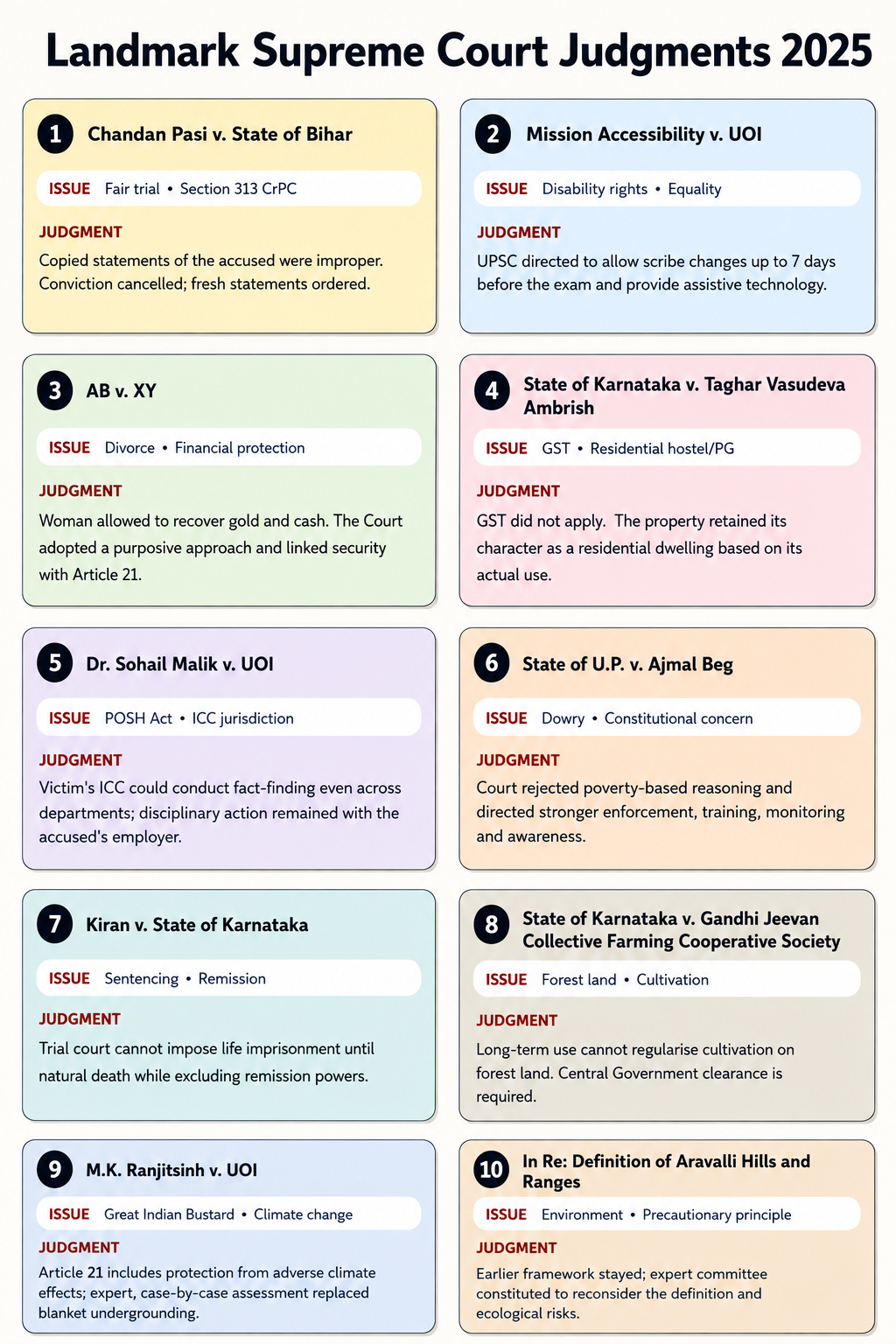
This article contains a list of nine judgments and one important constitutional order. The last matter is described as an order as it was not a final judgment. Together, these decisions are useful for students preparing for the CLAT exam as they connect statutory law with equality, dignity, fair procedure, social justice, environmental protection and separation of powers.
Fair trial must be meaningful - Chandan Pasi v. State of Bihar (2025 INSC 1317)
Facts
- The case originated from a 2016 murder incident in Bihar involving the killing of an individual named Ghughali Pasi. The trial court convicted six individuals, sentencing them to life imprisonment, which was confirmed by the high court. Three of the convicted individuals appealed to the supreme court.
- The accused were examined under Section 313 of Code of Criminal Procedure (CrPC). During the examination, the court instead of asking each individual questions, copied and pasted the exact same answers for three different accused.
- The written recorded statements of all three accused individuals looked identical to each other, which infringed the accused right to defend themselves fairly.
Issues
Would a trial be called ‘fair’ if the judge just copied and pasted the questioning process instead of listening to each accused person individually?
Judgment
- The supreme court found that the statements of three accused persons recorded under section 313 of the Crpc were almost carbon copies of one another. It directed the trial court to record the statements again.
- The court also stated that a prosecutor is an officer of the court and cannot act as a defence lawyer.
- The ruling shows that section 313 is not a ritual, by this court means an accused must get a real opportunity to understand and answer the circumstances appearing to him. The case strengthens the link between criminal procedure and article 21.
- The court cancelled the conviction and ordered the lower court to redo the questioning and recording properly.
Equality requires removal of barriers - Mission Accessibility v. UOI (2025 INSC 1376)
Facts
This case is about making the civil services exam (UPSC) accessible for students with disabilities. As disabled candidates face practical difficulties during exams they need clear rules to easily change their exam helpers and use assistive software.
Issue
Does the government have a duty to remove physical and practical barriers so that disabled people can compete equally?
Judgement
- The supreme court held that disability rights are not charity but part of fundamental constitutional rights under articles 14, 19, and 21. The court ordered the UPSC to let candidates change their exam helper (scribe) up to 7 days before an exam, and directed UPSC to decide on these requests within 3 days.
- It also directed UPSC to create a plan to provide screen-reading software and technology tools for visually impaired students.
- Thus, the decision moves from formal equality to substantive equality by ensuring that the state must remove practical barriers that prevent a person from competing fairly.
Financial Protection after divorce - AB v. XY
Facts
- This is an anonymous case where a divorced muslim woman went to court to get back the gold and cash that was given to her husband when they got married.
- This case did the purposive interpretation of the specific law made for muslim woman i.e. Muslim Women (Protection of Rights on Divorce) Act, 1986.
Issue
Should welfare laws meant to protect women be interpreted strictly, or should they be read broadly to make sure women actually get financial protection after a divorce?
Judgement
The court ruled in favour of the muslim woman and allowed her to get her gold and cash back. It connected her financial security directly with Article 21, the right to life and personal dignity. The court stated that safety laws for vulnerable groups should never be read so narrowly that they become useless. They must provide real, practical help to protect women financially.
The case is important for understanding the purposive interpretation of the Muslim Women (Protection of Rights on Divorce) Act, 1986 statute.
GST and Hostel accommodation - State of Karnataka v. Taghar Vasudeva Ambrish (2025 INSC 1380)
Facts
- A property owner in Bengaluru leased out a large residential building to a private company. That company used the building to run a long-term hostel and PG facility for local students and working professionals.
- The dispute arose when tax authorities tried to charge Goods and Services Tax (GST) on this rental income. They argued that because the property was rented to a company and not directly to individuals it should be treated as a commercial business lease.
Issue
Does renting a residential building lose its tax-free status under GST just because it is leased to a corporate middleman or used as a student hostel?
Judgment
The supreme court ruled that GST does not apply. What matters the most is how the building is ultimately used, not who signs the lease. By this it adopted the practical approach.
It was held as the students and young professionals live there long-term, the property keeps its nature as a ‘residential dwelling’.
The court noted that tax laws should be interpreted practically keeping in mind the real social purpose of hostels and PG’s. This decision is therefore relevant at times as it highlights the reliability of students and young professionals on hostels and PG’s at affordable prices.
Wider Protection under the POSH Act - Dr. Sohail Malik v. UOI (2025 INSC 1415)
Facts
- A woman working in the one government department filed a sexual harassment complaint against a male employee who worked in a completely different department.
- She approached the Internal Complaints Committee (ICC) at her own workplace to start an investigation.
- The accused man challenged this in court. He argues that her workplace ICC had no power over him because he belonged to a separate organization and answered to a different boss.
Issue
Can a woman’s workplace ICC investigate a sexual harassment case under the POSH Act if the accused person works in an entierly different department.
Judgment
- Court treated Section 11(1) of the Sexual Harassment of Women at Workplace Act, 2013 as procedural not as a jurisdictional restriction. It held that the POSH Act is meant to protect women, not businesses.
- The supreme court ruled that the woman’s workplace ICC has full authority to investigate the complaint. It separated fact-finding from disciplinary action. It clarified how this cross-workplace process works in two stages.
- The victim's ICC does the independent fact-finding inquiry.
- The findings are sent to the accused person’s employer, who is then legally required to issue the formal punishment.
Dowry is a constitutional Concern - State of U.P. v. Ajmal Beg (2025 INSC 1435)
Facts
- A young woman named Nasrin was married to Ajmal Beg. Shortly after the wedding, Ajmal Beg, along with his family members began subjecting Nasrin to continuous physical and mental harassment. Just one day prior to her death, her husband Ajmal visited his father–in-law’s house and demanded certain items.
- On the very next day, Nasrin was found dead by her maternal uncle on his visit to her place. She was physically assaulted and was set on fire using kerosene oil, resulting in 100% burn injuries which ultimately took her life.
- Charges of Section 498A, cruelty by husband or relatives and section 304B, dowry death of IPC and section 3 and 4 of Dowry Prohibition Act were brought against Ajmal Beg and his mother. The trial court sentenced both of them to life imprisonment under dowry death and cruelty.
- The Allahabad High Court reversed the trial court’s verdict and acquitted the accused on the reasoning that the accused family is poor, so it is ‘illogical’ to assume that they would demand expensive things as it will be challenging for them to maintain it.
- The state government of UP was aggrieved by the high court’s decision thus they appealed to the supreme court.
Issues
- Whether the Allahabad High Court was legally justified in completely overturning the trial court conviction on the assumption that ‘poor people would not demand expensive items as they could not afford to maintain them’?
- Should the judiciary treat the eradication of the dowry system as an urgent national human rights and social equality issue rather than as mere local crime?
Judgment
- The supreme court went beyond the individual criminal appeal and described the elimination of dowry as an urgent constitutional and social necessity.
- It directed the government to strengthen educational awareness about equality in marriage, ensure Dowry Prohibition Officers perform their duties properly, train police and judicial officers, monitor pending cases and conduct grassroots awareness programmes.
- The judgement shows how courts can use constitutional and statutory powers to address a continuing social evil. It also recognised the need to distinguish genuine cases from fake or abusive proceedings.
Limits on trial-court sentencing power - Kiran v. State of Karnataka (2025 INSC 1453)
Facts
The casse revolves around a sessions court sentencing a convicted individual to life imprisonment. The trial court explicitly ordered that the convict must remain in prison until their natural death, intentionally blocking any chance of early release, remission or reduction of sentence.
Issue
Does a local trial court have the legal power to sentence a person to life imprisonment until natural death and take away government remission powers?
Judgment
- The supreme court held that a trial court cannot pass such a sentence and such exceptional restrictions can be imposed only by constitutional courts, not by a trial court.
- The court protects institutional boundaries within the criminal justice system. It does not mean that serious offenders must automatically be released. It means that sentencing must remain within the authority given by law.
- For CLAT PG students this case is important to understand life imprisonment, remission and the separation of judicial functions.
Forest land cannot be regularised for farming - State of Karnataka v. Gandhi Jeevan Collective FArming Cooperative Society Ltd. (2025 INSC 1461)
Facts
- A collective farming cooperative group wanted to use designated forest land for farming and cultivation purposes.
- The group argued that because they had been farming or using the land for a long time, or based on equitable fairness, their lease should be officially approved and regularized.
- But according to the Forest (Conservation) Act, 1980, using forest land for non-forest purposes like farming requires prior permission from the central government.
Issue
Can long-term use of farming justify the turning of permanent forest land into agricultural farmland without proper central government approval?
Judgment
- The supreme court of India ruled that forest land cannot be regularised for farming purposes. Cultivation is a non-forest activity that strictly requires central clearance.
- The court made it clear that just because someone has been using the land for a long time does not make an illegal lease valid.
- This decision treats forest protection as a public and constitutional responsibility, not merely as a dispute over government property. It supports sustainable development and the protection of resources for future generations. The court made it clear that economic use cannot automatically prevail over statutory environmental safeguards.
The Great Indian Bustard and Climate Policy - M.K. Ranjitsinh v. UOI (2025 INSC 1472)
Facts
- This case deals with the direct clash between two important environmental goals i.e. protecting the critically endangered bird, the Great Indian Bustard (GIB), and expanding renewable energy, solar and wind power plants to fight climate change.
- The large overhead power lines from renewable energy plants were causing the heavy-bodied GIB birds to collide and die.
Issue
The main question was that how should the court balance the urgent need to protect a dying, endangered bird species against the global need to expand clean energy and fight climate change?
Judgement
- The supreme court beautifully expanded the right to life under Article 21 to include a constitutional right to be free from the adverse effects of climate change.
- The court moved away from its earlier blanket order requiring all power lines across huge areas to be put underground. Evidence showed that massive undergrounding was technically impossible, dangerous and very expensive.
- Instead of a strict judicial command, the court formed an expert committee to assess the area case-by-case. The goal is a balanced path where key habitats are saved without killing India's clean energy transition.
Judicial Caution in Environmental Matters - In Re: Definition of Aravalli Hills and Ranges
Facts
- On november 20, 2025, Supreme court had issued a landmark environmental framework to define what area legally counts as the protected ‘Aravalli Hills and Ranges.’ This was defined on the basis of a partly 100 meter elevation threshold.
- The court decided to pause its previous orders realizing that a rigid threshold might leave ecologically connected areas completely unprotected.
- It also blocked all new mining permissions in areas identified by the 2010 forest survey of India report without court permission.
Issue
Should the court pause and rewrite its own legal definition of a mountain range if sticking to the older definition causes irreversible environmental destruction and unchecked illegal mining?
Order
- The supreme court stayed the earlier guidelines and called for institutional self-correction while dealing with scientific uncertainty and nature. The court set up a high-powered expert committee to re-examine the definition, making sure both ecological connectivity and environmental risks are properly managed.
- The court applied the precautionary principle and reaffirmed that when there is scientific uncertainty, the legal framework must bend to prevent irreversible environmental harm rather than letting economic exploitation destroy a fragile ecosystem.
- This order is important as it shows institutional self-correction. Courts must revisit a framework when scientific uncertainty may cause irreversible environmental harm.
Conclusion
The December 2025 decisions show how the supreme court helps law keep pace with society. It protected the accused from an unfair trial, required accessibility for persons with disabilities, strengthened workplace remedies and treated women’s financial security and freedom from dowry as constitutional concerns.
These cases show that the supreme court does not make laws in the same manner as parliament. It interprets legislation, enforces constitutional rights and issues directions when necessary to make existing law effective.
Get case-law updates weekly
Join 10,000+ subscribers.
JU
Julie Nigam
Contributing author
Have a doubt about this judgment?Ask Doubts
