
Top 10 Supreme Court Judgments of September 2025
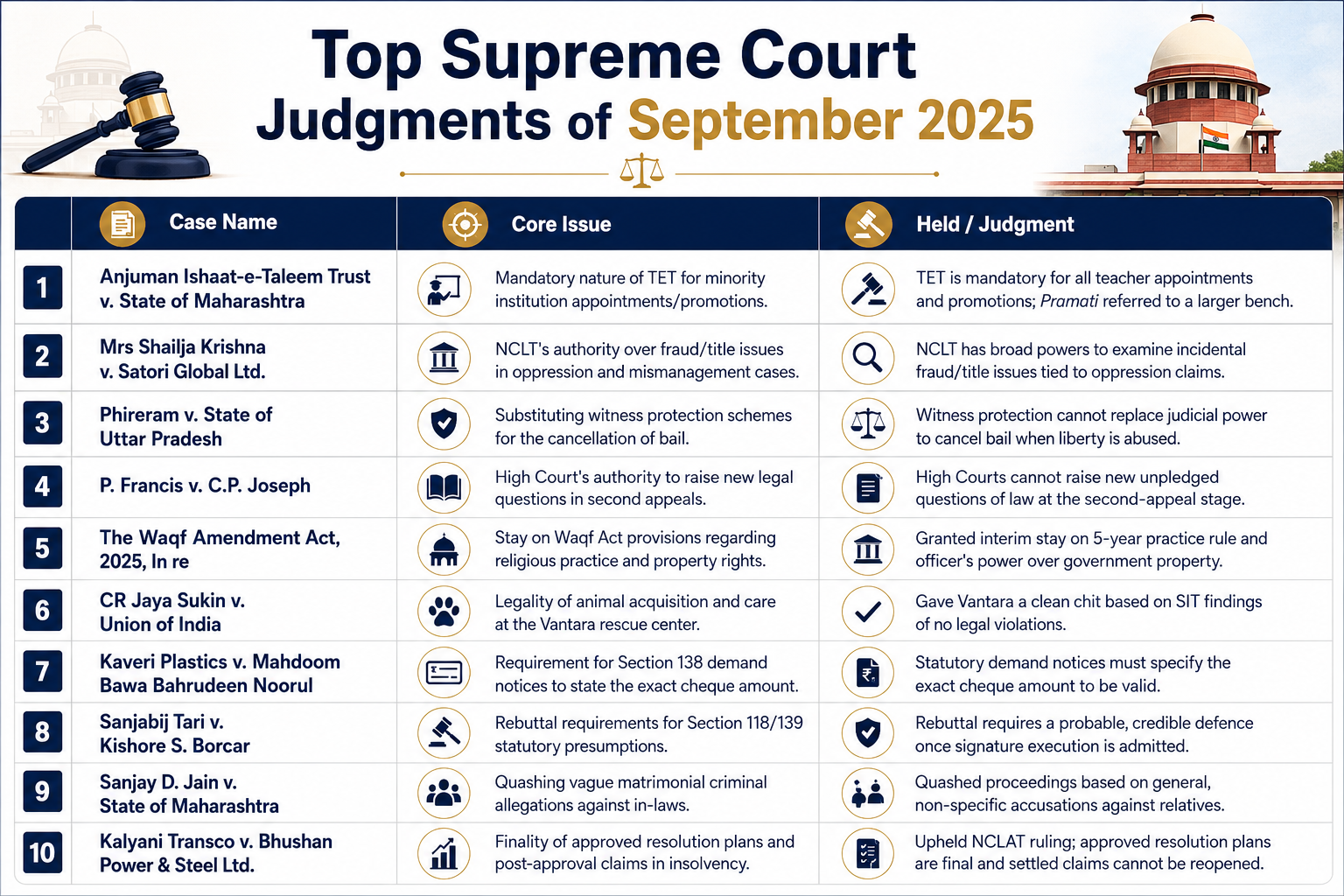
Have a look at Top 10 Supreme Court Judgments of September, 2025 which gave landmark rulings, including cases in the areas of minority education, company law, criminal procedure, cheque dishonour, insolvency and the constitutional limits on public power. For those aspirants preparing for the CLAT PG the Court's rulings link statutory interpretation with fair procedure, accountability, access to justice and the separation of powers.
Anjuman Ishaat-e-Taleem Trust v. State of Maharashtra (2025 INSC 1063)
Facts
The issue was about the requirement for teachers working in schools, including those in minority educational institutions, to take the Teacher Eligibility Test (TET).
The people who had brought the petition used the case of Pramati Educational and Cultural Trust v. Union of India to claim that the Right of Children to Free and Compulsory Education Act, 2009 (RTE Act) did not extend to minority institutions. The dispute also covered teachers who were already in employment as well as those who were applying for promotion.
Issue
The question is whether obtaining the TET is a mandatory requirement for the appointment and promotion of teachers, and whether minority institutions are entitled to an exemption from this requirement.
Judgment
The Court stated that both teachers who are applying for a post and those who are currently serving and seeking a promotion must have the required qualification in the TET, otherwise they have no entitlement to have their applications taken into account. It also cast doubt on the correctness of the Pramati decision and sent the matter to a bigger Bench. The judgment is significant in regard to the way the Court weighs minority rights under Article 30 against the State’s obligation to keep educational standards.
Mrs Shailja Krishna v. Satori Global Ltd. (2025 INSC 1065)
Facts
A shareholder and director claimed that she had been removed as a result of a fraudulent gift deed, manipulated share transfers, and defective corporate meetings.
The National Company Law Tribunal (NCLT) looked into these allegations and awarded relief, but the National Company Law Appellate Tribunal raised the question of whether the NCLT was entitled to decide matters relating to fraud and title in cases of oppression and mismanagement.
Issue
The question is whether the NCLT has the authority to look into cases of fraud, invalid transfers of shares, and defective board resolutions where such issues come up in a petition brought on grounds of oppression and mismanagement.
Judgment
The Supreme Court has reinstated the order of the NCLT. It stated that the Tribunal has broad powers to deal with incidental issues relating to fraud, forgery, coercion and invalid corporate documents where those issues are directly linked to the alleged oppression or mismanagement.
A party cannot overcome a valid shareholder claim just by bringing up technical objections concerning shareholding or the choice of forum. This case underlines the protective function of the NCLT in disputes involving minority shareholders.
Phireram v. State of Uttar Pradesh (2025 INSC 1074)
Facts
The appellant had applied for the cancellation of the bail granted to a person who was alleged to have threatened or intimidated witnesses. The High Court refused to cancel the bail and recommended that the appellant should instead make use of the Witness Protection Scheme, 2018.
Issue
The question is whether the fact that witness protection is available can serve to replace the court’s authority to cancel bail in cases where there is prima facie evidence of threats or misuse of liberty.
Judgment
The Supreme Court disagreed with the method adopted by the High Court. It stated that witness protection and the cancellation of bail are distinct forms of relief. It cannot be considered acceptable to use the Witness Protection Scheme in place of deciding whether bail should be cancelled, otherwise the statutory power to cancel bail would be rendered meaningless.
The case was sent back for further examination on its merits. The case also shows the difference between the preventive protection of witnesses and the curative control over the bail of an accused.
P. Francis v. C.P. Joseph (2025 INSC 1071)
Facts
The issue was about the validity of a joint will and the inheritance rights of the family members. In its second appeal, the Kerala High Court considered and decided a significant question of law relating to Section 67 of the Indian Succession Act, 1925, even though that point had not been properly raised or argued before the lower courts.
Issue
What are the limits on the power of a High Court to formulate an additional important question of law under section 100 of the Code of Civil Procedure, 1908?
Judgment
The Supreme Court has reinstated the concurrent findings in favour of the will. It stated that a substantial question of law must be raised by the pleadings, the issues and the findings in the case.
A High Court is not entitled to raise a new issue at the second-appeal stage, to reappreciate the evidence as though it were at the first appellate level, or to decide any additional question without first giving the parties a fair chance to respond.
This decision serves as a clear reminder that the jurisdiction for a second appeal is exceptional and restricted.
The Waqf Amendment Act, 2025, In re
Facts
It has been the case that several petitions have questioned certain provisions of the Waqf (Amendment) Act, 2025. The people who brought the petitions asked for a temporary halt to the whole law and raised issues concerning the creation of waqf, registration, government property and the makeup of waqf bodies.
Issue
The question is whether the Court should suspend the operation of the entire statute and if any of the specific provisions involve a serious constitutional or legal difficulty justifying temporary protection.
Judgment
The Court did not refuse to suspend the whole Act but only granted a limited interim stay. The stay was given with regard to the provision which required a person to have practised Islam for five years before they could create a waqf, on the ground that the statute did not provide a feasible way of ascertaining that condition.
Similarly, the power of the designated officer to decide if property was waqf property or government property was also stayed, it being noted that such a decision should be left to a judicial or quasi-judicial authority. All the other provisions were affirmed, including the exclusion of protected monuments from the category of waqf property.
This ruling shows what the difference is between invalidating a law in principle and offering protection to the parties involved in the constitutional review.
CR Jaya Sukin v. Union of India
Facts
It has been claimed in public interest petitions that at Vantara, a wildlife rescue and rehabilitation centre, animals were acquired unlawfully, imported in an improper manner and mistreated. In response, the Supreme Court set up a Special Investigation Team (SIT) to look into these allegations.
The SIT examined the records, listened to the relevant parties and then delivered its report in a sealed envelope.
Issue
The question is whether the accusations made against the centre are backed up by evidence of breaches of wildlife, customs, foreign exchange, environmental or criminal laws.
Judgment
The Court agreed with the SIT’s finding that no breach of the relevant laws had been established and therefore gave Vantara a clean chit. This case illustrates the way in which a court can obtain independent expert advice in a matter of public interest. However, sealed material must still be used with care since transparency and natural justice remain at the heart of judicial review.
Kaveri Plastics v. Mahdoom Bawa Bahrudeen Noorul (2025 INSC 1133)
Facts
A cheque was dishonoured, but the notice under section 138 of the Negotiable Instruments Act, 1881 required payment of an amount which was different from that stated on the cheque, and the accused objected to the complaint being maintainable.
Issue
Should a demand notice under Section 138 specify the exact amount of the cheque?
Judgment
The Supreme Court ruled that it had to. The reference to 'the said amount of money’ in the statutory notice is to the amount on the cheque. If the notice demands a substantially different amount, it is flawed and cannot be used as a basis for a prosecution under Section 138.
Although further claims such as interest or expenses may be stated separately, the amount of the cheque must be clearly specified. This judgment emphasizes the need for strict adherence to the conditions of a penal provision.
Sanjabij Tari v. Kishore S. Borcar (2025 INSC 1158)
Facts
The case was started by a complaint made under section 138 of the Negotiable Instruments Act, the defendant admitted having signed the cheque but advanced a defence which failed to properly explain the liability in question, the High Court then acquitted the defendant after re-evaluating the evidence.
Issue
What effect do the assumptions provided for in Sections 118 and 139 of the Negotiable Instruments Act have when it is admitted that the cheque has been executed?
Judgment
The Supreme Court stated that the statutory presumptions come into effect when the signature and execution are accepted. Although the accused has the right to challenge them, they must do so by putting forward a probable and credible defence; a simple reply notice or merely asserting the complainant’s financial capacity is not sufficient.
The Court also gave practical instructions aimed at reducing delays in cases concerning bounced cheques, emphasizing that the main aim of the law is to ensure payment and to maintain confidence in cheques.
Sanjay D. Jain v. State of Maharashtra (2025 INSC 1168)
Facts
It was claimed that family members, such as in-laws, had been the subject of criminal proceedings as a result of the accusations in the matrimonial dispute. The Supreme Court considered whether the allegations were specific enough to warrant the continuation of the prosecution.
Issue
The question is whether general and vague accusations made against relatives, without specifying the actual acts in question, are sufficient for initiating criminal proceedings.
Judgment
The Court overturned the proceedings concerning the relatives when the accusations were general and failed to specify a particular criminal role. The decision does not grant immunity against actual prosecution; rather, it mandates that courts should differentiate between a specific and well-supported allegation and the automatic assumption that applies to every relative.
The ruling is pertinent to the abuse of criminal process and inherent jurisdiction.
Kalyani Transco v. Bhushan Power & Steel Ltd. (2025 INSC 1165)
Facts
The case stemmed from the insolvency resolution process involving Bhushan Power and Steel Ltd, and former promoters as well as other parties challenged the National Company Law Appellate Tribunal’s decision, particularly regarding the treatment of claims following the approval of the resolution plan.
Issue
The question is whether the decisions of the appellate body in the insolvency procedure, especially as they concern claims made after approval and the resolution plan, should be set aside.
Judgment
The three-judge Bench rejected the appeals brought by the former promoters and maintained the decision of the NCLAT. The judgment emphasizes the importance of finality in the insolvency resolution process and restricts any efforts to reopen claims which have been settled after a resolution plan has been approved.
For students preparing for the CLAT PG exam, this case is helpful when reviewing the role of the Committee of Creditors, the importance of an approved resolution plan, and the policy of time-bound insolvency proceedings.
Conclusion
The September 2025 decisions show the Supreme Court working across several areas of law while repeatedly returning to a few core ideas. The Court protected shareholders from corporate manipulation, insisted on precision in cheque-bounce notices, separated witness protection from bail cancellation and controlled the scope of second appeals.
At the constitutional level, the Waqf litigation and the TET ruling illustrate how statutory schemes can affect minority rights, public administration and educational quality.
Get case-law updates weekly
Join 10,000+ subscribers.
JU
Julie Nigam
Contributing author
Have a doubt about this judgment?Ask Doubts
