
Top 10 Supreme Court Judgments of 2020
Below is the list of top landmark judgments of 2020 relevant to CLAT PG preparation.
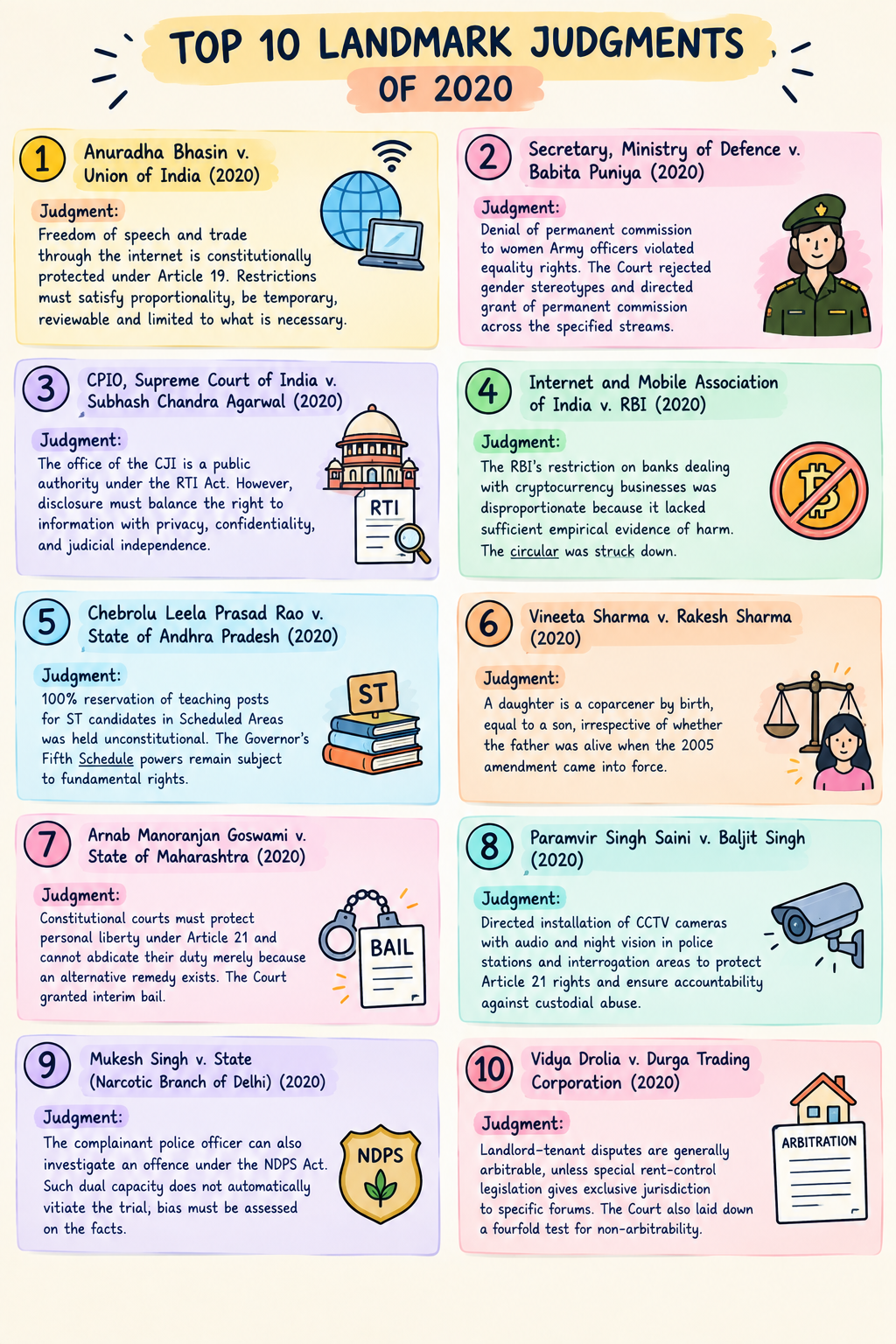
1. Anuradha Bhasin v. Union of India, (2020) 3 SCC 637
Facts
The petitioner, Executive Editor of the Kashmir Times, challenged the communication restrictions imposed in Jammu and Kashmir after the abrogation of Article 370 in August 2019.
The government suspended internet services, mobile connectivity, and imposed movement restrictions under Section 144 CrPC, citing threats to public order and national security. Journalists could not publish newspapers, and a Member of Parliament could not communicate with his constituents, prompting a batch of petitions before the Supreme Court.
Issues
- Whether indefinite suspension of internet services violates the fundamental rights guaranteed under Article 19(1)(a) and Article 19(1)(g) of the Constitution.
- Whether the government must disclose and periodically review suspension orders, and what standard governs restrictions imposed in the name of security.
Judgment
The Supreme Court held that freedom of speech and expression, along with the freedom to carry on trade and business through the internet, enjoys constitutional protection under Article 19.
It did not declare internet access itself a distinct fundamental right, but it applied the doctrine of proportionality to test the validity of restrictions. The Court directed the government to publish all suspension orders, ensure such restrictions remain temporary and reviewable, and confine them to the minimum necessary to achieve their stated purpose.
2. Secretary, Ministry of Defence v. Babita Puniya, (2020) 7 SCC 469
Facts
Women officers commissioned into the Indian Army under the Short Service Commission scheme approached the Delhi High Court after the government denied them permanent commission on par with male officers.
The High Court ruled in their favour, and the Ministry of Defence appealed to the Supreme Court, arguing that physical and operational constraints justified excluding women from command roles and permanent postings.
Issues
- Whether the policy denying permanent commission and command postings to women officers violated the right to equality under Articles 14 and 16 of the Constitution.
- Whether physiological and sociological arguments could justify excluding women from combat and command functions in the armed forces.
Judgment
The Supreme Court rejected the government's justifications as resting on "sex stereotypes" rather than genuine operational necessity, and held that denying permanent commission to women officers violated their right to equality.
It directed the government to grant permanent commission to women SSC officers across all ten streams within three months, extending this benefit regardless of whether they had completed fourteen years of service. The Court emphasised that constitutional guarantees cannot yield to institutional bias dressed up as policy.
3. Central Public Information Officer, Supreme Court of India v. Subhash Chandra Agarwal, (2020) 5 SCC 481
Facts
The respondent, an RTI activist, sought information regarding correspondence between judges, asset declarations by Supreme Court judges, and details of the collegium's deliberations on judicial appointments.
The Central Information Commission directed disclosure, and the Delhi High Court upheld this direction, prompting the Supreme Court itself to challenge the ruling through its Registry.
Issues
- Whether the office of the Chief Justice of India falls within the definition of "public authority" under the Right to Information Act, 2005.
- How courts should balance the citizen's right to information against the judges' right to privacy and the independence of the judiciary.
Judgment
The Supreme Court held that the office of the CJI is indeed a public authority under the RTI Act and therefore subject to its disclosure obligations.
However, the Court clarified that the right to information is not absolute, and information officers must apply a proportionality test weighing public interest in disclosure against privacy and confidentiality concerns, particularly regarding collegium deliberations.
The ruling therefore permits transparency without treating disclosure as automatic in every case.
4. Internet and Mobile Association of India v. Reserve Bank of India, (2020) 10 SCC 274
Facts
The Reserve Bank of India issued a circular in April 2018 directing all regulated entities, including banks, to stop providing services to businesses dealing in virtual currencies. Cryptocurrency exchanges, represented through the Internet and Mobile Association of India, challenged the circular, arguing it destroyed their business without any demonstrated harm caused by their activities.
Issues
- Whether the RBI circular violated the petitioners' fundamental right to carry on trade and business under Article 19(1)(g) of the Constitution.
- Whether the RBI, despite its regulatory mandate over the financial system, could impose such a blanket restriction without evidence of actual or potential damage.
Judgment
The Supreme Court struck down the RBI circular, holding that it failed the test of proportionality since the RBI could not point to any empirical data showing that virtual currency trading had caused harm to entities it regulated.
The Court accepted that the RBI possesses wide regulatory powers over the economy, but held that even legitimate regulatory objectives cannot justify a disproportionate restriction on trade. This judgment effectively revived legal banking access for India's cryptocurrency exchanges.
5. Chebrolu Leela Prasad Rao v. State of Andhra Pradesh, (2021) 11 SCC 401 (decided 2020)
Facts
The Governor of Andhra Pradesh, exercising powers under Paragraph 5(1) of the Fifth Schedule to the Constitution, issued an order reserving 100 percent of teaching posts in schools located in Scheduled Areas exclusively for Scheduled Tribe candidates.
The Andhra Pradesh Administrative Tribunal quashed the order, but the High Court later upheld it, leading to appeals before the Supreme Court.
Issues
- Whether the Governor's power under the Fifth Schedule permits total exclusion of non-tribal candidates from public employment in Scheduled Areas.
- Whether such absolute reservation breaches the 50 percent ceiling laid down in Indra Sawhney v. Union of India and violates Articles 14, 15, and 16 of the Constitution.
Judgment
The Supreme Court struck down the 100 percent reservation as unconstitutional, holding that the Governor's powers under the Fifth Schedule remain subject to the fundamental rights guaranteed under Part III.
It reaffirmed that reservation must remain proportionate and adequate rather than absolute, since total exclusion of other communities defeats the very purpose of protective discrimination. The Court applied its ruling prospectively, protecting past appointments while barring future recruitment under the invalid order.
6. Vineeta Sharma v. Rakesh Sharma, (2020) 9 SCC 1
Facts
The dispute concerned a daughter's right to claim coparcenary status and an equal share in ancestral Hindu Undivided Family property under the Hindu Succession (Amendment) Act, 2005.
Conflicting Supreme Court decisions had previously created uncertainty, with one ruling requiring the father-coparcener to be alive on the date the amendment came into force, and another taking a more liberal view.
Issues
- Whether a daughter's right to become a coparcener by birth depends on her father being alive as on 9 September 2005, the date the amendment took effect.
- Whether the 2005 amendment operates retroactively to confer coparcenary rights on daughters born before that date.
Judgment
The Supreme Court held that a daughter becomes a coparcener by birth in the same manner as a son, and this right does not depend on the father being alive when the 2005 amendment came into force.
The Court clarified that the amendment operates retroactively, meaning daughters born before 2005 also acquire coparcenary rights, since the right flows from birth rather than from any living relative's survival. This judgment settled years of conflicting precedent and secured daughters' equal inheritance rights in ancestral property.
7. Arnab Manoranjan Goswami v. State of Maharashtra, (2021) 2 SCC 427 (decided 2020)
Facts
The Alibaug police arrested journalist Arnab Goswami in connection with a 2018 case involving the alleged abetment of suicide of an interior designer, reopened after a change in the state government.
Goswami approached the Bombay High Court seeking interim bail, alleging political vendetta, but the High Court directed him to approach the Sessions Court instead of granting immediate relief.
Issues
- Whether the High Court erred in declining to examine the interim bail application on merits and instead relegating the matter to a lower court.
- When must constitutional courts intervene to protect personal liberty under Article 21 against arbitrary arrest and prosecution.
Judgment
The Supreme Court granted interim bail to Goswami, holding that constitutional courts cannot abdicate their duty to safeguard personal liberty merely because an alternative remedy exists.
It emphasised that arrest constitutes a serious inroad into personal freedom and courts must remain vigilant against its misuse, particularly where prosecutorial power appears to target press freedom. The Court nonetheless cautioned that this intervention should not become routine practice for every criminal arrest.
8. Paramvir Singh Saini v. Baljit Singh, (2020) SCC OnLine SC 983
Facts
The case originated from a Punjab and Haryana High Court ruling that police had illegally detained the petitioner's sons, violating their right to life under Article 21. The matter reached the Supreme Court through a special leave petition, which expanded into a nationwide inquiry into the absence of CCTV surveillance in police stations across India.
Issues
- Whether the state's failure to install CCTV cameras in police stations and interrogation centres violates detainees' fundamental rights against custodial torture and illegal detention.
- What specific directions were necessary to ensure effective monitoring and accountability of police conduct.
Judgment
The Supreme Court directed every state and union territory to install CCTV cameras covering all entry and exit points, lock-ups, corridors, and interrogation rooms in every police station, extending this requirement to central agencies such as the CBI, NIA, and ED.
It mandated that footage include audio and night vision capability, and that recordings be preserved for a minimum period to enable scrutiny. The Court grounded these directions in the fundamental right to life and dignity under Article 21, treating custodial transparency as constitutionally mandated.
9. Mukesh Singh v. State (Narcotic Branch of Delhi), (2020) SCC OnLine SC 700
Facts
The petitioner, prosecuted under the Narcotic Drugs and Psychotropic Substances Act, argued that his trial stood vitiated because the same police officer who lodged the complaint also conducted the investigation.
He relied on the earlier three-judge bench ruling in Mohan Lal v. State of Punjab, which had held that such dual roles automatically entitled the accused to acquittal.
Issues
- Whether investigation conducted by the complainant-officer himself automatically vitiates the trial and entitles the accused to acquittal.
- Whether the NDPS Act specifically bars the informant from also acting as the investigating officer.
Judgment
The Supreme Court overruled Mohan Lal, holding that the NDPS Act does not bar the complainant from also investigating the offence, and that such dual capacity does not automatically vitiate the trial.
The Court held that any question of bias or unfair investigation must be examined on the specific facts of each case at trial, rather than through a blanket rule of acquittal. This restored flexibility to trial courts while rejecting an automatic presumption of prejudice.
10. Vidya Drolia v. Durga Trading Corporation, (2021) 2 SCC 1 (decided 2020)
Facts
The dispute arose from a landlord-tenant disagreement governed by the Transfer of Property Act, 1882, where the landlord sought to refer the matter to arbitration under an arbitration clause in the lease deed.
An earlier Division Bench ruling in Himangni Enterprises had held that such tenancy disputes could not be arbitrated because they were considered contrary to public policy, creating a reference to a larger bench for reconsideration.
Issues
- Whether landlord-tenant disputes governed by the Transfer of Property Act qualify as arbitrable, or whether they must remain exclusively within the jurisdiction of civil courts.
- When a court, while deciding an application under Sections 8 or 11 of the Arbitration and Conciliation Act, 1996, should itself examine arbitrability rather than leaving it to the arbitral tribunal.
Judgment
The Supreme Court overruled Himangni Enterprises and held that landlord-tenant disputes are arbitrable unless they fall under special rent control legislation that confers exclusive jurisdiction on specific forums.
The Court laid down a fourfold test to determine non-arbitrability, covering disputes involving rights in rem, third-party effects, inalienable sovereign functions, and matters expressly reserved for specific tribunals by statute.
It further clarified that courts should conduct only a prima facie review of arbitrability at the reference stage, leaving detailed examination to the arbitral tribunal itself.
Get case-law updates weekly
Join 10,000+ subscribers.
HA
Hanspal Bakul
Contributing author
Have a doubt about this judgment?Ask Doubts
