Vicarious Liability under the Law of Torts: Meaning, Essentials, Principles, Exceptions, Landmark Cases & Remedies!
Introduction
The general rule in the law of torts is that a person is liable only for the wrongful acts committed by them. However, in certain situations, the law departs from this principle and imposes liability on one person for the tortious acts of another. This is known as the doctrine of Vicarious Liability.
The doctrine is based on the idea that a person who benefits from another’s work should also bear the responsibility for the risks arising from that work. Consequently, employers may be held liable for torts committed by their employees while acting in the course of employment, even if the employer has not personally committed the wrongful act.
Vicarious liability is particularly significant in modern society, where businesses, corporations, hospitals, educational institutions, and government bodies operate through employees and agents. The doctrine ensures that victims receive effective compensation while encouraging employers to exercise proper supervision over their workforce.
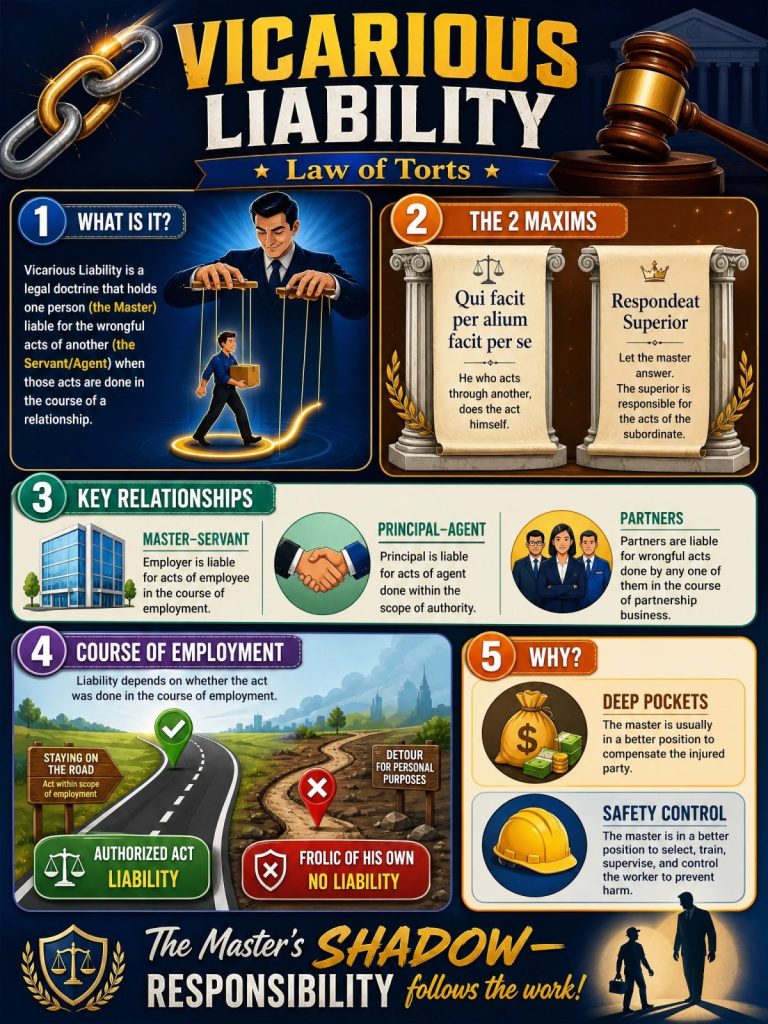
Meaning and Definition of Vicarious Liability
Vicarious liability refers to the legal responsibility imposed on one person for the wrongful acts committed by another due to the existence of a recognised legal relationship between them. The most common example is the liability of an employer for the torts committed by an employee during the course of employment.
Unlike direct liability, where a person is responsible for their own wrongful act, vicarious liability arises because of the relationship between the parties rather than personal fault.
The doctrine is founded on the Latin maxim Qui facit per alium facit per se, which means “He who acts through another is deemed to act himself.” Since an employer carries on business through employees, the law treats certain acts of employees as the acts of the employer.
Illustration: A delivery company employs a driver to transport goods. While making deliveries, the driver negligently causes an accident and injures a pedestrian. Although the employer did not personally drive the vehicle, the company may be held liable because the accident occurred during the course of employment.
Objectives of Vicarious Liability
The doctrine of vicarious liability serves several important purposes.
1. To Ensure Compensation to Victims
An employee may not possess sufficient financial resources to compensate an injured person. Employers are generally in a better position to satisfy claims. Therefore, imposing liability on employers increases the likelihood that victims receive adequate compensation.
2. To Promote Responsible Supervision
The doctrine encourages employers to recruit competent employees, provide proper training, and supervise their activities carefully. This reduces the likelihood of negligence and protects public safety.
3. To Allocate Business Risks Fairly
Since employers derive economic benefit from the work performed by employees, they should also bear the risks associated with that work. The cost of compensation becomes part of the ordinary cost of conducting business.
Essentials of Vicarious Liability
To establish vicarious liability, the plaintiff must prove certain essential elements.
1. There Must Be a Recognised Legal Relationship
The first requirement is the existence of a recognised legal relationship capable of giving rise to vicarious liability. The most common relationship is that of employer and employee (master and servant).
Other recognised relationships may include principal and agent or, in certain situations, partners in a partnership.
The relationship must exist at the time the wrongful act is committed.
Illustration: If an employee resigns and later commits a tort in a purely personal capacity, the former employer cannot be held vicariously liable because the employment relationship has ceased.
2. The Employee Must Commit a Tort
The employee must have committed a recognised tort such as negligence, nuisance, trespass, assault, battery, false imprisonment, or defamation.
If no tort has been committed, the employer cannot be held vicariously liable.
3. The Tort Must Be Committed During the Course of Employment
This is the most important requirement under the doctrine.
An employer is liable only when the employee commits the wrongful act while performing duties connected with employment. The expression “course of employment” includes not only authorised acts but also unauthorised methods of performing authorised work.
Landmark Case: In Century Insurance Co. Ltd. v. Northern Ireland Road Transport Board (1942), a petrol tanker driver negligently threw away a lighted cigarette while transferring petrol, causing an explosion. The House of Lords held the employer liable because the driver was performing an authorised duty, although he carried it out negligently.
The case established that an employer remains liable where an employee performs authorised work in an improper or careless manner.
Illustration: A bus driver, while driving along an authorised route, exceeds the speed limit and injures a pedestrian. Although speeding is unauthorised, the employer remains liable because the wrongful act occurred during the course of employment.
Tests for Determining Employer–Employee Relationship
Courts apply different tests to determine whether a person is an employee or an independent contractor.
1. Control Test
Under the control test, an employer–employee relationship exists where the employer has the authority to control not only what work is done but also how it is performed.
This test was traditionally applied where employers exercised direct supervision over workers.
2. Organisation or Integration Test
According to this test, a person is considered an employee if their work forms an integral part of the employer’s organisation rather than an independent business.
For example, a full-time accountant working within a company is generally an employee because the work is integrated into the company’s operations.
3. Multiple Test
Modern courts consider several factors together, including control, payment of wages, ownership of tools, method of appointment, right to dismiss, and the overall nature of the relationship.
No single factor is decisive. Courts examine the entire relationship before determining whether vicarious liability arises.
Subscribe for updates
Join 10,000+ subscribers.
SH
Shruti chauhan
Contributing author
Have a doubt about this?Ask Doubts

