
Can the Bar Council of India Punish Law Students?
What decision did the Supreme Court make?
On 3 September 2026, the Supreme Court examined a case which had originated at NALSAR University of Law in Hyderabad, where the Bar Council of India (BCI) had acted against law students who had expressed opposition to inviting the Chief Justice of India to appear as the chief guest at the university’s convocation.
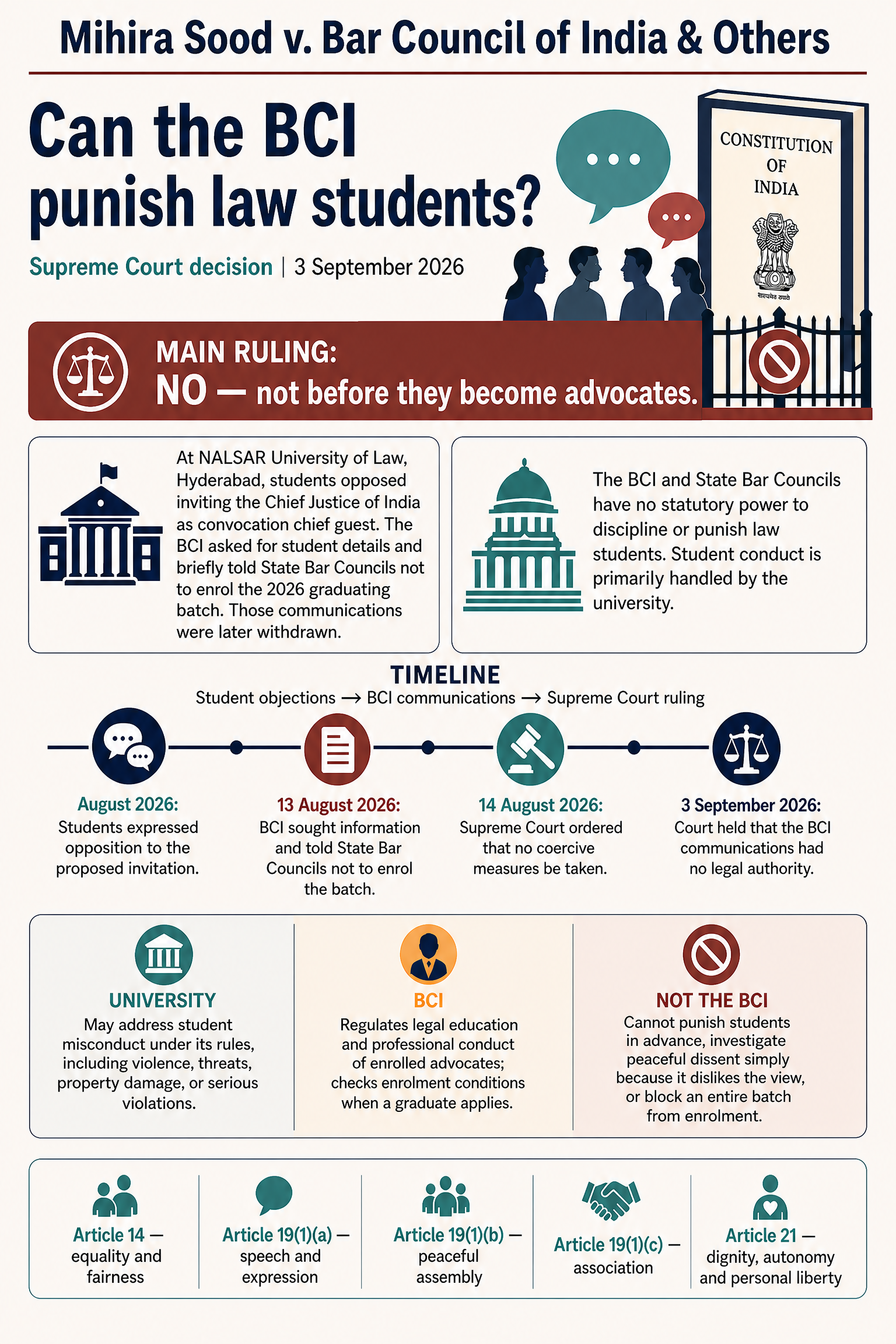
The Supreme Court made it clear that neither the Bar Council of India nor the State Bar Councils have the statutory power to discipline or punish law students before they have become advocates. It is the responsibility of the university or the educational institution to deal with students' conduct.
While the BCI may regulate legal education and can check whether the conditions for enrolment have been met when a law graduate applies to become an advocate, it cannot punish a student in advance or prevent an entire batch from being enrolled simply because the students have expressed dissent.
Development of the case
The case is listed as Mihira Sood v. Bar Council of India & Others, (W.P. (Civil) No. 1040 of 2026). The NALSAR alumni brought the petition before the Supreme Court. The bench was composed of Chief Justice Surya Kant and the judges Joymalya Bagchi and V. Mohana.
In August 2026, some students from NALSAR objected to the proposal that the CJI should take part in their convocation. The reason for their objection was a previous public discussion about the remarks the CJI had made during the proceedings regarding the alleged police action against the protesters. This includes calling ‘cockroaches’ or ‘parasites’ to the young lawyers.
On 13 August 2026 the BCI sent messages to both NALSAR and the State Bar Councils, asking for information regarding the students in question and instructing that the NALSAR graduates of 2026 should not be admitted as advocates until further notice.
However, this communication was withdrawn within a short time, after which it was altered to request an inquiry and this revised communication was also withdrawn not long afterwards.
On 14 August the Supreme Court instructed that no coercive measures should be taken against the students, the teaching staff or the administrative staff of NALSAR with regard to the dispute. The Court then considered the case finally on 3 September 2026 and ruled that the BCI's communications had no legal authority.
Facts
- The petitioners had a connection with the group of students who graduated from NALSAR University of Law in 2026.
- There was some opposition from students to the idea of inviting the CJI as chief guest at the convocation.
- The BCI regarded the campaign as one which needed to be investigated and aimed at finding out who had organised or given support to it.
- It instructed the State Bar Councils not to enrol the entire batch of graduates from NALSAR in 2026 as advocates until further orders.
- The BCI then withdrew and altered its communications and eventually brought its proceedings to an end.
- The petitioners claimed that the BCI lacked the authority to regulate student behaviour and that its actions had the effect of chilling freedom of speech and freedom of association.
Issues before the Court
- Whether the Advocates Act, 1961 confers on the BCI the authority to discipline students and whether it has the power to order a university to investigate student conduct or to prevent a student from being admitted in the future?
- Whether the action breached Articles 14, 19 and 21 of the Indian Constitution?
- Whether the power of disciplining students lies with the university?
Relevant legal provisions
Article 14 of the Constitution
Article 14 ensures that everyone is treated equally under the law and enjoys the same protection by it. The practice of disqualifying an entire batch without allowing the individual students to be heard gave rise to worries about arbitrariness and an absence of fairness.
Article 19(1)(a)
The freedom of speech and expression set out in Article 19(1)(a) means that students have the right to express their disagreement with an invitation, a policy or a public figure, provided that such disagreement is subject to the reasonable limitations specified in Article 19(2). Thus, criticism carried out in a peaceful manner does not amount to misconduct.
Article 19(1)(b) and Article 19(1)(c)
The rights of peaceful assembly set out in Article 19(1)(b) and the right to form associations set out in Article 19(1)(c) cover a student campaign or collective representation if such campaign or representation is peaceful and legal.
Article 21
Article 21 safeguards life and personal liberty, including dignity and autonomy, and a threat to a student’s future career may have the effect of undermining these freedoms.
Sections 7 and 24 of the Advocates Act, 1961
The functions of the BCI are set out in Section 7. These consist of establishing standards of professional conduct for advocates, promoting legal education, prescribing the standards for legal education, and acknowledging universities whose law degrees qualify someone for enrolment as an advocate.
The qualifications needed in order to be admitted as an advocate are discussed in Section 24, which indicates that admission comes at a later stage after one has completed legal education.
Section 35 of the Advocates Act, 1961
Section 35 deals with the punishment of advocates who have engaged in professional or other misconduct. If a State Bar Council has reason to believe that an advocate on its roll has acted improperly, it can refer the case to its disciplinary committee.
Section 35 refers to an ‘advocate on the roll’, not to a law student who has not yet been enrolled.
The Right to hold Different Opinions (Right to Dissent)
The Supreme Court's ruling gives strong protection to students’ right to hold differing views. In a university environment, discussion and questioning are essential elements of legal education. It is expected of law students to understand constitutional values, to examine the exercise of public power and to put forward well-reasoned objections.
The Court noted that the action of the BCI could have a chilling effect, which would cause students to cease speaking freely since they were afraid of being punished or of suffering damage to their future careers. A legal regulator should not be able to use its powers to suppress lawful criticism just because it dislikes the opinion which has been expressed.
The right to dissent is not without limits. A university can take action in response to violence, threats, damage to property, or serious violations of its rules. The appropriate body to do so, though, is the university, not the BCI acting outside the scope of its statutory powers.
Judgment
The Supreme Court ruled that neither the BCI nor the State Bar Councils have any expressly or implicitly granted power under the Advocates Act, 1961 to impose disciplinary or punitive measures upon law students.
The Court drew a clear distinction between legal education and professional regulation:
The Court said that the BCI could look at the conditions precedent to enrolment in the case of a graduate who is applying to become an advocate. But it could not give a prior directive stating that a student would not be enrolled in the future on the grounds of their behaviour during university life.
Likewise, it could not interfere with the university’s right to decide whether a student should continue their education.
Conclusion
The ruling in Mihira Sood v. Bar Council of India establishes that a statutory body may carry out only those powers which the law has conferred upon it. Although the BCI is responsible for regulating legal education and enrolled advocates, it does not have general disciplinary authority over students. It is the universities that are in charge of student discipline, while peaceful and responsible dissent continues to be protected.
Subscribe for updates
Join 10,000+ subscribers.
JU
Julie Nigam
Contributing author
Have a doubt about this?Ask Doubts
