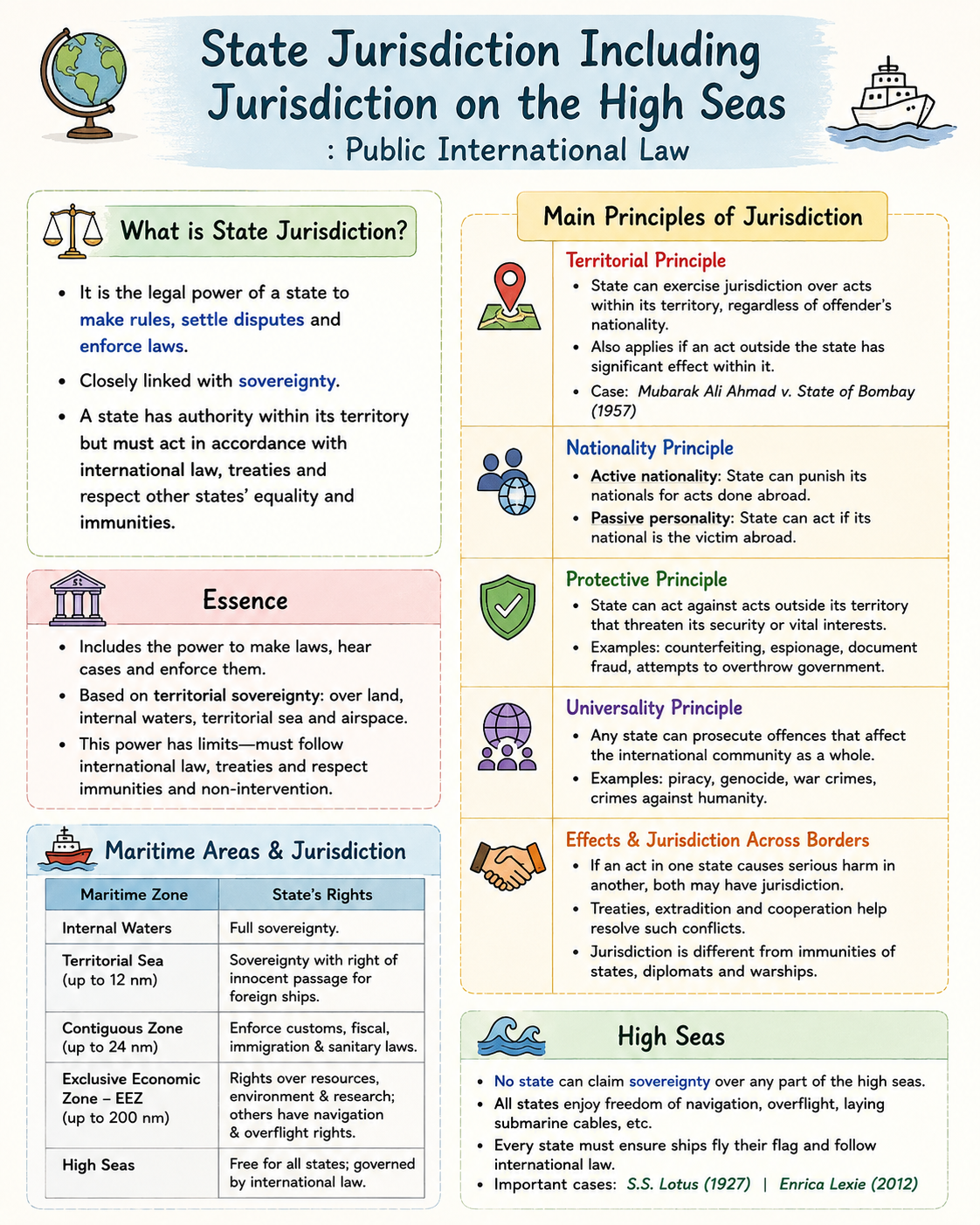
What ‘state jurisdiction’ needs is the legal power of a state to establish rules, settle disputes and enforce laws. It is closely linked with sovereignty. Generally, a state determines what occurs within its own territory, but modern activities such as international travel, cybercrime, shipping, terrorism and environmental damage frequently cross borders. Because of this, jurisdiction has become an important and at times disputed element of public international law.
The article deals with the main principles of state jurisdiction, maritime jurisdiction as established by UNCLOS, the special status of the high seas, and various important cases such as S.S. Lotus and Enrica Lexie.
Meaning and Essence of State Jurisdiction
The authority involves the ability to make laws, to hear cases and to put them into effect. A State can establish a rule but is generally unable to enforce it within another State’s territory unless that State gives its consent.
The fundamental principle is territorial sovereignty, which means that a State has authority over its land, its internal waters, its territorial sea and its airspace. Yet this authority is not without limits, it must be exercised in a manner consistent with treaties, customary international law, the principle of sovereign equality, diplomatic immunity and the ban on unlawful intervention.
Main Principles of Jurisdiction
Territorial principle
On the basis of the territorial principle a State has the right to exercise jurisdiction over acts which take place within its territory no matter what the national identity of the person who committed them. The principle may also be applied in cases where an act starts outside the State but has a significant effect within it. This is referred to as the objective territorial principle.
In the case of Mubarak Ali Ahmed v. State of Bombay(1957) the accused had been outside India when he made the fraudulent statements, but some essential elements of the offence took place in Bombay. The Indian court therefore decided to exercise jurisdiction. The case is helpful for seeing that it is not always necessary for the accused to be physically present when the offence is completed or has effects in the forum State.
Nationality principle
The principle of active nationality enables a state to regulate or penalise the actions of its nationals even if those actions take place abroad. It is usually applied in cases of serious offences such as treason, terrorism or certain kinds of corruption.
The passive personality principle depends on the nationality of the victim. A State can assert jurisdiction on the grounds that one of its nationals was injured abroad. Although some States in the past have criticised this principle for being too wide, it is now more and more accepted in treaty-based systems concerned with terrorism, offences involving aircraft and transnational crime.
Protective principle
On the basis of the protective principle a State has the right to exercise state jurisdiction in respect of acts which take place outside its territory if those acts threaten its essential security or its governmental functions. This includes cases such as the counterfeiting of currency, espionage, document fraud aimed at the State, or attempts to overthrow its constitutional order.
Universality principle
The principle of universality enables any state to bring prosecutions for offences that concern the international community as a whole. Piracy is the classic case in point, and other offences such as genocide, war crimes and crimes against humanity may also be covered by the relevant law.
Effects and Jurisdiction across Borders
When an action in one state results in considerable harm in another, then both states can lay claim to concurrent jurisdiction. The assistance of treaties, extradition and legal cooperation can be used to deal with such conflicts. Moreover, it is necessary to distinguish jurisdiction from the immunities held by foreign states, diplomats and warships.
Maritime Areas and Jurisdiction
The United Nations Convention on the Law of Sea (UNCLOS) divides the sea into various legal zones. Generally, the coastal State has full sovereignty over internal waters. The territorial sea can extend up to 12 nautical miles from the baseline and in this area the coastal State has sovereignty, although foreign ships usually have the right of innocent passage.
The contiguous zone can extend to a distance of 24 nautical miles in order to enforce customs, fiscal, immigration and sanitary laws. The Exclusive Economic Zone (EEZ) can extend up to 200 nautical miles. The coastal State has the rights with regard to the resources and also specific responsibilities in the field of the environment and research, while other States continue to have the rights of navigation and overflight.
The EEZ is therefore different from territorial sovereignty, a distinction which became important in the case of Enrica Lexie.
Jurisdiction over the High Seas
The areas known as the high seas, as defined in Article 86 of UNCLOS, are those which lie beyond internal waters, archipelagic waters, the territorial sea and the EEZ. No State can lay claim to sovereignty over them.
Article 87 provides for freedom of navigation, overflight, fishing, scientific research and the laying of submarine cables and pipelines, on the condition that international law is respected and due regard is had for the rights of other States.
Flag-State Jurisdiction
The main principle is the flag-State principle. According to Articles 91 and92 of UNCLOS a ship is of the nationality of the State under the flag of which it flies and is normally brought within the exclusive jurisdiction of that State on the high seas. According to Article 94 the flag State must effectively carry out administrative, technical and social control over the vessel.
A ship should usually fly a single flag, if a vessel uses more than one flag for convenience then it may be regarded as a ship without nationality and will not be able to assert those nationalities against another State. Warships and government ships which are used for non-commercial purposes have full immunity from the state jurisdiction other than the flag state pursuant to Articles 95 and 96.
Exceptions to exclusive Flag-State Jurisdiction
Exclusive flag-State jurisdiction is by no means absolute. UNCLOS allows action to be taken against ships that are engaged in piracy, those involved in the transport of slaves, and vessels that have no nationality. Article 100 obliges all States to cooperate in the suppression of piracy.
Article 101 describes piracy as acts of illegal violence, detention or depredation carried out for private purposes on the high seas or in a place outside the jurisdiction of any State. And under Article 105, any State may seize a pirate ship and arrest the pirates, provided that legal safeguards are observed.
The right of visit enables a warship to check the nationality of a vessel in certain cases, for example when piracy or the slave trade is suspected. A coastal state may carry on a lawful and continuous pursuit once it has reached the high seas.
Article 97 establishes a special rule regarding collisions and other navigation incidents. In general, penal or disciplinary proceedings against the master or the crew can only be initiated before the authorities of the flag State or those of the State of nationality. The ship cannot be seized by authorities other than those of the flag State in the case of such an incident.
Court Decisions concerning Jurisdiction on the High Seas
The Turkish vessel Boz-Kourt collided with the French ship Lotus while at sea, resulting in some deaths. Upon arriving in Constantinople, Turkey prosecuted the French officer who was on watch. France maintained that it was France, as the flag State, which had the authority.
The Permanent Court of International Justice stated that Turkey had not breached international law by bringing the case. It explained that, in accordance with the law in force at the time, both France and Turkey had a connection with the incident and that concurrent jurisdiction was therefore possible.
The case is linked to the Lotus principle, which holds that states are free to act provided that international law does not prohibit them, although they cannot enforce their laws in another state’s territory unless there is a recognised legal basis.
At present, Articles 92 and 97 of UNCLOS limit competing criminal jurisdiction in cases involving navigation.
In 2012, two Italian marines, who were serving on the Italian-flagged ship ‘Enrica Lexie’, fired upon the Indian fishing boat ‘St. Antony’ and thus killed two Indian fishermen. The event took place at a distance of about 20.5 nautical miles from India i.e, outside the territorial sea but still within India’s EEZ. India detained the marines and claimed jurisdiction, while Italy depended on the jurisdiction of the flag state and the status of the marines.
The tribunal established under Annex VII of UNCLOS concluded that Italy had violated India’s rights by interfering with India’s jurisdiction, and as a result India was required to halt its criminal proceedings and to cooperate with Italy’s investigation and prosecution. India was entitled to be compensated for the loss of life and for the related non-material harm.
The case demonstrates that the EEZ is not equivalent to a territorial sea, that the interests of the coastal state are still relevant, and that jurisdiction must be balanced against the flag-State rule and the applicable immunities.
Developments concerning the High Seas Treaty
The Biological Diversity of Areas beyond National Jurisdiction (BBNJ) Agreement, also known as the 2023 High Seas Treaty, functions within the framework of UNCLOS. It aims at conserving marine biodiversity, promoting benefit-sharing, establishing protected areas and carrying out environmental assessments. It does not turn the high seas into territorial waters.
Conclusion
The sovereignty expressed by state jurisdiction functions within the constraints of international law. With regard to CLAT PG, it should be remembered that the Flag State usually has exclusive jurisdiction over its ship when it is on the high seas.
UNCLOS provides exceptions in the cases of piracy, hot pursuit and stateless vessels. S.S. Lotus stands for the earlier concurrent approach, whereas Enrica Lexie illustrates the more structured treaty-based approach.