
Corporate Governance for CLAT PG: Company Law
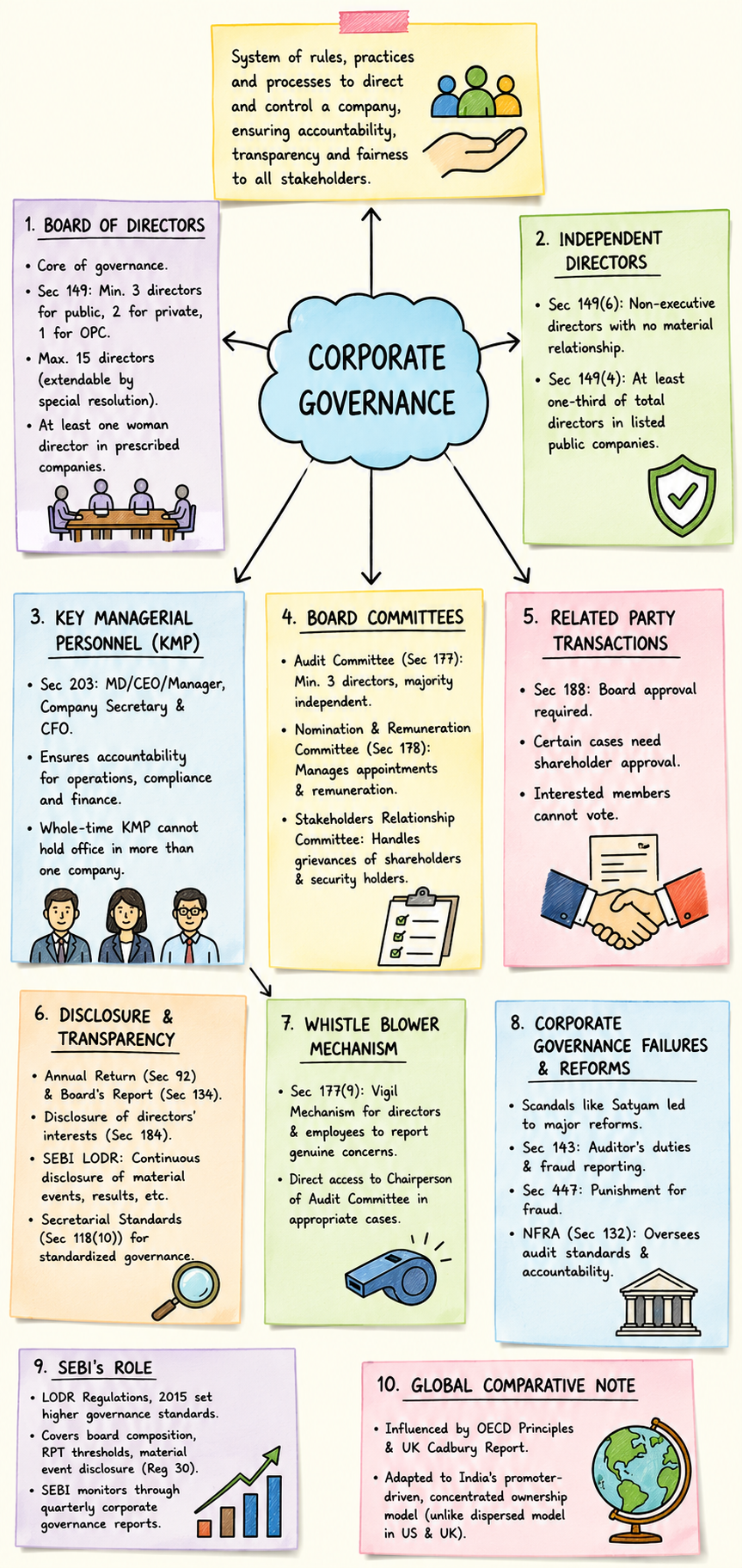
Corporate Governance refers to the system of rules, practices, and processes through which a company is directed and controlled, balancing the interests of shareholders, management, employees, creditors, and society at large. It seeks to ensure accountability, transparency, and fairness in a company's dealings with all its stakeholders.
In India, corporate governance norms are drawn from multiple sources: the Companies Act, 2013, SEBI (Listing Obligations and Disclosure Requirements) Regulations, 2015 (LODR), and voluntary guidelines issued by the Ministry of Corporate Affairs. Together, these establish a hybrid framework of statutory compliance and disclosure-based regulation.
Board of Directors
The Board of Directors forms the core of corporate governance architecture. Section 149 of the Companies Act, 2013 mandates minimum and maximum board strength, requiring at least three directors for a public company, two for a private company, and one for an OPC, with a cap of fifteen directors, extendable by special resolution.
Section 149(1) also mandates at least one woman director for prescribed classes of companies, including every listed company and certain public companies meeting paid-up capital or turnover thresholds. This aims to ensure gender diversity in board composition.
Independent Directors
Independent directors play a central role in governance oversight. Section 149(6) defines an independent director as a non-executive director who has no material or pecuniary relationship with the company, its promoters, or directors, apart from receiving director's remuneration, and who meets prescribed qualifications of integrity and expertise.
Section 149(4) mandates that every listed public company have at least one-third of its total directors as independent directors. Regulation 17 of the LODR further prescribes enhanced independent director requirements for listed companies, including a minimum number on the board depending on whether the Chairperson is executive or non-executive.
Key Managerial Personnel
Section 203 mandates certain classes of companies to appoint Key Managerial Personnel (KMP), namely the Managing Director or Chief Executive Officer or Manager, Company Secretary, and Chief Financial Officer. This ensures dedicated accountability for operational, compliance, and financial functions within the governance structure.
A whole-time KMP cannot hold office in more than one company at the same time, except as permitted under the Act, ensuring focused attention and reducing conflicts of interest.
Board Committees
The Act mandates specific committees for prescribed classes of companies to strengthen governance oversight. The Audit Committee under Section 177 must have a minimum of three directors, with independent directors forming a majority, and is responsible for reviewing financial statements, related party transactions, and internal financial controls.
The Nomination and Remuneration Committee under Section 178 oversees appointment and remuneration policies for directors and senior management, while the Stakeholders Relationship Committee addresses grievances of shareholders, debenture holders, and other security holders.
Related Party Transactions
Section 188 regulates transactions between a company and its related parties, requiring Board approval and, in certain cases, approval by ordinary resolution of shareholders, with interested members restrained from voting. This provision curbs the diversion of company resources for the personal benefit of promoters or connected persons, a recurring governance concern in Indian corporate scandals.
Disclosure and Transparency Norms
Transparency is reinforced through mandatory disclosures such as the Annual Return (Section 92), Board's Report (Section 134), and disclosure of directors' interests (Section 184). Listed companies additionally comply with continuous disclosure obligations under the SEBI LODR Regulations, covering material events, financial results, and shareholding patterns.
Secretarial Standards issued by the Institute of Company Secretaries of India, given statutory recognition under Section 118(10), further standardize governance procedures relating to board and general meetings.
Corporate Governance Committees and Reports
India's governance framework has evolved through influential committee reports, including the Kumar Mangalam Birla Committee (2000), which led to the introduction of Clause 49 of the erstwhile Listing Agreement, and the Narayana Murthy Committee (2003), which strengthened norms on audit committees and related party disclosures. The Uday Kotak Committee (2017) subsequently shaped reforms culminating in the LODR amendments of 2018.
Whistle Blower Mechanism
Section 177(9) mandates every listed company and certain prescribed classes of companies to establish a Vigil Mechanism (whistle blower policy) for directors and employees to report genuine concerns, with direct access to the Chairperson of the Audit Committee in appropriate cases, safeguarding against victimization.
Corporate Governance Failures
Judicial and regulatory scrutiny of governance failures, such as the Satyam Computer Services scandal, prompted significant reforms in auditor accountability, culminating in provisions like Section 143 (auditor's duties and reporting of fraud) and Section 447 (punishment for fraud) under the Companies Act, 2013.
The National Financial Reporting Authority (NFRA), established under Section 132, was created to oversee auditing standards and enforce accountability among auditors and audit firms of specified companies, addressing gaps in self-regulation exposed by past corporate failures.
SEBI's Role in Governance
For listed entities, SEBI's LODR Regulations, 2015 impose more stringent governance standards than the Companies Act, covering areas such as board composition, related party transaction thresholds, and disclosure of material events under Regulation 30. SEBI also monitors compliance through quarterly corporate governance reports filed by listed companies.
Global Comparative Note
Indian corporate governance draws conceptual influence from international frameworks such as the OECD Principles of Corporate Governance and the UK's Cadbury Committee Report, adapted to India's concentrated shareholding pattern, where promoter-controlled companies remain dominant, unlike the dispersed ownership model common in the US and UK.
Corporate governance in India represents a layered framework combining statutory mandates under the Companies Act, 2013 with enhanced disclosure norms under SEBI regulations. For CLAT PG aspirants, a sound understanding of board composition, independent directors, committee structures, and related party transaction norms is essential, given the increasing focus on governance-related questions in company law assessments.
Subscribe for updates
Join 10,000+ subscribers.
HA
Hanspal Bakul
Contributing author
Have a doubt about this?Ask Doubts
