
Corporate Social Responsibility (CSR) : Company Law
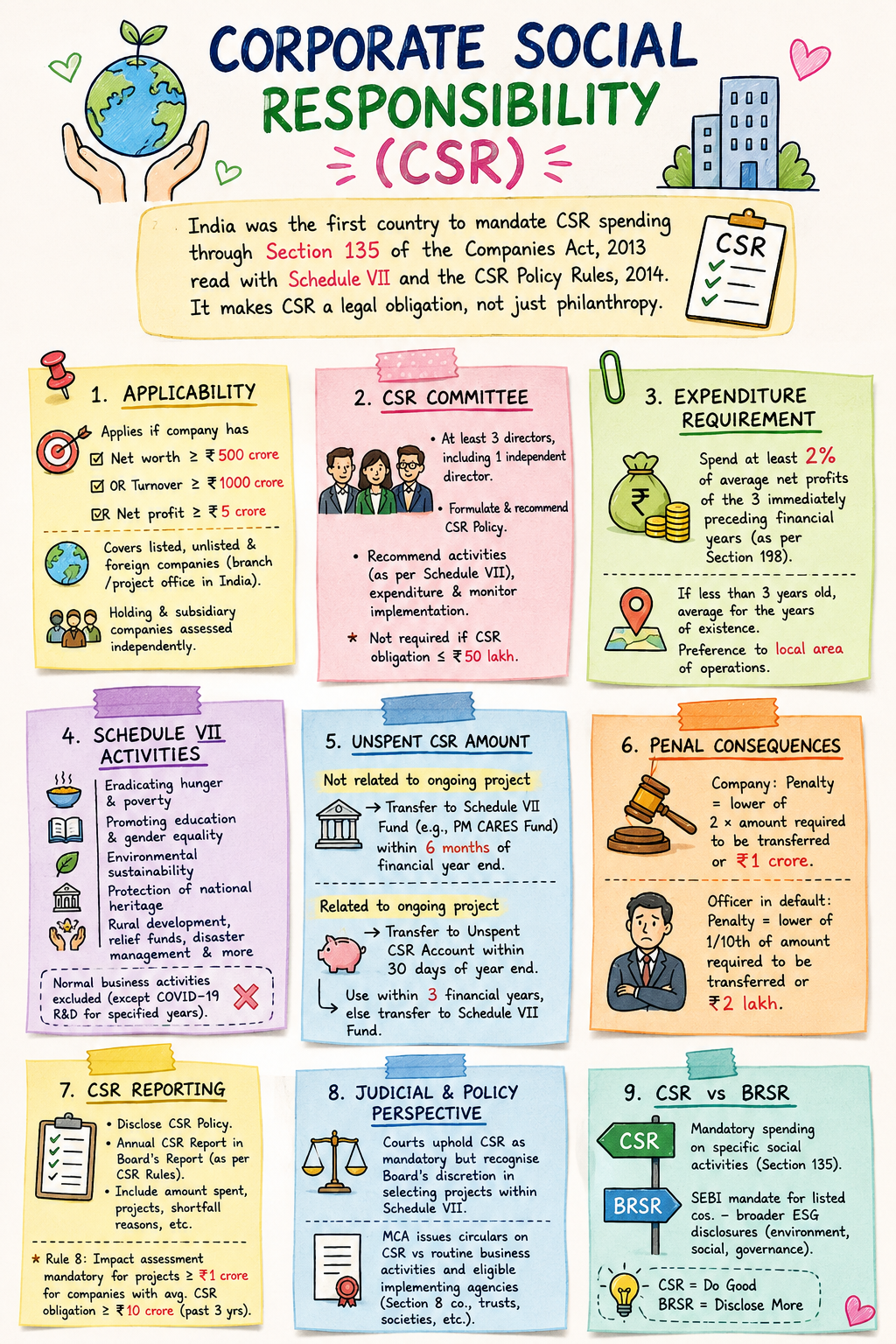
Corporate Social Responsibility refers to the obligation of companies to contribute towards social, environmental, and economic development as part of their business operations. India became the first country to statutorily mandate CSR spending through Section 135 of the Companies Act, 2013, read with Schedule VII and the Companies (CSR Policy) Rules, 2014.
The provision reflects a shift from voluntary corporate philanthropy to a legally enforceable obligation, requiring qualifying companies to institutionalize social spending as part of their governance framework.
Applicability of Section 135
Section 135(1) applies to every company having a net worth of Rs. 500 crore or more, or turnover of Rs. 1000 crore or more, or net profit of Rs. 5 crore or more, during the immediately preceding financial year. Such companies must constitute a CSR Committee of the Board.
The threshold applies to both listed and unlisted companies, including foreign companies having a branch or project office in India that meet these criteria. Holding and subsidiary companies are assessed independently unless the parent company undertakes CSR on behalf of the group.
CSR Committee
The CSR Committee must consist of at least three directors, including one independent director. However, where a company is not required to appoint an independent director under Section 149(4), the committee may function without one, provided it still has at least two directors.
The Committee is responsible for formulating and recommending the CSR Policy, indicating activities to be undertaken under Schedule VII, recommending expenditure, and monitoring implementation. Companies not meeting the threshold amount under the second proviso to Section 135(9) (CSR obligation up to Rs. 50 lakh) are exempted from constituting a committee.
CSR Expenditure Requirement
Section 135(5) mandates that the Board ensure the company spends, in every financial year, at least 2% of the average net profits made during the three immediately preceding financial years, calculated in accordance with Section 198.
If the company has not completed three financial years since incorporation, the average is computed based on the years for which it has been in existence. Preference is to be given to spending in the local area where the company operates.
Schedule VII Activities
CSR activities must fall within the categories listed in Schedule VII, which include eradicating hunger and poverty, promoting education, gender equality, environmental sustainability, protection of national heritage, contribution to relief funds, rural development projects, and disaster management, among others.
Activities undertaken in the normal course of business are generally excluded from qualifying as CSR expenditure, except research and development activities related to COVID-19 for specified financial years, as clarified through subsequent amendments.
Unspent CSR Amount
The Companies (Amendment) Act, 2019 and 2020 introduced a structured mechanism for unspent CSR amounts. Under Section 135(5), if the company fails to spend the required amount, and the unspent amount does not relate to an ongoing project, it must be transferred to a Fund specified in Schedule VII (such as the PM CARES Fund) within six months of the financial year's end.
Where the unspent amount relates to an ongoing project, it must be transferred to a special account called the "Unspent Corporate Social Responsibility Account" within 30 days of the financial year's end, and utilized within three financial years, failing which it must be transferred to a Schedule VII Fund.
Penal Consequences
Section 135(7) prescribes penalties for non-compliance. The company is liable to a penalty of twice the amount required to be transferred, or Rs. 1 crore, whichever is less. Every officer in default is liable to a penalty of one-tenth of the amount required to be transferred, or Rs. 2 lakh, whichever is less.
This marks a departure from the earlier "comply or explain" approach, converting non-transfer of unspent CSR funds into a punishable default, thereby strengthening enforcement.
CSR Reporting
Companies covered under Section 135 must disclose their CSR Policy and include an annual report on CSR in their Board's Report, in the format prescribed under the CSR Rules. This includes details of the amount spent, projects undertaken, and reasons for any shortfall.
Rule 8 of the CSR Rules also mandates impact assessment for CSR projects with an outlay of Rs. 1 crore or more, undertaken by companies having an average CSR obligation of Rs. 10 crore or more in the preceding three financial years.
Judicial and Policy Perspective
Courts have generally upheld the mandatory nature of CSR spending while recognizing the Board's discretion in selecting projects within Schedule VII. The Ministry of Corporate Affairs has periodically issued clarificatory circulars distinguishing CSR from routine business activities and specifying eligible implementing agencies, such as Section 8 companies, registered trusts, and societies with an established track record.
Distinction from Sustainability Reporting
CSR under Section 135 is distinct from Business Responsibility and Sustainability Reporting (BRSR) mandated by SEBI for listed companies. While CSR focuses on mandatory expenditure on specified social activities, BRSR requires broader disclosure on environmental, social, and governance parameters, reflecting India's evolving corporate governance landscape.
Section 135 represents a unique legislative attempt to mandate corporate participation in nation-building through structured social spending. For CLAT PG aspirants, understanding the applicability thresholds, CSR Committee composition, unspent amount mechanism, and penal provisions is essential, as this remains a frequently tested and evolving area of company law.
Subscribe for updates
Join 10,000+ subscribers.
HA
Hanspal Bakul
Contributing author
Have a doubt about this?Ask Doubts
