
Winding Up of a Company for CLAT PG : Company Law
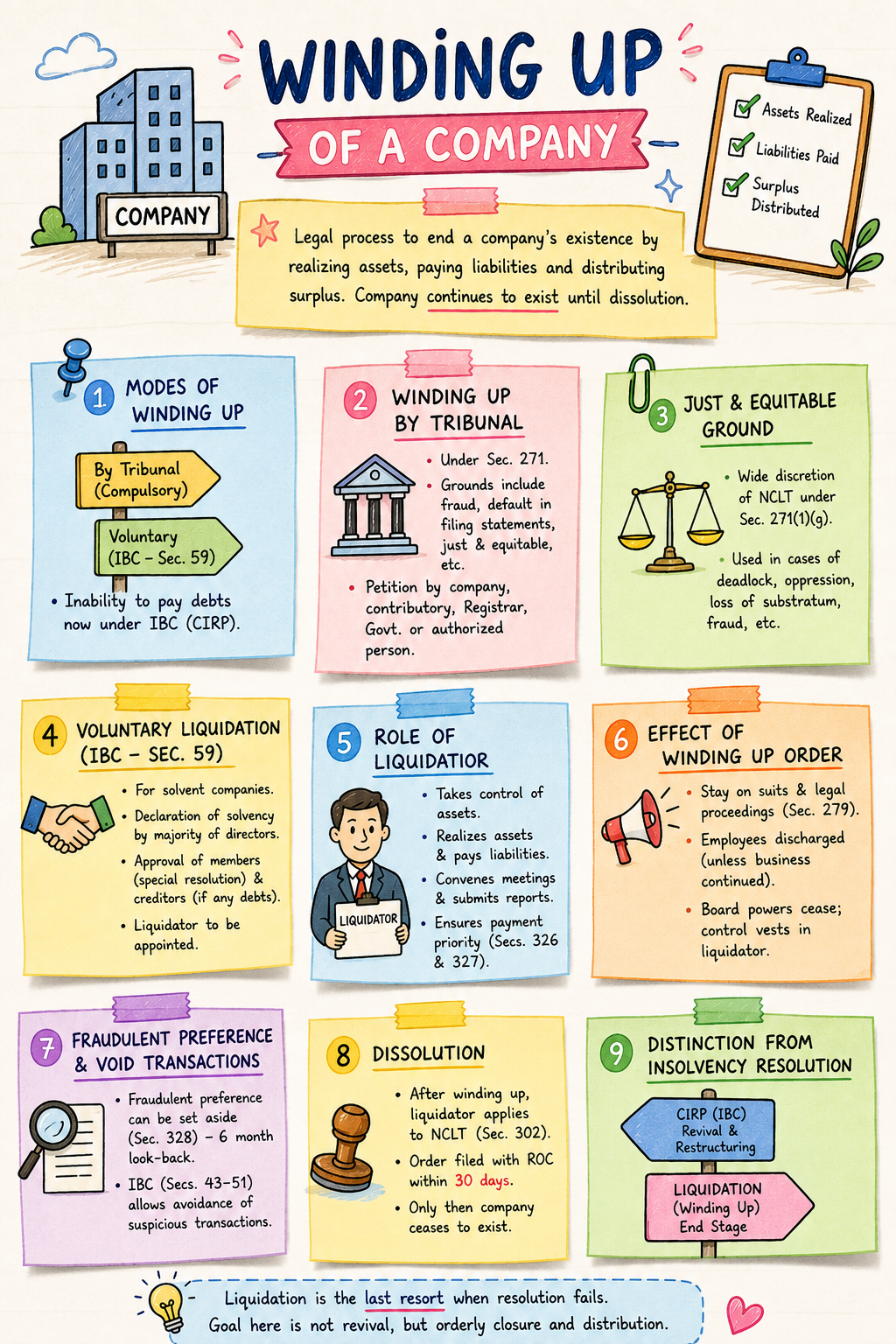
Winding up is the legal process by which a company's existence is brought to an end, its assets are realized, liabilities discharged, and any surplus distributed among members. It is the first stage in the dissolution of a company, followed by formal dissolution through the Registrar or Tribunal.
Winding up does not automatically dissolve the company; the company continues to exist as a legal entity until dissolution is complete. The process is primarily governed by the Companies Act, 2013, and, in cases involving inability to pay debts, by the Insolvency and Bankruptcy Code, 2016 (IBC).
Modes of Winding Up
Under the Companies Act, 2013, winding up may occur through the Tribunal (compulsory winding up) or voluntarily. The Insolvency and Bankruptcy Code (Amendment) Act, 2018 significantly altered this framework by omitting most provisions relating to winding up due to inability to pay debts, transferring such cases to the Corporate Insolvency Resolution Process (CIRP) under the IBC.
Voluntary winding up provisions under the Companies Act, 2013 (Sections 304-323) have also been repealed and replaced by the voluntary liquidation process under Section 59 of the IBC, 2016.
Winding Up by the Tribunal
Section 271 of the Companies Act, 2013 lays down the grounds on which the National Company Law Tribunal (NCLT) may order winding up.
These include a special resolution passed by the company for winding up, acting against the sovereignty and integrity of India, conduct of affairs in a fraudulent manner, default in filing financial statements for five consecutive years, or where the Tribunal is of the opinion that it is just and equitable to wind up the company.
A petition for winding up may be filed under Section 272 by the company itself, any contributory, the Registrar, a person authorized by the Central Government, or the Central or State Government in cases involving conduct prejudicial to the sovereignty and integrity of India.
Just and Equitable Ground
The "just and equitable" ground under Section 271(1)(g) gives the Tribunal wide discretionary power. Courts have applied this ground in situations such as deadlock in management, loss of substratum of the company, oppression of minority shareholders, or where the company was formed for a fraudulent purpose.
The landmark case of Ebrahimi v. Westbourne Galleries Ltd. (1972) illustrates the application of this principle in quasi-partnership companies.
Voluntary Liquidation under the IBC
Section 59 of the IBC, 2016 permits a solvent corporate person to initiate voluntary liquidation, provided a declaration of solvency is made by majority of directors, supported by an affidavit stating the company has no debts or will be able to pay debts from proceeds of asset sale.
The process requires approval by a special resolution of members within four weeks of the declaration, appointment of an insolvency professional as liquidator, and, where the company owes debts, approval of two-thirds of creditors in value.
Role of the Liquidator
Upon the official commencement of winding up or liquidation, control shifts away from management. A liquidator is appointed to function as an officer of the court or regulatory body.
Under the Companies Act framework, the Tribunal holds ultimate supervisory power. It can appoint a provisional liquidator under Section 273 during the pendency of a winding-up petition, or a permanent Company Liquidator under Section 275.
The liquidator's core duties include:
- Taking custody and control of all corporate assets and property.
- Settling the list of "contributories" (persons liable to contribute to the assets of the company in the event of its being wound up).
- Liquidating (selling) the assets and discharging outstanding liabilities.
- Conducting statutory meetings of creditors and contributories while submitting periodic progress reports.
- Ensuring meticulous compliance with the statutory order of priority in payment of debts under Section 326 (overriding preferential payments) and Section 327 (preferential payments).
Effect of Winding Up Order
A formal winding-up order by the NCLT instantly alters the company’s legal landscape:
- Stay of Legal Proceedings: Under Section 279, no new suit or legal proceeding can be commenced against the company, and no pending suit can be continued, except with the express leave of the Tribunal. (This restriction does not apply to appeals pending before the Supreme Court or a High Court).
- Discharge of Employees: The order serves as an official notice of discharge to all employees and workmen, unless the liquidator specifically continues the business for the limited purpose of a beneficial winding up.
- Cessation of Board Powers: The powers of the Board of Directors are instantly suspended, and total operational control vests in the liquidator.
Fraudulent Preference and Void Transactions
To prevent dying companies from intentionally draining their funds before liquidators arrive, the law provides robust clawback tools to reverse suspicious historical transactions:
- Fraudulent Preference (Section 328, Companies Act): The Tribunal can invalidate transfers made to favor specific creditors to the detriment of others, provided the transaction occurred within a 6-month look-back window prior to filing the winding-up application.
- Avoidance Transactions (Sections 43–51, IBC): When liquidation occurs under the IBC, the framework mirrors these protections with strictly defined look-back periods for preferential, undervalued, extortionate credit, and fraudulent transactions
Dissolution
It is vital to understand that "winding up" and "dissolution" are not synonyms. Winding up is the operational process of gathering assets and paying debts. Dissolution is the final legal event.
Under Section 302 of the Companies Act, once the corporate affairs are fully wound up, the liquidator applies to the Tribunal. The NCLT then passes an explicit order of dissolution. This order must be filed with the Registrar of Companies (ROC) within thirty days. Only when the Registrar records it in the official register does the company’s legal personality cease to exist.
Distinction from Insolvency Resolution
Confusing insolvency resolution with winding up is a common corporate law error.
- Corporate Insolvency Resolution Process (CIRP): The primary goal of the IBC's resolution phase is corporate life, revival, and debt restructuring. It views the corporate debtor as a "going concern" to be saved.
- Liquidation/Winding Up: This is an end-stage mechanism. Liquidation under the IBC (Sections 33–54) is triggered only when the CIRP fails or a resolution plan cannot be approved. In modern Indian jurisprudence, asset liquidation is strictly treated as a measure of last resort.
Winding up marks the culmination of a company's corporate life, requiring careful balancing of creditor protection, shareholder interest, and orderly asset distribution. For CLAT PG aspirants, familiarity with Sections 271-302 of the Companies Act, 2013, alongside the interplay with the IBC's liquidation framework, is critical given the frequent overlap tested in company law and insolvency law questions.
Subscribe for updates
Join 10,000+ subscribers.
HA
Hanspal Bakul
Contributing author
Have a doubt about this?Ask Doubts
