
Legal Realism under Jurisprudence
Introduction
Jurisprudence is the study of the nature, purpose and working of law. It asks not only what a legal rule says, but also how law operates in society. Legal Realism shifts attention from law written in books to law applied by courts and experienced by people.
For CLAT PG and other competitive exams students , this topic is useful both for jurisprudence questions and for reading judgments. It encourages students to examine the statutory provision along with the facts, social conditions, policies, reasoning and effect of decisions. It therefore connects legal philosophy with constitutional law, judicial review, public interest litigation and social justice.
What is Legal Realism?
Legal realism is a practical and empirical approach to law. It maintains that law cannot be properly understood by reading legal rules alone. The real meaning of law becomes visible through its application, particularly through judicial decisions. Realists study what judges, lawyers, administrators and other legal institutions actually do rather than relying only on what legal texts appear to promise.
The movement developed mainly as a reaction against legal formalism. This pictured mechanical application of clear rules. Realists argued that broad words, disputed facts and conflicting principles leave room for judicial judgment. Realists do not say that judges decide randomly. Their point is that judicial decision-making is a human activity. The text matters but does not fully explain the outcome. Social facts and institutional practices also matter.
Definition of Legal Realism
There is no single definition accepted by every realist. In simple terms, legal realism may be defined as the view that law should be studied as it works in real life. It should be studied with special attention to judicial behaviour, social conditions and the practical consequences of legal decisions. The theory gives importance to ‘law in action’ rather than only ‘law in books.’
The realists question how courts interpret open-ended words, whether similar cases receive similar treatment and how a judgment affects disadvantaged groups. This makes realism a study of institutions and human behaviour as well as statutes.
Legal Realism as part of which school of jurisprudence?
Legal realism is generally associated with the Realist School of jurisprudence often viewed as an extension of the Sociological school. It studies the relationship between law and society, and views law as what courts and judges actually do in practice rather than static rules on paper.
However, legal realism is also treated as a distinct twentieth-century movement because of its strong focus on courts, judges and actual legal outcomes. The movement is usually discussed through two broad traditions.
- American Legal realism
- Scandinavian legal realism
American legal realism developed in the United States during the 1920s and 1930s. It focused on judicial behaviour, legal uncertainty and the influence of facts and policy on decisions.
Scandinavian legal realism, associated with thinkers such as Axel Hagerstrom, took a more philosophical and psychological approach and questioned the existence of abstract legal values independent of human practices.
Realism is therefore a practical movement closely connected with sociological jurisprudence, not a completely uniform school with one mixed formula.
Philosophers and Jurists Associated with Legal Realism
Oliver Wendell Holmes Jr. is often regarded as an important philosopher of American legal realism. Holmes argued that the life of law is shaped by experience, not logic alone. His ‘prediction’ approach viewed law partly as what courts are likely to do in practice.
Karl Llewellyn emphasised the importance of observing courts and legal institutions. He distinguished between formal rules and the actual working rules used by judges. He also reminds readers that judges are human beings with personal histories and professional experiences.
Jerome Frank gave greater importance to uncertainty in fact finding. According to him, the result of a case may depend not only on the legal rule but also on how the judge understands the evidence and assesses the witnesses. Frank’s work is sometimes described as ‘fact septicism.’
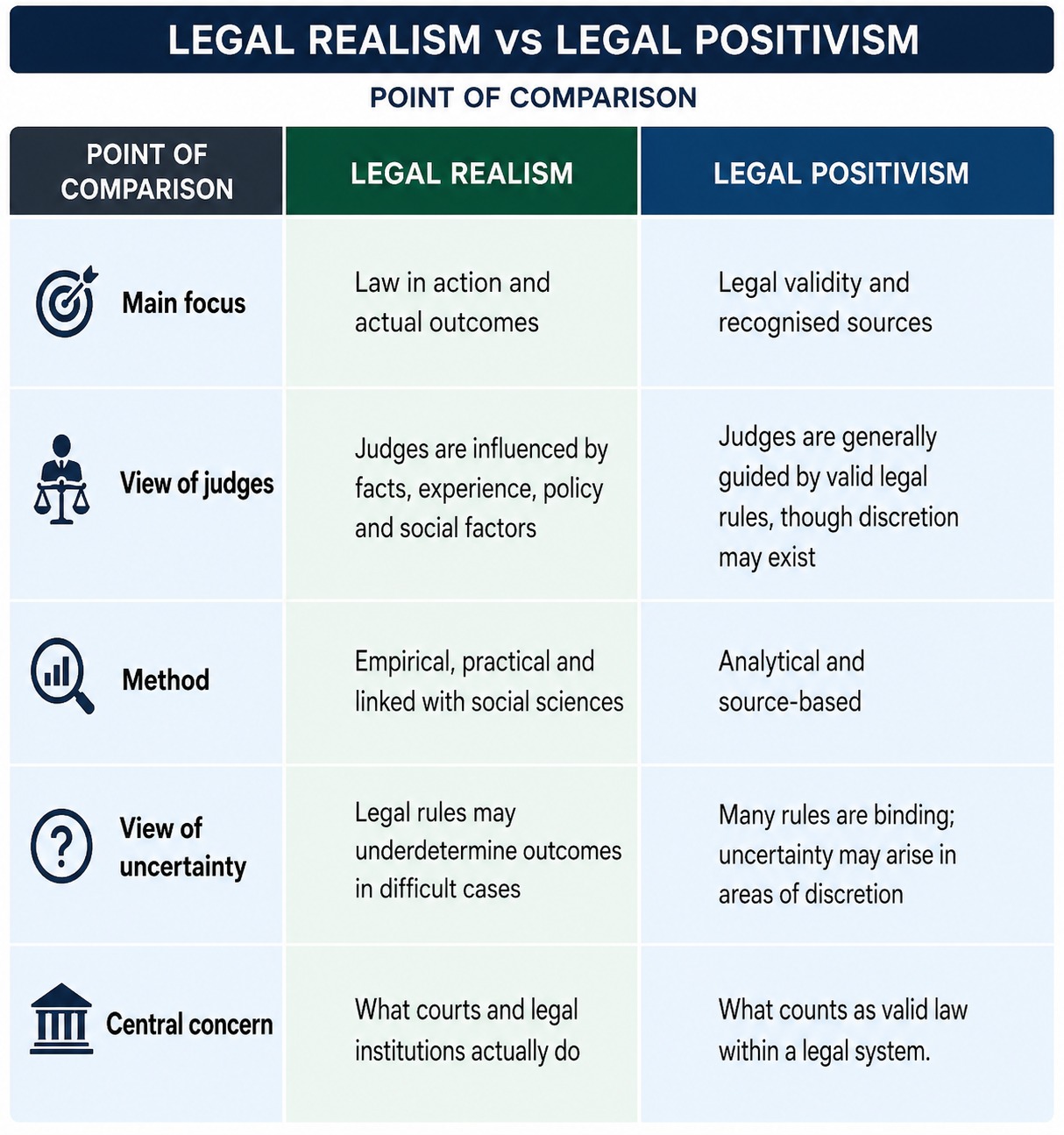
Difference between Legal Realism and Legal Positivism
Legal realism and legal positivism are not identical, although both generally treat law as a human and social creation. Legal positivism mainly asks how a rule becomes legally valid. It focuses on sources such as legislation, precedent, constitutional procedures and accepted official practices. H.L.A. Hart, for example, explained legal validity through a social rule of recognition accepted by officials.
Legal realism asks a different question i.e. how does law operate when officials apply it to actual disputes. It pays special attention to judicial actions, institutional behavior and consequences. A positivist may say that a statute is law because it was made according to a recognized legal procedure. A realists group accepts that point but adds that statutes practical meaning cannot be understood until courts interpret and enforce it.
Criticism of Legal Realism
Legal Realism has made jurisprudence more realistic, but it has also faced serious criticism. One criticism is that it may reduce law to predictions about courts. This makes it difficult to explain why legal rules are considered binding before a case reaches court.
Second, realistics may exaggerate uncertainty. Many cases are resolved by clear rules, precedent, constitutional limits and accepted methods of interpretation.
Third, the claim that a judge ‘made’ law may weaken the separation of powers. If judges rely too heavily on personal policy references, judicial power may become difficult to control. This is especially important in constitutional adjudication.
Fourth, the theory does not always predict decisions reliably. A result may still depend on new facts, arguments or social changes. Much law is also followed voluntarily and never comes before a court, so court decisions cannot represent the whole legal system.
How Legal Realism Applies
Its practical value lies in its method. A realist lawyer reads the statute and examines how courts have interpreted it, which facts they considered important, which precedents they followed or rejected, the policy concerns in the reasoning and the remedy granted.
Thus Approach is especially useful where legal language is open-ended. Words such as ‘reasonable’, ‘fair’, ‘public interest’, ‘cruelty’ or ‘obscene’ cannot be applied without context. Courts give them context through interpretation. Realism also helps explain why the same legal provision may produce different results when the facts of social setting changes.
In India, legal realism is not accepted in its strongest form. Judges remain bound by the constitution, legislation and precedent. Yet constitutional interpretation, judicial review, public interest litigation and welfare legislation show attention to social realities.
How Legal Realism is Reforming and Shaping Society
Legal realism has influenced society by encouraging courts to examine the real effect of legal rules. It supports a functional view of rights, a right is meaningful only when people can use it in actual circumstances. This has strengthened attention to poverty, discrimination gender inequality, labour conditions, education and environmental harm.
In India, a sensitive adjudication can be seen in public interest litigation and judicial activism. Courts have sometimes relaxed procedural requirements and developed interpretations aimed at making constitutional guarantees effective. The realist perspective explains this by asking whether law actually protects people, not merely whether a formal rule exists.
Realism should not be confused with unlimited judicial activism. Court lead reform must respect constitutional text, institutional competence and fairness. Its lasting contribution is the reminder that judges and lawyers must consider the human consequences of interpretation.
Conclusion
Legal realism brings jurisprudence closer to everyday legal life. It shows that outcomes are shaped by rules as well as facts, institutions, human judgement, social interests and public policy.
For CLAT PG and other competitive exams students, it is a useful lens for understanding difficult cases and the difference between formal doctrine and practical justice.
At the same time, realism is limitless. Written law, precedent , constitutional structure and legal reasoning cannot be ignored. The best understanding is therefore balanced, legal rules provide the framework, while their application gives them practical meaning. Legal realism continues to shape modern legal thought because it reminds us that the success of law must finally be judged by how it works in the lives of people.
Subscribe for updates
Join 10,000+ subscribers.
JU
Julie Nigam
Contributing author
Have a doubt about this?Ask Doubts
