
Private Defence Under Criminal Law: Easy Notes!
Imagine waking up at 2 AM to find a stranger breaking into your house. Do you wait for the police, or do you protect yourself and your family right there? The law has an answer, and it is called the right of private defence.
This right sits at the heart of criminal law in India. It recognises a simple truth: the state cannot be everywhere at once, so ordinary citizens must be allowed to protect themselves when danger is immediate.
In this article, we break down private defence under the Bharatiya Nyaya Sanhita, 2023, in plain language, with illustrations and case law, so you can understand exactly where this right begins and where it ends.
Why is this examiner’s favourite topic?
Private defence is a favourite among examiners because it tests more than memory. It tests whether you can apply law to a fact pattern, since almost every question is built around a scenario, not a definition.
Exams like CLAT PG, various judiciary services, and UGC NET regularly ask candidates to decide whether a person acted lawfully or exceeded their right. Understanding the sections deeply, along with a few landmark cases, gives you a real edge here.
The Legal Framework Under BNS 2023
Private defence is covered under Chapter III of the Bharatiya Nyaya Sanhita, 2023, from Sections 34 to 44 under Chapter III. These sections replace Sections 96 to 106 of the old Indian Penal Code, and the core principles remain largely the same.
The law recognises two broad categories. One is the right of private defence of the body, and the other is the right of private defence of property.
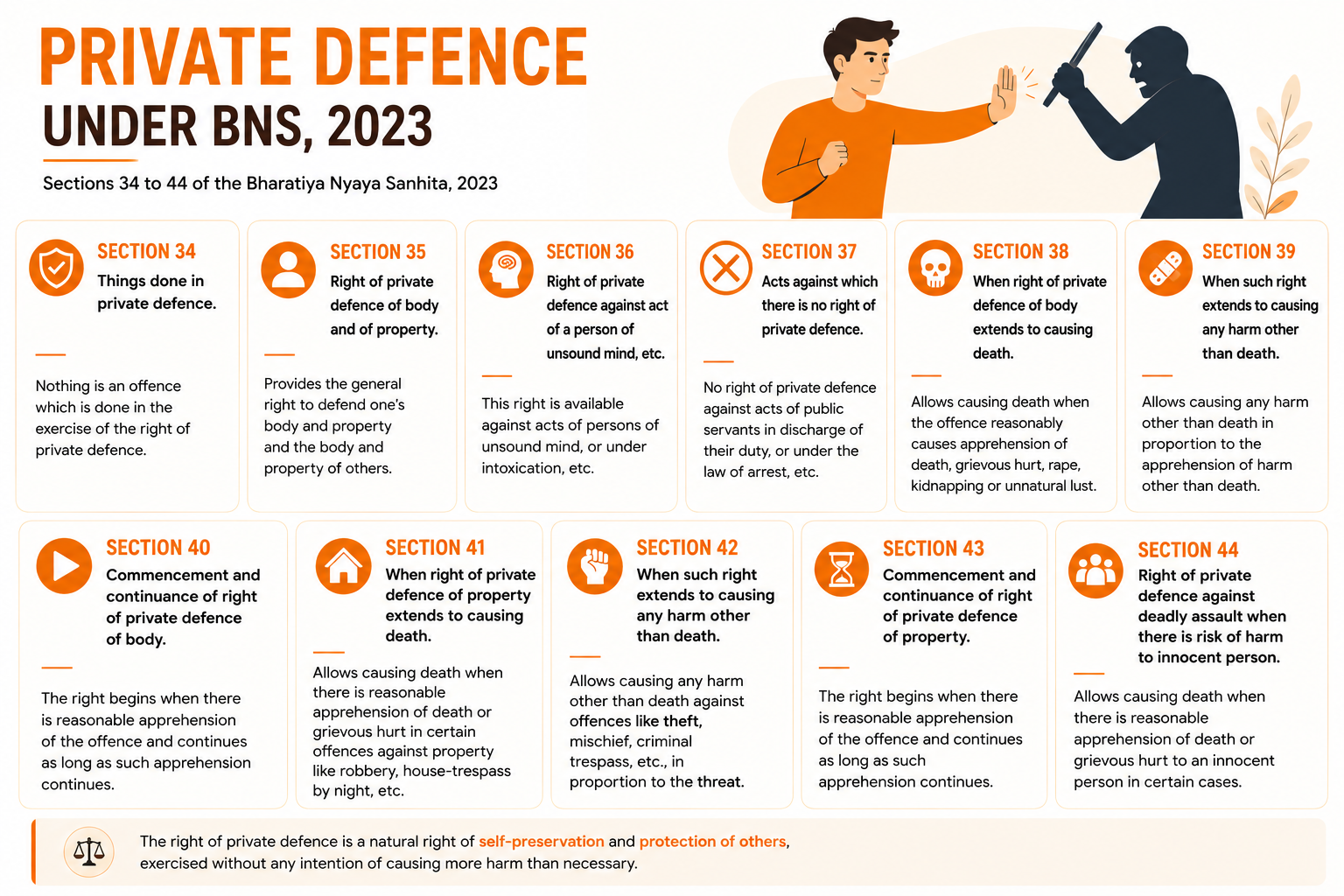
Section 34: The Declaratory Section
Section 34 lays the groundwork for the entire chapter. It simply states that nothing is an offence which is done in the exercise of the right of private defence.
This means that if your act genuinely falls within this right, you are not guilty of any crime at all. It is a complete legal shield, not merely a reason for a lighter sentence.
Section 35: Who and What Can Be Defended
Section 35 grants every person the right to defend their own body and the body of any other person against offences affecting the human body.
It also allows a person to defend their own property, or the property of another, whether movable or immovable, against theft, robbery, mischief, or criminal trespass, including attempts to commit these offences.
Illustration: If you see a stranger trying to snatch a bag from an elderly woman on the street, you are legally entitled to intervene and use reasonable force to stop the theft, even though the property is not yours.
Section 36: Defence Against Persons Who Cannot Be Punished
Section 36 clarifies that private defence is available even against acts committed by a child, a person of unsound mind, an intoxicated person, or someone acting under a genuine misunderstanding.
The reasoning is practical. The threat feels exactly the same to the victim, regardless of whether the attacker can later be held criminally responsible for it.
Illustration: A person suffering from a mental illness attacks a stranger with a knife. The stranger can still exercise the right of private defence, even though the attacker himself may not be convicted due to unsoundness of mind.
Section 37: The Limits of This Right
Section 37 is the most important one to remember, because it sets the boundaries. Private defence is not available in several situations.
It cannot be claimed against acts done by a public servant acting in good faith under their lawful authority, unless that person reasonably believes his life is in danger. It also does not apply where there is enough time to seek help from public authorities.
Most importantly, the force used must never exceed what is necessary for defence. This is where the principle of proportionality comes in, and it is tested constantly in exams and in real courtrooms.
When Can Private Defence Extend to Causing Death?
This is the part students often get wrong, so let us slow down here.
Section 38 deals with the body. It lists seven specific situations where the right of private defence extends to voluntarily causing death of the assailant. These are an assault causing reasonable apprehension of death, an assault causing reasonable apprehension of grievous hurt, an assault with intention to commit rape, an assault with intention to gratify unnatural lust, an assault with intention to kidnap or abduct, an assault with intention to wrongfully confine a person under circumstances that may reasonably cause them to believe they cannot seek help from public authorities, and an act of throwing or administering acid that may reasonably cause apprehension of grievous hurt.
That last clause on acid attacks is new, and it did not exist in the old Section 100 of the IPC.
Illustration: An assailant grabs a woman and drags her towards a car, clearly intending to kidnap her. If she or a bystander causes his death while stopping him, this falls squarely within Section 38 and is not an offence.
Section 39 covers all other situations involving the body. If the threat does not fall within any of the seven categories above, the right only extends to causing harm, but never death.
Illustration: If someone merely pushes or slaps you during an argument, you may push back or restrain them, but killing them would go far beyond what the law permits.
Defending Property: When Death Is Justified
Section 41 governs property, and it is far more restrictive than Section 38. The right extends to causing death only in four situations: robbery, house breaking committed after sunset and before sunrise, mischief by fire or an explosive substance on a building or vessel used as a dwelling or for storing property, and theft, mischief, or house trespass under circumstances that may reasonably cause apprehension of death or grievous hurt.
Illustration: If someone breaks into your home late at night, the darkness and unpredictability of the intrusion itself justify a strong defensive response, even one that proves fatal, because night time house breaking is treated as inherently dangerous.
Section 42 covers property offences outside these four categories, where the right only extends to causing harm, not death. Ordinary daytime theft of an unattended item, for instance, does not justify killing the thief.
When Does the Right Begin and End?
Sections 40 and 43 answer this question for the body and property respectively.
The right of private defence begins as soon as a reasonable apprehension of danger arises, even before the actual offence is committed, and it continues only as long as that apprehension lasts. Once the threat has genuinely ended, so does the right to defend.
Illustration: If an armed attacker drops his weapon and runs away, continuing to attack him afterward is no longer private defence. It becomes retaliation, which the law does not protect.
Section 44: A Special Rule for Chaotic Situations
Section 44 addresses a genuinely difficult scenario. If a person is defending himself against an assault that reasonably causes apprehension of death, and he cannot effectively exercise that right without risking harm to an innocent bystander, the law allows him to take that risk.
Illustration: A is attacked by a violent mob intending to kill him. A has a firearm and fires to protect himself, but a child standing nearby is accidentally injured. Since A had no safer way to defend himself, his right of private defence still protects him.
Landmark Cases on Private Defence
Darshan Singh v. State of Punjab (2010) remains one of the most cited judgments on this topic. The Supreme Court laid down clear guiding principles, holding that a person facing reasonable apprehension of death or grievous hurt is not expected to modulate his defence step by step. The Court also confirmed that there is no obligation to retreat, and the accused had validly exercised private defence after his father was seriously injured by an attacker.
James Martin v. State of Kerala (2003) held that courts should assess private defence claims practically, looking at the injuries received by the accused, the danger apprehended, and the actual circumstances, rather than expecting a person under attack to weigh the exact force required with mathematical precision.
Yeshwant Rao v. State of Madhya Pradesh (1992) involved a father who fatally struck a man attempting to assault his daughter. The Court held that this fell within the clauses protecting against rape and grievous hurt, since the threat created a genuine and reasonable apprehension of serious harm.
A Simple Way to Remember This Topic
Ask yourself three questions whenever you face a fact pattern on this subject.
Was there a real and immediate threat, or could the person have simply called for help?
Did the response match the seriousness of the threat, or was it clearly excessive?
And finally, does the specific threat fall within the limited categories under Sections 38 or 41 that justify causing death?
If you can answer these three questions confidently, you can resolve almost any private defence problem thrown at you in an exam or a courtroom.
Thus, to conclude Private defence is one of the oldest ideas in criminal law, resting on the basic instinct of self-preservation. The Bharatiya Nyaya Sanhita, 2023 has retained this principle almost entirely from the old IPC, while adding a few thoughtful updates like the specific mention of acid attacks.
Understanding the structure, from the foundational Section 34 to the special situation under Section 44, along with the landmark cases that interpret them, will help you master this topic with real clarity and confidence.
Subscribe for updates
Join 10,000+ subscribers.
SH
Shruti chauhan
Contributing author
Have a doubt about this?Ask Doubts
