Recovery of Possession of Immovable Property
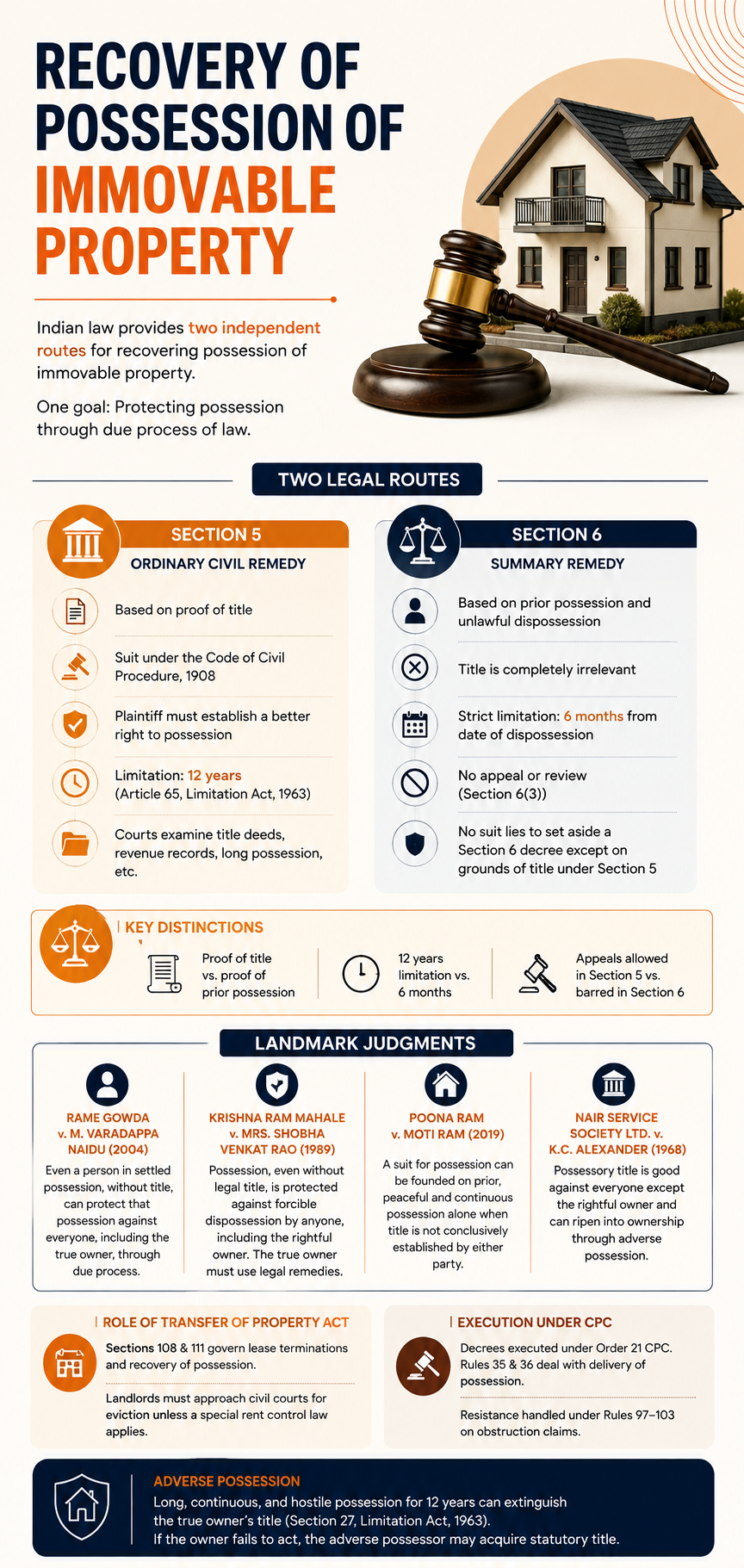
Indian law recognises two independent routes which deal with the recovery of possession of immovable property. The first route rests on proof of title, while the second rests purely on prior possession, regardless of title. The Specific Relief Act, 1963 codifies both remedies under Sections 5 and 6.
Courts have consistently held that possession itself deserves legal protection, independence of ownership. This principle prevents self-help and forcible eviction, even by a true owner. Consequently, a person in settled possession can resist dispossession except through due process of law.
Ordinary process of Civil Law: Section 5
Section 5 of the Specific Relief Act allows a person entitled to possession of specific immovable property to recover it through the ordinary process of civil law. Such a suit proceeds under the Code of Civil Procedure, 1908, and requires the plaintiff to prove title. The plaintiff must establish a better right to possession than the defendant currently enjoys. Mere possession by the defendant does not bar this remedy if title is proved.
This remedy carries no special limitation period beyond the general twelve-year period prescribed under Article 65 of the Limitation Act, 1963. Courts examine revenue records, sale deeds, and long possession as indicators of title.
Summary Remedy: Section 6
Section 6 provides a summary remedy for a person dispossessed of immovable property without consent and otherwise than by due process of law. Such a person may recover possession by filing a suit within six months from the date of dispossession, irrespective of any other title claim.
The defining feature of Section 6 is that title becomes wholly irrelevant to the proceeding. Even a trespasser in settled possession can invoke this provision against a rightful owner who evicts him forcibly.
However, Section 6(3) explicitly bars any appeal or review against an order passed in such a suit. Similarly, no suit lies to set aside a Section 6 decree except on grounds of title under Section 5. The six-month limitation period is strict and cannot be extended under ordinary circumstances.
Landmark Cases
In Rame Gowda v. M. Varadappa Naidu (2004), the Supreme Court held that even a person in settled possession, without title, has the right to protect that possession against everyone including the true owner acting through due process.
Similarly, in Krishna Ram Mahale v. Mrs Shobha Venkat Rao (1989), the Court reiterated that possession, even without legal title, is protected against forcible dispossession by anyone, including the rightful owner. The judgment clarified that the true owner must resort to legal remedies rather than self-help.
In Poona Ram v. Moti Ram (2019), the Supreme Court examined the interplay between Sections 5 and 6, holding that a suit for possession can be founded on prior possession (which must be peaceful and continuous) alone when title is not conclusively established by either party. This decision reaffirmed that possession creates a rebuttable presumption of ownership against everyone except the true owner.
Distinction Between Sections 5 and Section 6
First, Section 5 requires proof of title, whereas Section 6 requires only proof of prior possession and unlawful dispossession. Second, Section 5 carries a twelve-year limitation period, while Section 6 imposes a strict six-month limitation. Third, Section 6 bars appeals, whereas Section 5 suits follow ordinary appellate procedure.
Furthermore, a plaintiff can pursue both remedies, though not simultaneously in the same suit under the same cause of action. If a Section 6 suit fails, the aggrieved party retains the right to file a fresh suit under Section 5 based on title.
Role of the Transfer of Property Act and CPC
The Transfer of Property Act, 1882 also intersects with possession disputes, particularly through Sections 108 and 111, which govern lease terminations and consequent recovery of possession. Landlords seeking eviction after lease termination must still approach civil courts unless a specific rent control statute applies.
Once a decree for possession is obtained, execution proceeds under Order 21 of the Code of Civil Procedure, 1908. Rules 35 and 36 specifically deal with delivery of possession of immovable property, distinguishing between decrees against parties in actual possession and those against tenants or third parties.
The executing court oversees this delivery process. Resistance to execution invokes Rules 97 to 103, allowing courts to adjudicate obstruction claims.
Doctrine of Adverse Possession
The doctrine of adverse possession also becomes relevant when discussing recovery of possession, since long, continuous, and hostile possession can extinguish the true owner's title under section 27 of the Limitation Act. If the original owner fails to recover possession within twelve years of dispossession, the adverse possessor may acquire statutory title.
The Supreme Court in Nair Service Society Ltd. v. K.C. Alexander (1968) held that possessory title is good against everyone except the rightful owner, and such possession can ripen into ownership through adverse possession.
Subscribe for updates
Join 10,000+ subscribers.
HA
Hanspal Bakul
Contributing author
Have a doubt about this?Ask Doubts

