
Recovery of Possession of Movable Property under Specific Relief Act, 1962
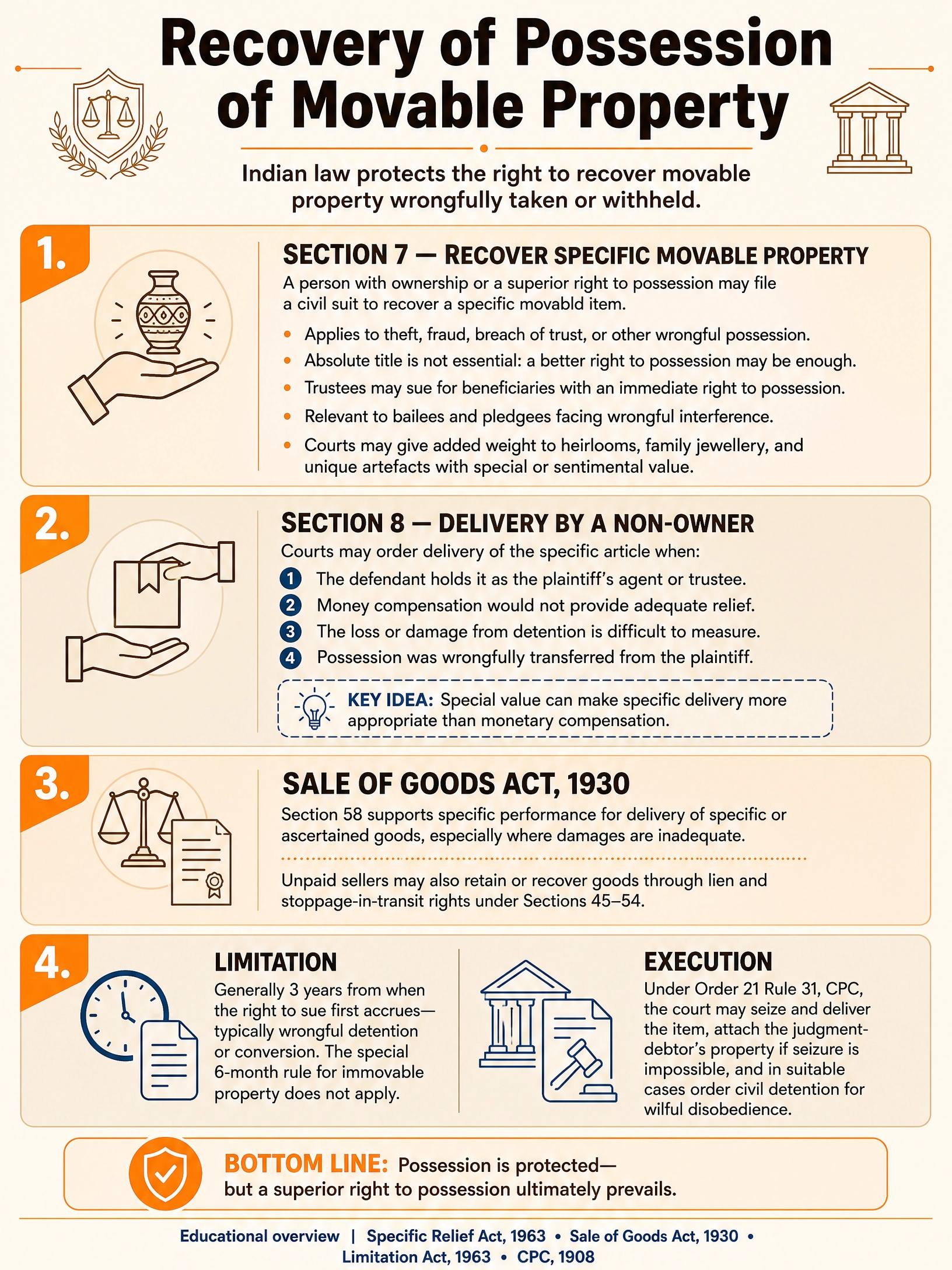
Indian law protects a person's right to recover movable property wrongfully taken or withheld by another. The Specific Relief Act, 1963 addresses this concern through Sections 7 and 8, which cover the recovery of Possession of Movable Property. These provisions balance the interests of rightful owners against those in wrongful possession.
The underlying philosophy mirrors that of immovable property law: possession deserves protection, but ownership ultimately prevails. However, movable property presents unique enforcement challenges since physical recovery becomes difficult once the item changes hands. Courts therefore developed both specific recovery remedies and compensatory alternatives.
Recovery of specific movable property: Section 7
Section 7 of the Specific Relief Act allows a person entitled to possession of specific movable property to recover it through a civil suit. The plaintiff must prove ownership or a superior right to possession over the defendant.
This remedy applies regardless of how the defendant acquired possession, whether through theft, fraud, or breach of trust. Importantly, Section 7 also permits trustees to sue on behalf of beneficiaries for recovery of trust property.
The provision draws heavily from English common law principles governing conversion, adapted to Indian conditions. A plaintiff need not prove absolute title; a better right to possession than the defendant suffices for relief.
This lowers the evidentiary burden considerably compared to title suits for immovable property. Consequently, even a bailee or pledgee can invoke Section 7 against wrongful interference by third parties.
Section 7 contains an important Explanation stating that a trustee may sue for recovery of movable property against a third party for the beneficiary having a right of immediate possession. This extends the remedy beyond simple ownership disputes into fiduciary relationships.
Additionally, courts apply Section 7 liberally when the property carries special or sentimental value beyond mere market price. Heirlooms, family jewellery, and unique artefacts often invoke this heightened judicial concern.
Delivery of Movable Property by Non-Owner : Section 8
Section 8 empowers courts to order delivery of specific movable property.This provision applies in four specific circumstances outlined within the section itself.
First, when the defendant holds the article as an agent or trustee of the plaintiff. Second, when compensation in money would not afford adequate relief for the loss.Third, when ascertaining actual damage caused by the property's detention proves difficult in practice. Fourth, when possession of the article has been wrongfully transferred from the plaintiff.
These four grounds give courts wide discretion to fashion appropriate relief based on circumstances.
The concept of "special value" becomes crucial when courts decide between ordering specific delivery versus awarding monetary compensation. Money cannot always replace an item of unique historical or emotional significance to its owner.
Interplay with the Sale of Goods Act, 1930
The Sale of Goods Act, 1930 supplements Specific Relief Act remedies when the dispute involves goods sold under a contract of sale. Section 58 of that Act allows courts to direct specific performance of a contract for delivery of specific or ascertained goods.
This remedy becomes available particularly when the goods are unique or when damages would not compensate the buyer adequately. Courts frequently cross-reference both statutes when movable property disputes arise from commercial transactions.
Additionally, an unpaid seller's rights under Sections 45 to 54 of the Sale of Goods Act intersect with possession recovery principles, particularly regarding lien and stoppage in transit.
These rights allow sellers to retain or recover possession of goods even after property has passed to the buyer, provided payment remains outstanding. This statutory scheme demonstrates how possession and ownership can diverge temporarily during commercial dealings.
Procedural Aspects and Limitation
A suit for the recovery of specific movable property follows a three-year limitation period governed by specific provisions of the Limitation Act, 1963, rather than the residuary Article 113. Time begins running from the date the right to sue first accrues, typically when wrongful detention or conversion occurs.
Unlike Section 6 of the Specific Relief Act for immovable property, no special six-month limitation applies here. This longer window gives plaintiffs more flexibility in pursuing movable property claims.
Execution of a decree for movable property proceeds under Order 21 Rules 31 of the Code of Civil Procedure, 1908. These rules empower executing courts to seize and deliver the specific article, or attach the judgment-debtor's property if direct seizure proves impossible.
The court may also detain the judgment-debtor in civil prison for wilful disobedience in appropriate cases. This enforcement mechanism ensures decrees do not remain merely paper victories for successful plaintiffs.
Subscribe for updates
Join 10,000+ subscribers.
HA
Hanspal Bakul
Contributing author
Have a doubt about this?Ask Doubts
