
Rectification, Rescission and Cancellation: Understanding Equitable Remedies under the Specific Relief Act, 1963
The Specific Relief Act, 1963 does more than enforce contracts. It also corrects, undoes, and cancels instruments when justice demands it. Rectification, rescission, and cancellation form this trio of equitable remedies.
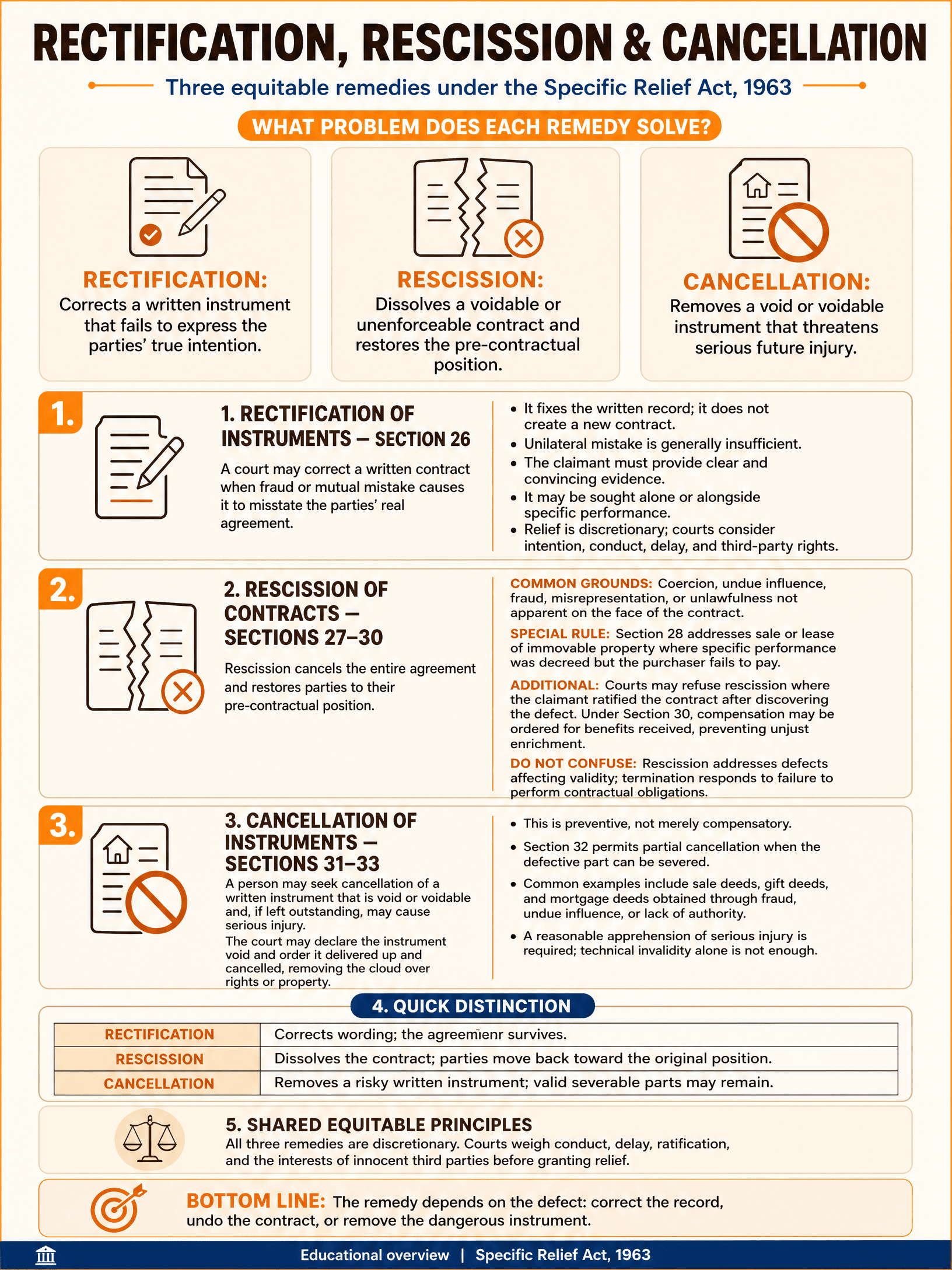
These remedies address different problems. Rectification fixes a document that fails to reflect the parties' true intention. Rescission cancels a voidable or unenforceable contract. Cancellation removes the threat posed by a void or voidable written instrument. Each serves a distinct purpose, yet all three protect fairness.
Rectification of Instruments
Section 26 governs rectification. It applies when a written contract does not express the real intention of the parties due to fraud or mutual mistake. The court steps in to correct the document, aligning it with what the parties actually agreed upon.
Rectification does not create a new contract. It merely corrects the written record of an existing one. The underlying agreement remains untouched; only its expression gets fixed.
Two grounds justify rectification: fraud and mutual mistake. Fraud involves deliberate misrepresentation by one party during drafting. Mutual mistake occurs when both parties share a common error while reducing their agreement to writing. Unilateral mistake, however, is generally insufficient.
The burden of proof lies heavily on the party seeking rectification. Courts demand clear and convincing evidence, not mere probability. This high threshold prevents parties from rewriting contracts simply because outcomes turned unfavourable later.
Rectification can be claimed as a substantive relief or as ancillary relief. A plaintiff may either seek rectification alone or combine it with a suit for specific performance of the corrected instrument. This flexibility makes it procedurally useful in litigation.
Importantly, rectification is a discretionary remedy. Courts examine intention, conduct, and third-party rights before granting it. If innocent third parties have acquired rights based on the original document, rectification may be refused to protect them.
Rescission of Contracts
Sections 27 to 30 deal with rescission. Rescission cancels a contract, restoring parties to their pre-contractual position. Unlike rectification, which fixes wording, rescission dissolves the entire agreement. It treats the contract as if it never existed.
A party can seek rescission when the contract is voidable due to coercion, undue influence, fraud, or misrepresentation. It also applies when the contract is unlawful for reasons not apparent on its face. This ties rescission closely to Sections 19 and 20 of the Indian Contract Act, 1872.
However, Section 28 addresses a special situation: rescission of contracts for the sale or lease of immovable property when specific performance has already been decreed but the purchaser fails to pay. This provision links specific performance and rescission within one procedural framework.
Courts retain discretion here as well. Rescission may be refused if the plaintiff has expressly or impliedly ratified the contract after discovering the defect. Ratification signals acceptance, and equity does not favour parties who approbate and then reprobate.
Section 30 permits courts to award compensation for any benefit received under the contract while granting rescission. This ensures restitution accompanies cancellation, preventing unjust enrichment on either side. The remedy thus balances fairness for both parties.
Rescission differs sharply from termination for breach under general contract law. Rescission operates on grounds like fraud, coercion, or mistake affecting the contract's validity itself. Termination, by contrast, responds to a party's failure to perform contractual obligations properly.
Cancellation of Instruments
Sections 31 to 33 govern cancellation, a remedy distinct from rescission despite superficial similarity. Cancellation applies to written instruments that are void or voidable and which, if left outstanding, may cause serious injury to the plaintiff.
Section 31 allows any person against whom a written instrument is void or voidable to sue for its cancellation. The court may adjudge the instrument void and order it delivered up and cancelled, removing the cloud over the plaintiff's rights or property.
This remedy is preventive rather than compensatory. It protects a person from potential future harm caused by an instrument that appears valid on its face but is legally defective. The apprehension of harm justifies pre-emptive judicial intervention.
Section 32, notably, addresses partial cancellation. If an instrument is void or voidable against the plaintiff only in part, and that part can be severed from the rest, the court may cancel that portion alone. This preserves the valid remainder of the document.
Cancellation typically targets documents like sale deeds, gift deeds, or mortgage deeds obtained through fraud, undue influence, or lack of authority.
The Supreme Court has consistently held that cancellation suits require the plaintiff to demonstrate a reasonable apprehension of serious injury. Mere technical invalidity, without any real threat, does not automatically warrant cancellation under this provision.
Distinguishing the Three Remedies
Rectification corrects wording without disturbing contractual validity. Rescission dissolves the contract entirely, restoring the original position. Cancellation removes a void or voidable instrument that threatens future harm. Each targets a different stage of contractual dysfunction.
Moreover, rectification presupposes a genuine agreement wrongly recorded. Rescission presupposes a valid-looking agreement vitiated by fraud, coercion, or mistake. Cancellation presupposes a document, not necessarily a bilateral contract, that poses ongoing legal risk to the plaintiff.
All three remedies remain discretionary, governed by equitable principles rather than automatic entitlement. Courts weigh conduct, delay, ratification, and third-party interests before granting relief.
Subscribe for updates
Join 10,000+ subscribers.
HA
Hanspal Bakul
Contributing author
Have a doubt about this?Ask Doubts
