
SEBI Regulatory Framework for CLAT PG - Part I
The Securities and Exchange Board of India (SEBI) is the apex regulatory authority governing the securities market in India. Established initially in 1988 as a non-statutory body, it was granted statutory status through the SEBI Act, 1992, following recommendations to curb malpractices exposed by market scams of that era.
SEBI's establishment marked a shift from the earlier regime governed primarily by the Controller of Capital Issues, towards a disclosure-based, investor-protection-oriented regulatory model aligned with international securities regulation standards. Therefore, the SEBI Regulatory Framework is of utmost importance for CLAT PG.
Objectives of SEBI
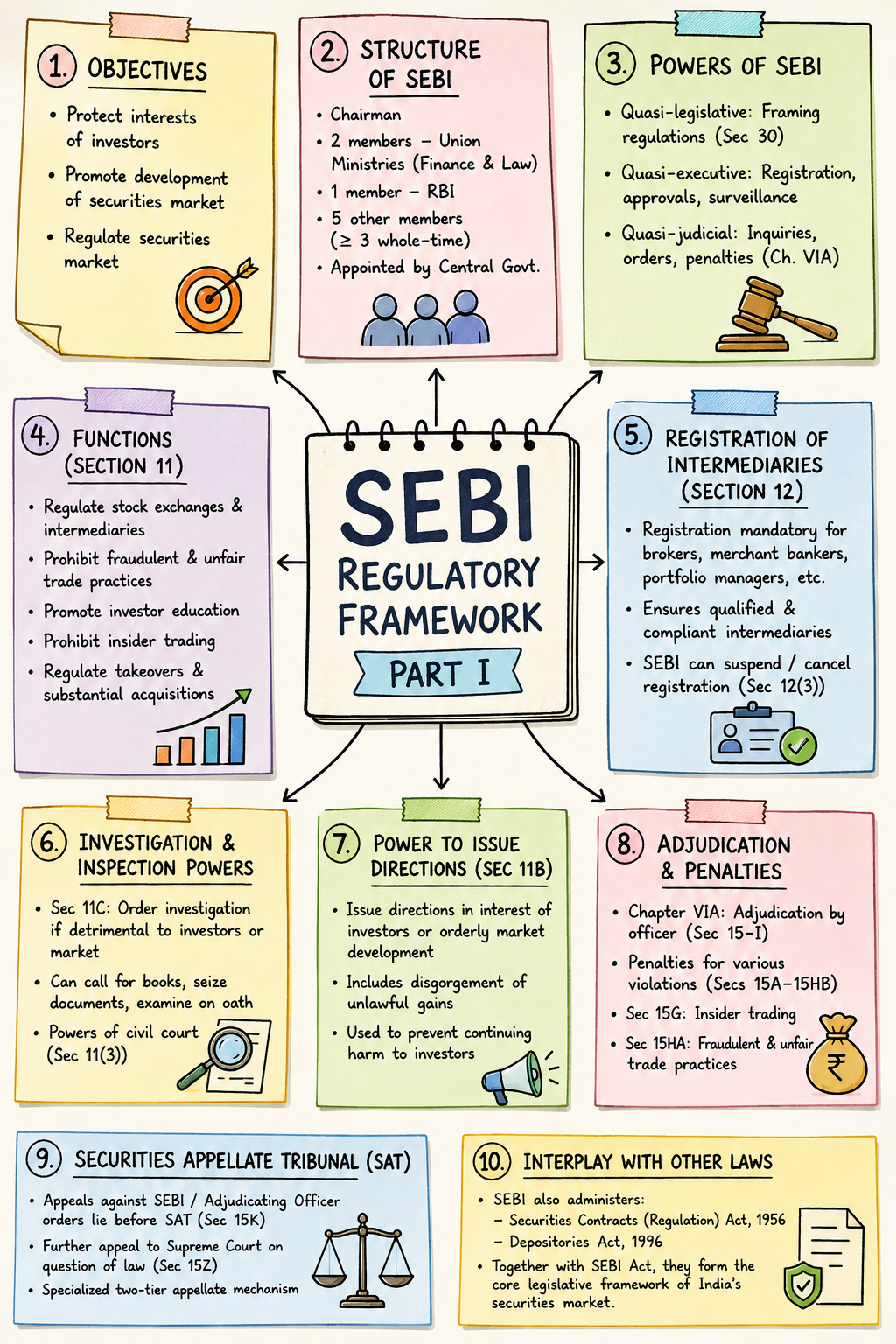
The Preamble to the SEBI Act, 1992 outlines its three-fold objective: protecting the interests of investors in securities, promoting the development of the securities market, and regulating the securities market. These objectives operate in tandem, requiring SEBI to balance investor protection with market growth and innovation.
This tripartite mandate distinguishes SEBI from purely enforcement-oriented regulators, as it also plays a developmental role, such as facilitating new financial instruments, market infrastructure institutions, and ease of capital raising for issuers.
Structure of SEBI
Section 4 of the SEBI Act provides for a Board comprising a Chairman, two members from the Union Ministries dealing with finance and law, one member from the Reserve Bank of India, and five other members, of whom at least three must be whole-time members, all appointed by the Central Government.
The Central Government retains overarching control, including powers to issue directions on policy matters under Section 16, supersede the Board under Section 17 in specified circumstances, and review SEBI's orders in certain limited respects, ensuring accountability within the regulatory framework.
Powers of SEBI
SEBI exercises a unique combination of quasi-legislative, quasi-executive, and quasi-judicial powers, making it a comprehensive regulator. Quasi-legislative power is exercised through framing regulations under Section 30 of the SEBI Act, such as the ICDR Regulations, LODR Regulations, and PIT Regulations, which have the force of subordinate legislation.
Quasi-executive power involves administrative functions such as registration of intermediaries, approval of schemes, and surveillance of market activities. Quasi-judicial power enables SEBI to conduct inquiries, pass orders, and impose penalties on violators, functioning similar to a tribunal in adjudicatory matters under Chapter VIA of the Act.
Functions under Section 11
Section 11 casts a duty on SEBI to protect investor interests and regulate the securities market through measures it deems fit. These include regulating stock exchanges and intermediaries, prohibiting fraudulent and unfair trade practices, promoting investor education, prohibiting insider trading, and regulating substantial acquisition of shares and takeovers.
Section 11(2) enumerates specific measures, including registration and regulation of stock brokers, sub-brokers, merchant bankers, portfolio managers, and other market intermediaries, along with registration of collective investment schemes and mutual funds, and regulation of credit rating agencies.
Registration of Market Intermediaries
Under Section 12, no person can act as a stock broker, sub-broker, share transfer agent, banker to an issue, merchant banker, underwriter, portfolio manager, or investment adviser without obtaining a certificate of registration from SEBI. This registration mechanism serves as the primary gatekeeping tool ensuring only qualified and compliant entities operate in the securities market.
SEBI's power to suspend or cancel registration under Section 12(3), after providing a reasonable opportunity of being heard, functions as an important enforcement tool against errant intermediaries.
Investigation and Inspection Powers
Sections 11C empowers SEBI to order investigation where it has reasonable grounds to believe that transactions are being conducted in a manner detrimental to investors or the securities market, or in contravention of the Act. Investigating authorities can require production of books, seize documents, and examine persons on oath.
SEBI also possesses powers akin to a civil court under Section 11(3), including summoning and enforcing attendance of persons, discovery and production of documents, and inspection of books and records of any listed company or intermediary.
Power to Issue Directions
Section 11B empowers SEBI to issue directions to any person or class of persons associated with the securities market, or to any company, in the interest of investors or orderly development of the securities market, including directions to disgorge unlawful gains made through violations.
This power has been extensively used in cases involving fraudulent public issues, market manipulation, and violation of disclosure norms, enabling SEBI to act swiftly to prevent continuing harm to investors pending final adjudication.
Adjudication and Penalties
Chapter VIA of the SEBI Act provides for adjudication of penalties by an Adjudicating Officer appointed under Section 15-I, for violations such as failure to furnish information, non-redressal of investor grievances, insider trading, and fraudulent and unfair trade practices, with penalties prescribed under Sections 15A to 15HB.
Section 15G specifically penalizes insider trading, while Section 15HA penalizes fraudulent and unfair trade practices, both attracting substantial monetary penalties, reflecting the seriousness with which market abuse is treated under Indian securities law.
Securities Appellate Tribunal
Appeals against orders of SEBI or Adjudicating Officers lie before the Securities Appellate Tribunal (SAT), constituted under Section 15K, ensuring an independent appellate mechanism outside the regular court hierarchy. Further appeal from SAT orders lies directly to the Supreme Court under Section 15Z, on a question of law.
This two-tier structure - SEBI/Adjudicating Officer followed by SAT - reflects the specialized and technical nature of securities law disputes, requiring domain expertise not always available in ordinary civil courts.
Interplay with SCRA and Depositories Act
SEBI also administers the Securities Contracts (Regulation) Act, 1956, which regulates stock exchanges and contracts in securities, and the Depositories Act, 1996, which governs the dematerialized holding and transfer of securities through depositories like NSDL and CDSL. Together with the SEBI Act, these three statutes form the core legislative framework of India's securities market.
SEBI's regulatory framework combines statutory authority with wide-ranging legislative, executive, and judicial powers to secure investor protection and market integrity. This Part I has covered SEBI's establishment, structure, and core powers under the SEBI Act, 1992; Part II will examine specific SEBI regulations governing takeovers, insider trading, and public issues, which are essential for CLAT PG preparation.
Subscribe for updates
Join 10,000+ subscribers.
HA
Hanspal Bakul
Contributing author
Have a doubt about this?Ask Doubts
