SEBI Regulatory Framework - Part II
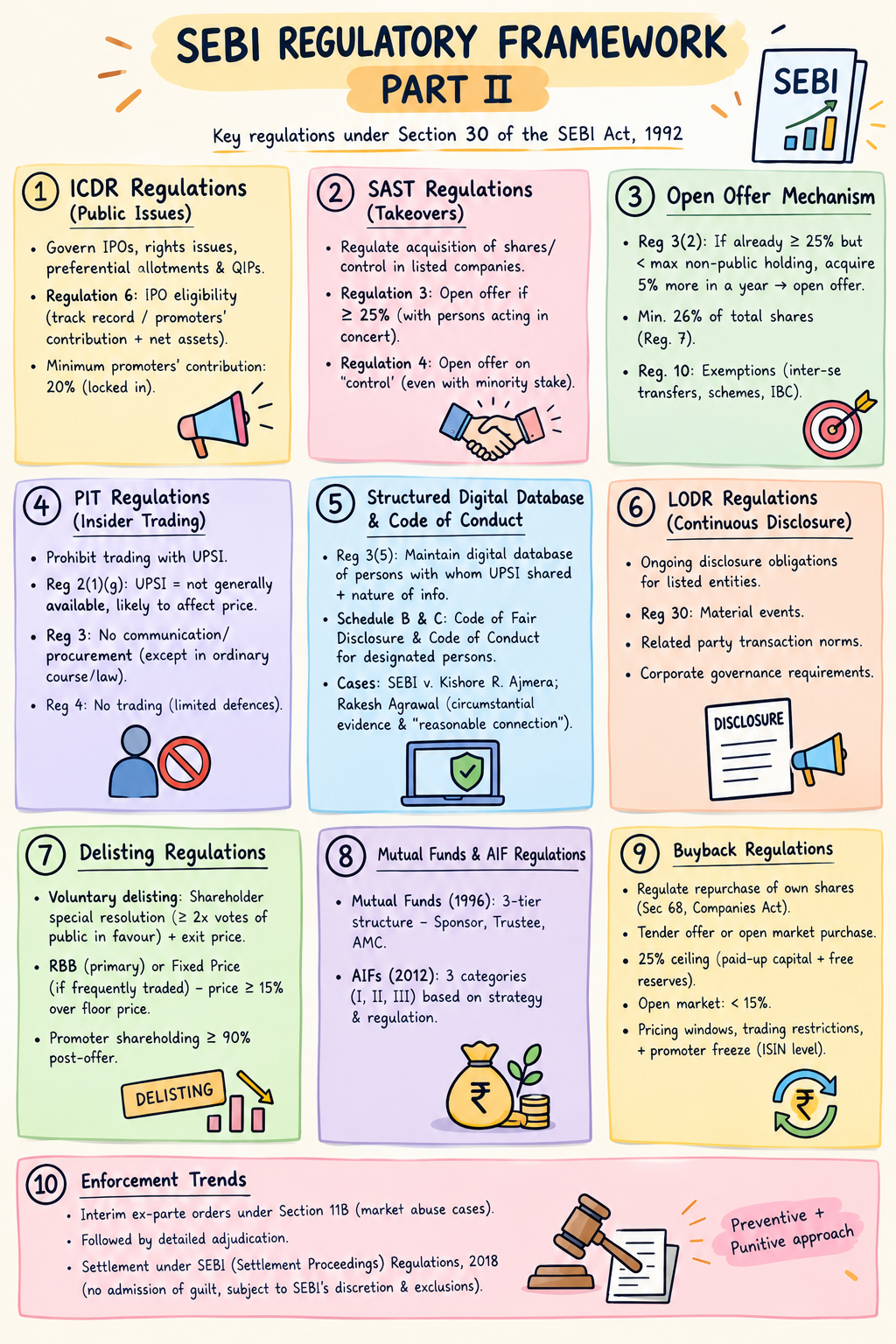
Building on SEBI Regulatory Framework Part I, this segment covers the key substantive regulations SEBI has framed under Section 30 of the SEBI Act, 1992, which govern specific market activities such as public issues, takeovers, and insider trading.
ICDR Regulations - Public Issues
The SEBI (Issue of Capital and Disclosure Requirements) Regulations, 2018 (ICDR) govern the process of raising capital through public and rights issues, preferential allotments, and qualified institutions placements (QIPs). They prescribe eligibility norms, pricing guidelines, and disclosure requirements for issuers.
Regulation 6 lays down eligibility conditions for an initial public offer (IPO), including track record of distributable profits or alternative conditions involving minimum promoters' contribution and net tangible assets. The regulations also mandate minimum promoters' contribution of 20%, locked in for specified periods, to ensure promoter commitment.
SAST Regulations - Takeovers
The SEBI (Substantial Acquisition of Shares and Takeovers) Regulations, 2011 (SAST), regulate acquisition of shares or control in listed companies. Regulation 3 mandates an open offer when an acquirer, together with persons acting in concert, acquires shares or voting rights entitling them to 25% or more of the target company.
Regulation 4 additionally triggers an open offer obligation upon acquisition of "control," irrespective of shareholding percentage, recognizing that control can be acquired even with a minority stake through board representation or special rights.
Open Offer Mechanism
Under Regulation 3(2), an acquirer already holding 25% or more but less than the maximum permissible non-public shareholding must make an open offer upon acquiring additional shares or voting rights of 5% or more in a financial year (creeping acquisition limit). The open offer must generally be for a minimum of 26% of the total shares of the target company, as prescribed under Regulation 7.
Regulation 10 provides specific exemptions from the open offer requirement, including inter-se transfers among promoters, acquisitions through schemes of arrangement, and acquisitions pursuant to a resolution plan approved under the IBC.
PIT Regulations - Insider Trading
The SEBI (Prohibition of Insider Trading) Regulations, 2015 (PIT Regulations) prohibit trading in securities of a listed company by an "insider" while in possession of unpublished price sensitive information (UPSI). Regulation 2(1)(g) defines UPSI as information not generally available, which upon becoming available is likely to materially affect the price of securities.
Regulation 3 prohibits communication or procurement of UPSI except where required in the ordinary course of business or under law, while Regulation 4 prohibits trading by an insider when in possession of UPSI, subject to limited defenses such as trading under an approved trading plan.
Structured Digital Database and Code of Conduct
Regulation 3(5) mandates listed companies and intermediaries to maintain a structured digital database of persons with whom UPSI is shared, along with the nature of information, to strengthen traceability of leaks. Schedule B and Schedule C further require listed companies to formulate a Code of Fair Disclosure and Code of Conduct for regulating trading by designated persons.
The landmark case of SEBI v. Kishore R. Ajmera and various orders in the Rakesh Agrawal line of cases have shaped the evolving jurisprudence on establishing insider trading through circumstantial evidence and the "reasonable connection" test.
LODR Regulations - Continuous Disclosure
Briefly recalling the governance discussion, the SEBI (Listing Obligations and Disclosure Requirements) Regulations, 2015 impose ongoing disclosure obligations on listed entities, including disclosure of material events under Regulation 30, related party transaction norms, and corporate governance requirements applicable specifically to listed companies, supplementing Companies Act provisions.
Delisting Regulations
The SEBI (Delisting of Equity Shares) Regulations, 2021 govern voluntary and compulsory delisting of listed companies from stock exchanges. Voluntary delisting requires approval by shareholders through a special resolution (where the votes cast by public shareholders in favor are at least two times the votes cast against) and an exit price determination mechanism.
While the Reverse Book-Building (RBB) process remains a primary route to determine the exit price, companies with frequently traded shares may alternatively opt for a Fixed Price Mechanism, provided the offered fixed price is at least a 15% premium over the floor price.
For a voluntary delisting to succeed under either path, the promoter's post-offer aggregate shareholding must reach at least 90% of the target company's total equity shares.
Mutual Funds and AIF Regulations
The SEBI (Mutual Funds) Regulations, 1996 regulate the establishment and functioning of mutual funds through a three-tier structure of sponsor, trustee, and asset management company. The SEBI (Alternative Investment Funds) Regulations, 2012 classify privately pooled investment vehicles into three categories (Category I, II, and III AIFs) based on their investment strategy and associated regulatory treatment.
Buyback Regulations
The SEBI (Buy-Back of Securities) Regulations, 2018 regulate the repurchase of a company's own shares, supplementing Section 68 of the Companies Act, 2013. Buybacks may be conducted through a tender offer or an open market purchase. Under Section 68, the buyback size is capped at a 25% ceiling relative to the paid-up capital and free reserves.
However, for open market buy-backs executed through stock exchanges, the ceiling is tighter and limited to less than 15% of the company's paid-up capital and free reserves.
Further, the open market stock exchange route operates under strict frameworks regarding pricing windows, trading restrictions, and a complete freeze on promoter shareholding at the ISIN level for the duration of the offer.
Enforcement Trends
SEBI's enforcement approach has increasingly relied on interim ex-parte orders under Section 11B in cases of ongoing market abuse, followed by detailed adjudication, reflecting a preventive-cum-punitive regulatory philosophy.
Settlement mechanisms under the SEBI (Settlement Proceedings) Regulations, 2018 also allow parties to settle proceedings without admission of guilt, subject to SEBI's discretion and specified exclusions for serious violations.
Part II demonstrates how SEBI's regulatory architecture translates its statutory powers into detailed substantive rules governing capital raising, takeovers, and market conduct. For CLAT PG aspirants, familiarity with SAST open offer triggers, PIT Regulations' UPSI framework, and ICDR eligibility norms is essential, as these areas are frequently tested through both conceptual and application-based questions.
Subscribe for updates
Join 10,000+ subscribers.
HA
Hanspal Bakul
Contributing author
Have a doubt about this?Ask Doubts
