
Separation of Powers : Under the Indian Constitution
Introduction
Lord Acton’s well-known observation “Power tends to corrupt, and absolute power tends to corrupt absolutely" explains why modern constitutions do not place all state power in one authority. A constitutional government must distribute power so that public institutions can control one another and citizens are protected from arbitrary rule.
The idea is closely associated with the French philosopher Montesquieu. In The Spirit of the Laws (1748), he identified three kinds of state power- the power to make laws, the power to execute them, and the power to decide disputes. He warned that liberty would be at risk if the same person or body made the law, enforced it and judged its violation. The doctrine of separation of powers developed from this concern.
India does not follow a completely rigid separation. Instead, the constitution creates a broad separation with carefully designed overlaps and checks. The legislature makes laws, the executive implements them, and the judiciary interprets the constitution and settles disputes. At the same time, each organ has limited powers to supervise the other. This balance is central to constitutional democracy.
Meaning of Separation of Powers
Separation of powers means the distribution of governmental functions among three organs -
- The legislature,
- The executive, and
- The Judiciary
The legislature debates and enacts laws, the executive administers the country and carries out those laws, and the judiciary interprets the law and decides cases. The basic purpose is to prevent the centralisation of power and to preserve individual liberty.
In its strict sense, the doctrine requires that each organ remain institutionally and functionally separate. A person belonging to one organ should not exercise the core functions of another. The United States is the classic example of this model.
In a broader sense, separation does not require complete isolation. Some overlap is permitted, provided that no organ destroys the constitutional role of another. India follows this broader approach.
How Montesquieu explained Separation of Powers
Montesquieu divided government power into three parts. Legislative power makes, changes and repeals laws. Executive power deals with matters such as national security, foreign relations and the implementation of laws. Judicial power punishes offences and resolves disputes between individuals.
For Montesquieu, separation was not merely an administrative arrangement. It was a protection for liberty. If the law-maker also controls its enforcements, oppressive laws could be easily applied without any restraint. If the judge were also the law-maker, the judge could decide cases according to rules created personally for that situation. Therefore, power had to be divided and balanced.
Today, separation is understood together with checks and balances. The goal is not to keep government branches completely separate, but to make sure they are responsible and answerable for their actions.
The Doctrine under the Indian Constitution
The constitution of India does not contain one single provision declaring that the three organs must be completely separate. The doctrine appears through several provisions and through the constitutional structure as a whole.
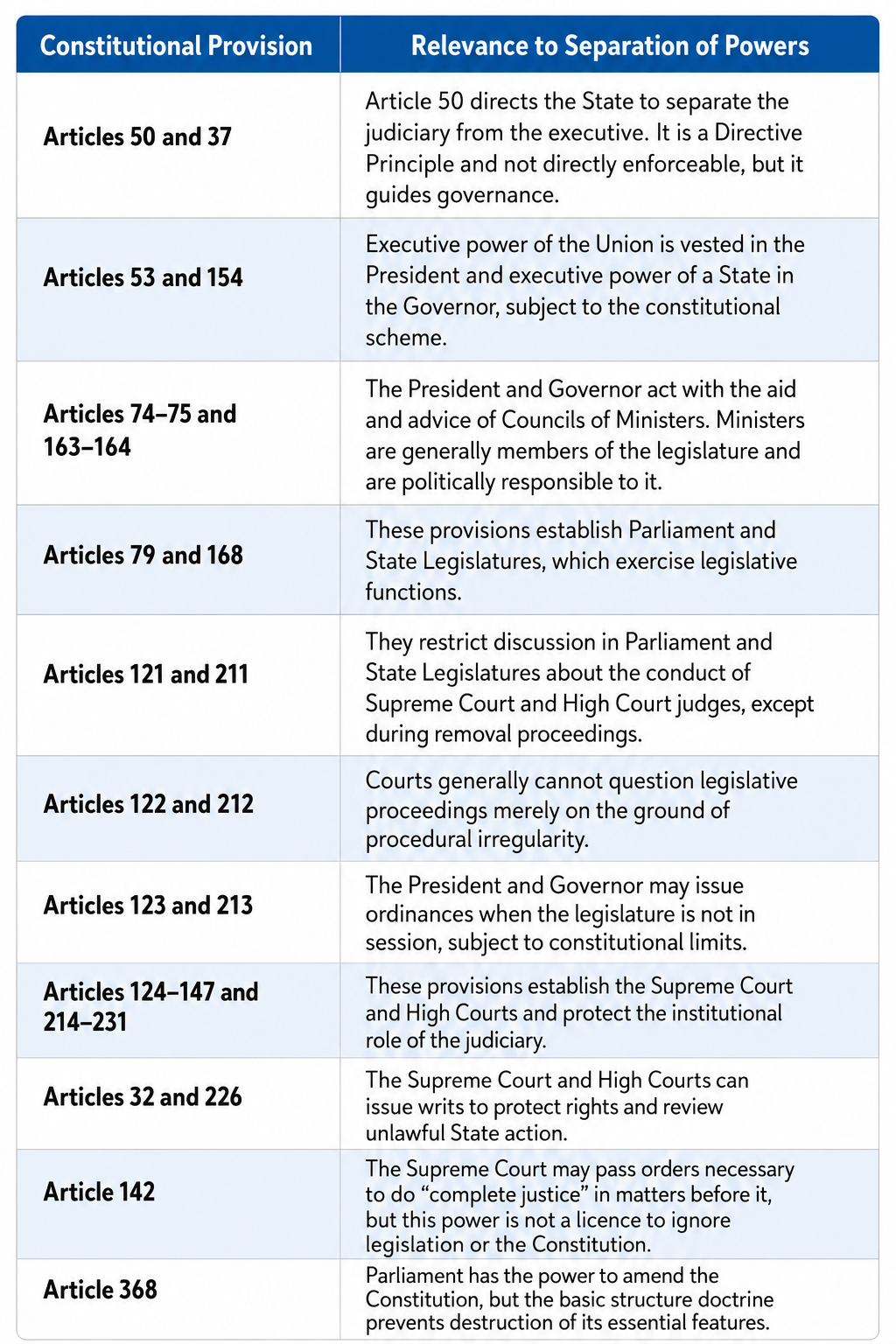
Article 50 is particularly important as it protects the independence of judges. It stops government leaders from interfering with the courts, which used to be a big problem for local magistrates in the past. However, this rule is just a guideline for the government rather than a strict law, so citizens cannot sue the state in court if it is ignored.
Additionally, India's government system allows different branches to mix and overlap. The Prime Minister and their top ministers must be members of Parliament, meaning they make the laws they also enforce.
This team can only run the country as long as the lower house of parliament, called the Lok Sabha, trusts and supports them. Because these powers blend together, India does not follow a strict system where the lawmakers and the leaders are kept completely separate.
Doctrine of Check and Balances in India
Checks and Balances give each organ constitutional tools to control excesses by the others. Parliament checks and executive through questions, debate, budgetary approval, committees and a no-confidence motion. Article 75(3) makes the council of ministers collectively responsible to the Lok Sabha.
The executive participates in law-making through Bills, delegates legislation and ordinances under Articles 123 and 213. It also exercises limited quasi-judicial powers, such as pardons under Article 72 and 161. These Powers remain reviewable if used arbitrarily.
Judicial review under Article 32 and Article 226 allows courts to invalidate unconstitutional laws and executive action. However courts respect institutional limits and avoid replacing policy choices with their own preference.
Article 368 permits amendments but not destruction of the basic structure. This prevents a temporary majority from removing democracy, rule of law or judicial review.
Separation of Power in India : Broad Separation, Not Complete Separation
The Indian constitution system combines separation with coordination. The legislature makes laws, but it also performs limited adjudicatory functions through privileges and disciplinary powers. The executive makes subordinate rules, decides many administrative matters and may exercise limited quasi-judicial powers. Courts interpret laws, develop legal principles and in extraordinary circumstances, use Article 142 to give effective relief.
These overlaps are not automatically unconstitutional. The key question is whether the essential function and independence of an organ have been undermined,
Judicial Perspective and important cases
Rai Sahib Ram Jawaya Kapur V State of Punjab (1955)
The Supreme Court recognised India’s flexible model. The constitution does not place all legislative, executive and judicial powers in complete separate bodies, and executive action is not always dependent on a prior statute, provided it remains constitutional.
In re Delhi Laws Act (1951)
The court permitted delegated legislation for filling in details, but held that the legislature cannot transfer its essential function of deciding policy and standards.
Kesvananda Bharti V State of Kerala (1973)
Parliament’s power under Article 363 is wide but cannot destroy the constitution’s basic structure. This protects the institutional framework from an unlimited amending majority.
Indira Gandhi V Raj Narayan (1975)
The court held that creation of government posts is an executive or legislative matter and cannot be ordered by judges. It stressed judicial restraint and India’s broad separation of powers.
Supreme Court Advocates-on-Record Association V Union of India (2015)
While invalidating the National Appointments Commission, the Court treated judicial interdependence as part of the basic structure. The case shows the judiciary protecting its institutional role, while also raising questions about accountability in appointments.
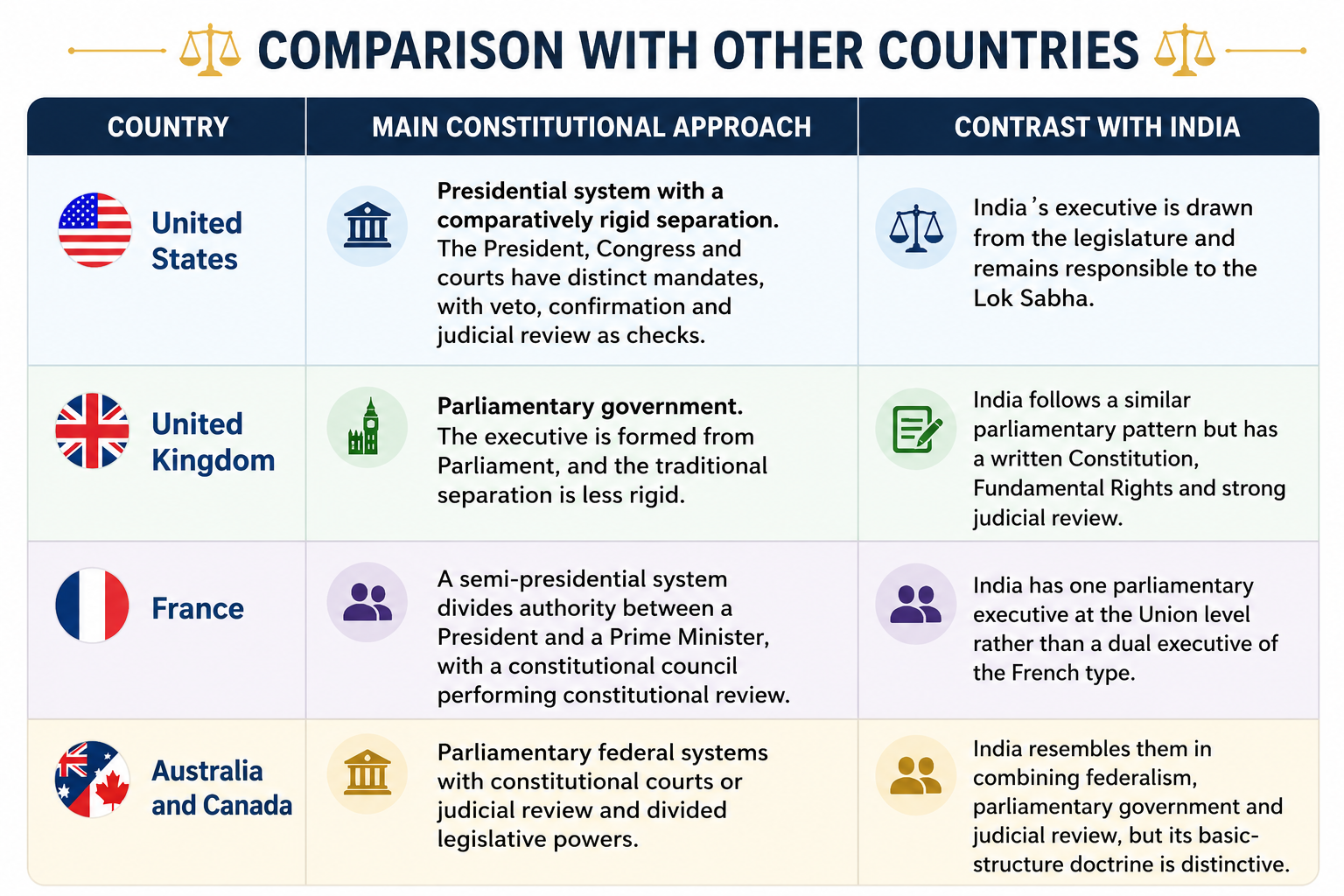
Comparison with Other Countries
Conclusion
Separation of powers under the Indian Constitution is a principle of controlled government rather than complete institutional isolation. The constitution assigns primary functions to the legislature, delegated legation, ordinances and judicial review all show this practical approach.
For CLAT PG preparation, the key point is that India follows a broad and functional separation of powers. No organ is supreme in every field. Parliament is limited by constitution, the executive is accountable to Parliament and the courts, and the judiciary is limited by judicial restraint and respect for institutional boundaries.
The basic structure doctrine gives the principle its strongest protection. Ultimately, separation of powers is not about making government rigid; it is about ensuring that no authority becomes powerful enough to govern without constitutional accountability.
Subscribe for updates
Join 10,000+ subscribers.
JU
Julie Nigam
Contributing author
Have a doubt about this?Ask Doubts
