
Specific Performance of Contracts under Specific Relief Act, 1963
Specific performance of Contracts is an equitable remedy compelling a party to perform its contractual obligations exactly as promised, rather than merely paying damages for breach. The Specific Relief Act, 1963 governs this remedy under Sections 9 to 25.
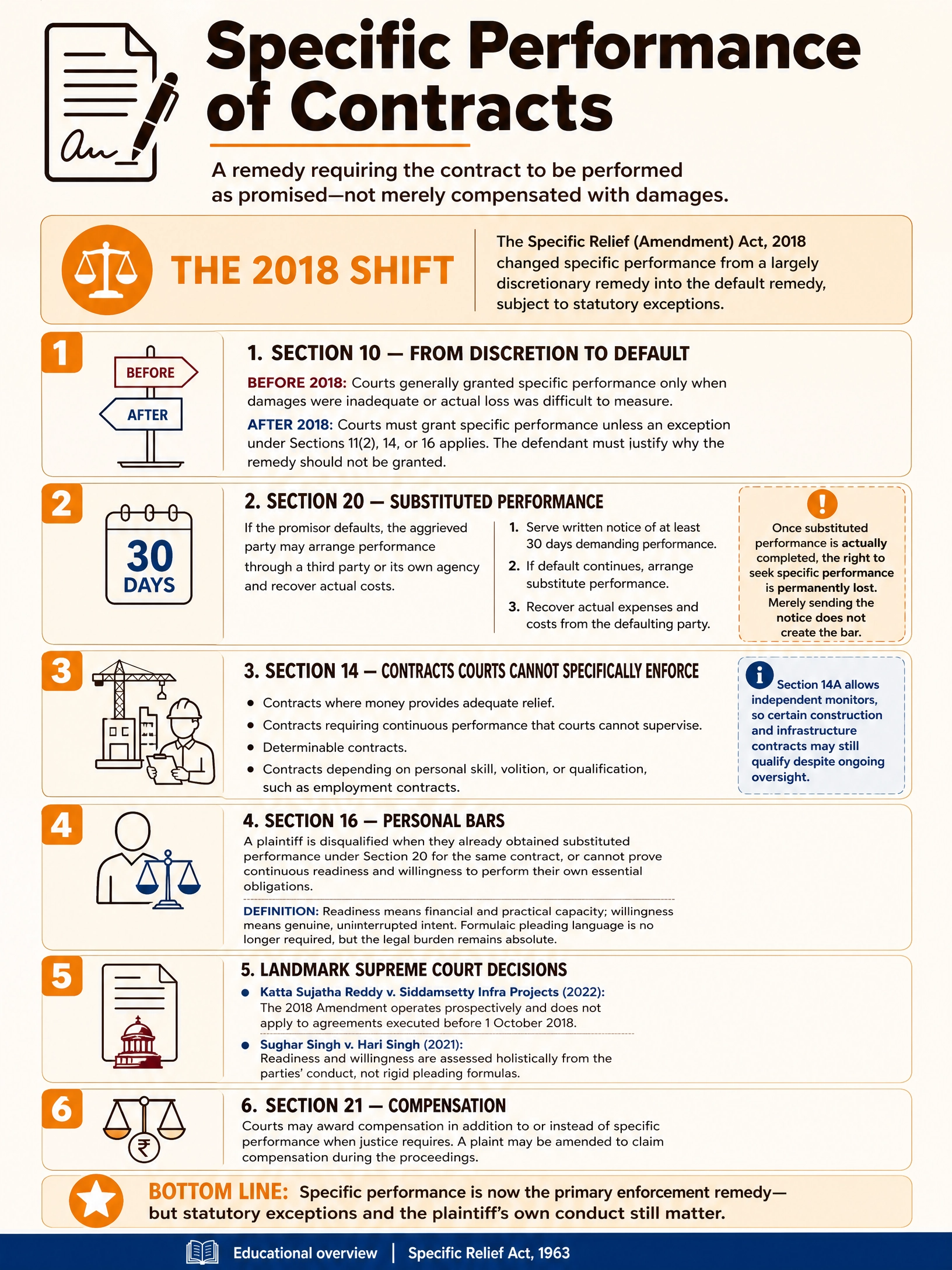
Historically, courts treated specific performance as discretionary and exceptional, granted only when monetary compensation proved inadequate. However, the Specific Relief (Amendment) Act, 2018 fundamentally transformed this discretionary character into a more rule-based entitlement.
This amendment marked a decisive shift from the traditional common law approach toward a regime favouring actual performance over damages. The legislature recognised that India's contract enforcement mechanism needed strengthening to support commercial confidence and ease of doing business.
Pre-Amendment Position of Section 10
Prior to the 2018 amendment, Section 10 rendered specific performance a highly discretionary remedy, empowering courts to grant it only when no standard existed to ascertain actual damage, or when monetary compensation would not afford adequate relief.
This discretionary framework created uncertainty for commercial parties who could not predict whether courts would enforce their contracts specifically. The unpredictability discouraged foreign investment and complicated dispute resolution in commercial matters.
Post-Amendment Position: Section 10 Substituted
The 2018 Amendment substituted Section 10 entirely, removing judicial discretion and making specific performance the default remedy for contract enforcement. Now, courts must grant specific performance unless the case falls within the exceptions specifically carved out under Section 11(2), 14, or 16.
This reversal places the burden on the defendant to justify why specific performance should not apply. The amendment effectively codifies specific performance as the primary remedy, not merely an equitable afterthought.
This change aligns Indian law more closely with international commercial arbitration standards and global contract enforcement practices.
Substituted Performance: Section 20
The 2018 Amendment introduced a pragmatic commercial remedy through Section 20, codifying the concept of 'substituted performance'. If a promisor defaults, the aggrieved party holds the statutory option to have the contract performed by a third party or via their own internal agency, subsequently recovering all actual expenses and costs from the defaulting party.
Activating this remedy strictly requires serving a written notice of not less than thirty days to the defaulting party, demanding performance within that window. If the promisor still fails to perform, the aggrieved party may execute the substituted performance.
Structurally, Section 20(3) mandates that once the aggrieved party has actually got the contract performed through an alternative agency, they permanently forfeit the right to file for specific performance. Crucially, merely issuing the 30-day notice does not trigger an automatic, immediate forfeiture; rather, it is the actual completion of the third-party performance that acts as the absolute statutory bar. This nuance allows commercial parties a measure of flexibility to pivot their legal strategies if arranging third-party substitutes proves commercially unviable midway.
Contracts Not Specifically Enforceable: Section 14
Section 14 lists contracts that courts cannot specifically enforce, even under the amended regime. These include contracts where monetary compensation provides adequate relief, contracts requiring continuous performance courts cannot supervise, and contracts of a determinable nature.
Additionally, contracts involving personal skill, volition, or qualification, such as employment contracts, remain non-enforceable specifically. This exception protects individual liberty by preventing courts from forcing unwilling parties into personal service relationships.
The 2018 Amendment notably removed the earlier exclusion of contracts requiring "constant supervision," recognising that courts can now appoint independent monitors under Section 14A.
This procedural innovation allows specific performance even for construction or infrastructure contracts that traditionally required ongoing oversight. Consequently, infrastructure and construction disputes, previously excluded from specific performance, now qualify for this remedy.
Personal Bars to Relief: Section 16
Section 16 of the Specific Relief Act establishes absolute personal bars, identifying distinct circumstances where a plaintiff is disqualified from obtaining specific performance regardless of the defendant's breach.
Under Section 16(a), a plaintiff who has successfully obtained substituted performance under Section 20 for the same contract is structurally barred from seeking specific performance. Furthermore, under Section 16(c), a plaintiff must affirmatively prove continuous readiness and willingness to perform their own essential contractual obligations to qualify for relief.
The 2018 Amendment updated Section 16(c) by removing the archaic, hyper-technical requirement that a plaintiff must plead specific formulaic phrases verbatim in their initial plaint. However, this change is not a substantive relaxation of the standard; while the formal rules of pleading have been modernized, the legal burden remains absolute. The plaintiff must still demonstrate a genuine, uninterrupted willingness (mental intent) and readiness (financial and practical capacity) to fulfill their reciprocal obligations throughout the lifecycle of the dispute.
Landmark Cases
In Katta Sujatha Reddy v. Siddamsetty Infra Projects (2022), the Supreme Court held that the 2018 Amendment operates prospectively and cannot be applied to transactions or agreements executed before October 1, 2018, even if the suit itself was instituted after the amendment came into force.
In Sughar Singh v. Hari Singh (2021), the Supreme Court reiterated that readiness and willingness must be assessed holistically from the parties conduct throughout the transaction, rather than through rigid pleading formulas. This judgment reinforced the amended Section 16 philosophy of flexible, conduct-based assessment.
Compensation in Specific Performance Suits: Section 21
Section 21 allows courts to award compensation in addition to or in substitution of specific performance when justice so requires. A plaintiff may claim compensation even if they did not originally seek it, provided the plaint is amended appropriately during proceedings.
This flexibility ensures plaintiffs are not left without remedy when specific performance becomes impossible during litigation. However, courts retain discretion regarding the quantum and appropriateness of such compensation awards.
The provision harmonises equitable relief with compensatory justice, ensuring no plaintiff suffers total loss due to procedural rigidity.
Subscribe for updates
Join 10,000+ subscribers.
HA
Hanspal Bakul
Contributing author
Have a doubt about this?Ask Doubts
