Taxation Law
Taxation Law for CLAT PG is a compact but scoring topic that joins constitutional law, federalism and everyday economic rules.
Questions usually test concepts like tax vs fee, Article 265, GST and income tax basics, and how courts read taxing statutes. These notes cover the essentials in simple language, with links to the related case laws so you can revise both together.
1. Meaning and Nature of Tax
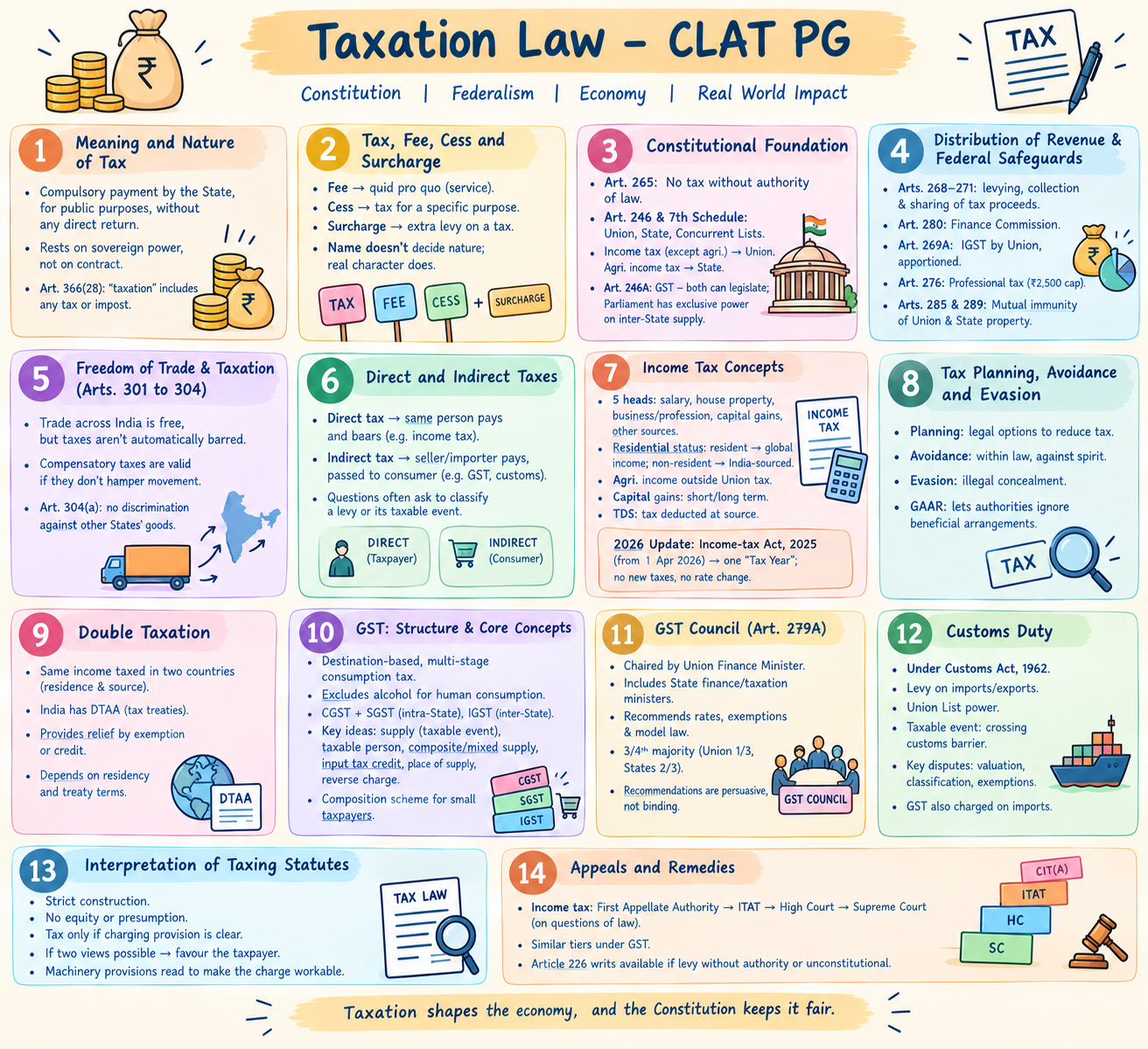
A tax is a compulsory payment imposed by the State under authority of law, for public purposes, without any direct return benefit to the payer. It rests on sovereign power and not on contract. Article 366(28) says “taxation” includes the imposition of any tax or impost.
2. Tax, Fee, Cess and Surcharge
A fee needs a quid pro quo, meaning a service rendered to the payer, though the match need not be exact. A cess is a tax earmarked for a stated purpose. A surcharge is an extra levy added on a tax already payable. A levy’s name does not decide its nature; its real character does.
3. Constitutional Foundation
Article 265: no tax can be levied or collected except by authority of law. This is the basis for challenging any levy made without a valid law.
Article 246 and the Seventh Schedule: the Union List, State List and Concurrent List divide legislative power over taxes. Income tax other than on agricultural income is a Union subject. Agricultural income tax is a State subject.
Article 246A: after the 101st Amendment, Parliament and State legislatures can both make laws on GST, with Parliament having exclusive power over inter-State supply.
4. Distribution of Revenue and Federal Safeguards
Articles 268 to 271 deal with how tax proceeds are levied, collected and shared between the Union and States, and the Finance Commission under Article 280 recommends the distribution. Article 269A provides that IGST on inter-State supply is levied by the Union and apportioned. Article 276 caps professional tax at ₹2,500 a year.
Articles 285 and 289 give mutual immunity of Union and State property from each other’s taxes.
5. Freedom of Trade and Taxation (Articles 301 to 304)
Trade across India is free, but taxes are not automatically barred. Compensatory taxes that do not hamper movement are valid. Article 304(a) bars taxes that discriminate against goods from other States. This is a common passage topic because it joins federalism, trade and tax.
6. Direct and Indirect Taxes
In a direct tax, the legal liability and the burden are on the same person, as with income tax. In an indirect tax, the seller or importer pays the government but passes the burden to the consumer, as with GST and customs duty. Questions often ask you to classify a levy or to identify its taxable event.
7. Income Tax Concepts
Income tax is charged on the total income of a person for the relevant year. The five heads of income are salary, house property, business or profession, capital gains, and other sources. Residential status decides the scope of taxation: a resident is taxed on global income, while a non-resident is taxed mainly on India-sourced income.
Agricultural income is outside the Union’s income tax. Capital gains are classified as short-term or long-term based on the holding period. TDS is tax deducted at source by the payer.
Update for 2026
The Income-tax Act, 2025 replaced the 1961 Act from 1 April 2026. It uses one “Tax Year” in place of “previous year” and “assessment year”. It is described as policy-neutral, with no new taxes and no change to rates or slabs. Matters relating to earlier years continue under the old law, so note which Act a question refers to.
- The Cut-off Line: Income earned during FY 2025-26 will still be filed and processed under the old Income-tax Act, 1961 terminology as Assessment Year (AY) 2026-27.
- The New Era: Income generated from April 1, 2026, onward moves fully into the 2025 Act framework and is referenced simply as Tax Year 2026-27.
8. Tax Planning, Avoidance and Evasion
Tax planning is using legal options to reduce liability. Tax avoidance is arranging affairs to cut tax technically within the law but against its spirit. Tax evasion is illegal concealment or falsification. GAAR (the General Anti-Avoidance Rule) allows tax authorities to disregard arrangements whose main purpose is a tax benefit.
9. Double Taxation
The same income may be taxed in two countries, once on residence and once on source. India has tax treaties (DTAA) that allocate taxing rights and give relief by exemption or credit. Treaty benefits depend on residency and on the treaty’s wording.
10. GST: Structure and Core Concepts
GST is a destination-based, multi-stage consumption tax on supply of goods and services. Article 366(12A) defines it, and it excludes alcohol for human consumption. The main components are CGST and SGST on intra-State supply and IGST on inter-State supply.
Important ideas are supply (the taxable event, Section 7 of the CGST Act), taxable person, composite and mixed supply, input tax credit (Section 16), place of supply and reverse charge. Reverse charge means the recipient pays tax instead of the supplier. The composition scheme offers simpler compliance for small taxpayers.
11. GST Council (Article 279A)
The Council is chaired by the Union Finance Minister and includes State finance or taxation ministers. It recommends rates, exemptions and the model law. Decisions need a three-fourths majority, with the Union holding one-third of the weight and States two-thirds. Its recommendations are persuasive and do not bind Parliament or State legislatures.
12. Customs Duty
Customs duty is levied under the Customs Act, 1962 on goods imported into or exported from India. Union power comes from the Union List. The taxable event for import is generally the crossing of the customs barrier. Valuation, classification and exemptions are the main areas of dispute. IGST is also charged on imports.
13. Interpretation of Taxing Statutes
Taxing laws are strictly construed. There is no equity or presumption in tax law, and a tax can be imposed only if the charging provision clearly says so. If two reasonable readings are possible, the one favouring the taxpayer is preferred. Machinery provisions are read to make the charge workable.
14. Appeals and Remedies
In income tax, the usual route is the first appellate authority, then the Appellate Tribunal, then the High Court and the Supreme Court on questions of law. Similar tiers exist under GST. Article 226 writs are available where a levy is without authority of law or a provision is unconstitutional.
You may read the hyperlinked articles to revise the landmark judgments and strengthen your understanding of the case laws on Taxation Law.
Subscribe for updates
Join 10,000+ subscribers.
HA
Hanspal Bakul
Contributing author
Have a doubt about this?Ask Doubts