The "Distinguished Jurist" Debate: Why Has India Never Used This Route to the Supreme Court?
A constitutional provision that has sat unused for over seven decades is back in public conversation. Justice Ujjal Bhuyan recently raised a pointed question: why has no person ever been appointed to the Supreme Court as a "distinguished jurist," despite the Constitution expressly permitting it?
What Article 124(3)(c) Actually Says
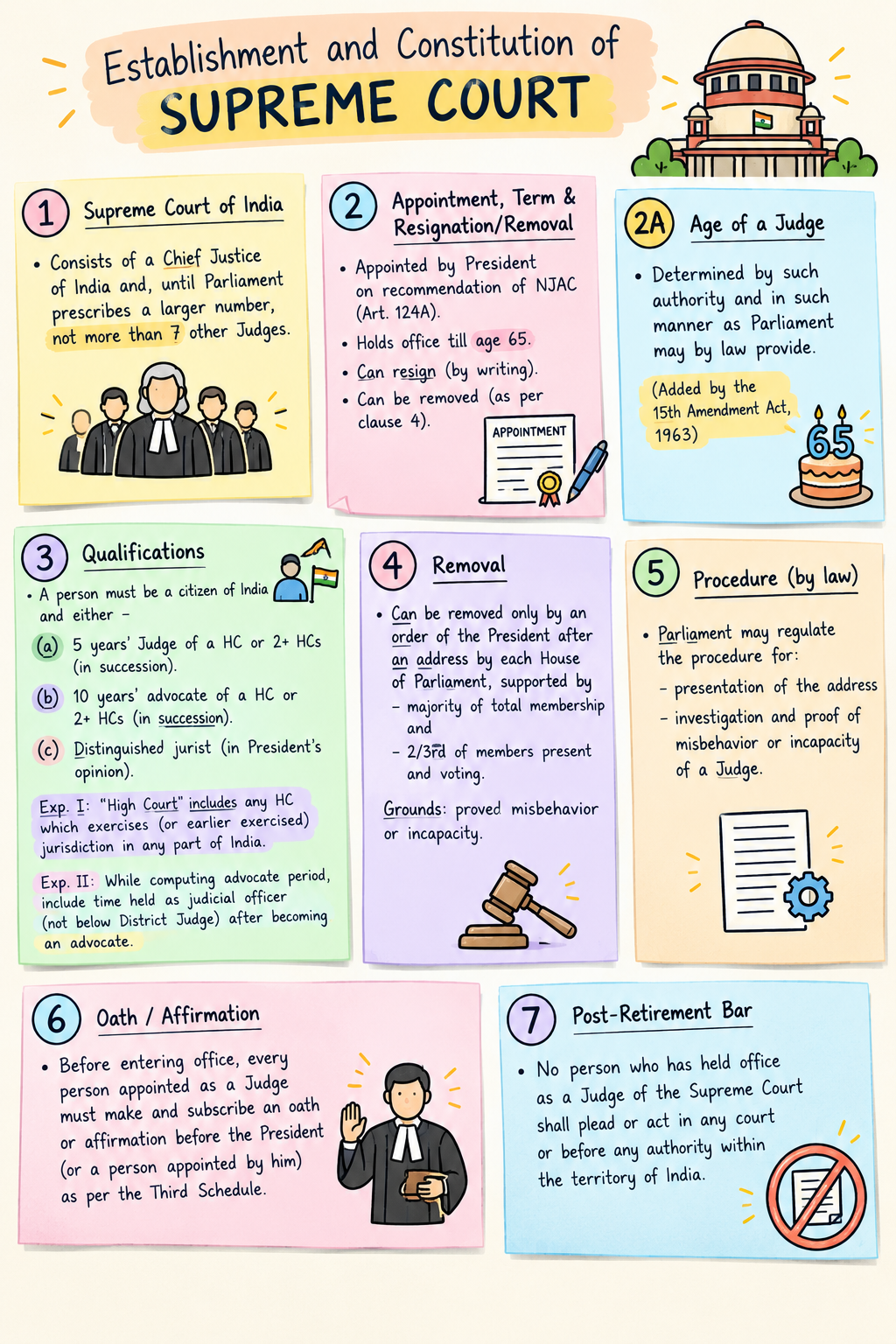
Article 124(3) lays down three distinct pathways for appointment to the Supreme Court. A person may qualify by having served as a High Court judge for at least five years, or as a High Court advocate for at least ten years.
The third and least-used route allows the President to appoint someone who is, in their opinion, a "distinguished jurist" - with no further definition attached.
This deliberate vagueness was not accidental. The Constituent Assembly's Drafting Committee chose the word "distinguished" over "eminent," signalling an intent to reward genuine scholarly contribution to law rather than mere reputation or seniority.
What the Constitution's Framers Intended
During the Constituent Assembly debates in 1949, H.V. Kamath proposed this provision specifically to open the Court to individuals with "outstanding legal and juristic learning."
Ananthasayanam Ayyangar supported the idea, arguing that Supreme Court appointments should not be confined to sitting judges, and that practising lawyers "barely come across constitutional problems" in their daily practice - making room for scholars was seen as essential to deepen the Court's constitutional reasoning.
A Missed Opportunity, According to Legal Scholars
Writing a decade ago, Professor Upendra Baxi lamented that India had "wilfully squandered" the chance to have its own equivalent of Justice Felix Frankfurter - the American legal scholar who served over two decades on the U.S. Supreme Court after a career in academia, and whose scholarly rigour shaped constitutional jurisprudence there.
Professor G. Mohan Gopal has gone further, suggesting the provision carries genuine transformative potential.
He argues that the Indian Supreme Court's bench has historically been dominated by a narrow set of communities, and that using Article 124(3)(c) to appoint jurists from outside this circle could meaningfully diversify the perspectives shaping the Court's jurisprudence - rather than simply reinforcing existing patterns.
Why It Has Never Been Used
Professor Baxi has revealed that he personally asked two former Chief Justices why no distinguished jurist had ever been elevated.
Both cited practical difficulties. Unlike specialised constitutional courts in Germany, Italy, or Spain - which are divided into dedicated benches for constitutional, civil, criminal, and administrative matters - the Indian Supreme Court has no such specialisation.
Every judge handles the Court's full range of admission and hearing matters, leaving little institutional space for someone without prior judicial experience to be absorbed smoothly.
A Related Provision That Was Repealed
Interestingly, a parallel route once existed for High Courts. The 42nd Amendment Act, passed during the Emergency, allowed distinguished jurists to be appointed as High Court judges - potentially creating a pipeline of jurists with practical judicial experience who could later move to the Supreme Court.
This provision was repealed by the 44th Amendment Act in 1978, closing off that pathway entirely.
A Global Comparison
India is not alone in having this kind of provision - but it is unusual in not using it. Countries such as Germany, Spain, and Japan reserve a fixed share of top-court seats for legal scholars.
Nepal, South Korea, Israel, Italy, and Kenya also allow academics or distinguished jurists onto their highest courts, often through dedicated judicial selection committees - a model India notably rejected when the Supreme Court struck down the National Judicial Appointments Commission (NJAC) Act in 2015.
This is a high-value topic connecting constitutional design, appointments law, and comparative constitutionalism - themes CLAT PG frequently tests together. Key threads to retain: the exact text and scope of Article 124(3)(c); the Constituent Assembly's rationale (Kamath and Ayyangar's speeches); the distinction between "distinguished" and "eminent" as a drafting choice; the repealed 42nd/44th Amendment provision for High Courts; and how India's appointment process compares with jurisdictions that use judicial selection committees or reserved scholarly seats.
Subscribe for updates
Join 10,000+ subscribers.
HA
Hanspal Bakul
Contributing author
Have a doubt about this?Ask Doubts