
The Specific Relief (Amendment) Act, 2018: A Paradigm Shift in Contract Enforcement
The Specific Relief Act, 1963 underwent significant transformation through the 2018 Amendment. This amendment fundamentally altered the philosophy governing specific performance.
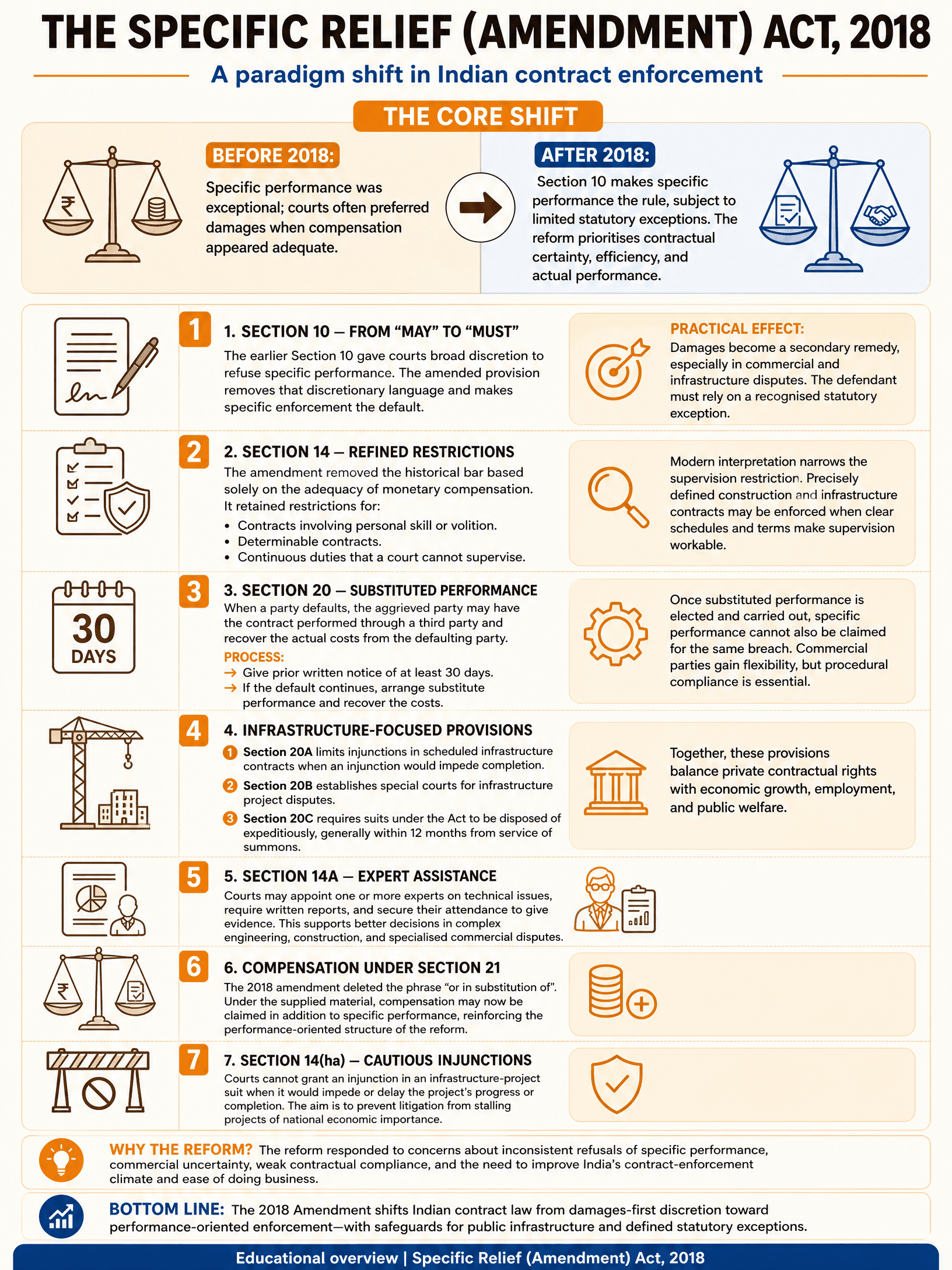
Before 2018, specific performance was an exceptional remedy. Courts granted it only when damages proved inadequate. The amendment reversed this approach entirely, making specific performance the rule rather than the exception.
The Core Philosophical Shift
Section 10 previously used the word "may," granting courts wide discretion to refuse specific performance. The amended Section 10 removes this discretionary language. Courts must now enforce contracts specifically, subject to limited statutory exceptions.
This change reflects India's growing emphasis on contractual certainty and ease of doing business. Moreover, it aligns Indian contract enforcement with international commercial practices, where specific performance receives greater judicial deference.
Consequently, damages have become a secondary remedy rather than the primary judicial preference. This reversal significantly impacts how courts approach breach of contract cases, particularly in commercial and infrastructure disputes.
Refinement of Section 14 Restrictions
The 2018 Amendment substituted Section 14 to realign it with a pro-enforcement philosophy. Most notably, it deleted the historical bar against enforcing contracts where monetary damages were adequate.
However, it retained strict exceptions for contracts involving personal skills, those that are determinable in nature, and those involving a continuous duty that a court cannot supervise.
While the court supervision bar remains law under Section 14(b) regarding the performance of the continuous duty, modern judicial interpretation has narrowed its application.
Courts are increasingly willing to enforce complex contracts (like construction or infrastructure) if the terms are precisely defined, moving away from past reluctance by focusing on clear schedules rather than assuming an ongoing duty is automatically unsupervisable.
Introduction of Substituted Performance
Section 20 introduces an entirely new remedy: substituted performance. If a party fails to perform the contract, the aggrieved party may get it performed through a third party, recovering costs from the defaulting party.
This provision requires prior written notice of not less than thirty days before invoking substituted performance. Importantly, once substituted performance is elected, the aggrieved party cannot simultaneously claim specific performance for the same breach.
Substituted performance offers commercial flexibility. It allows parties to mitigate losses quickly without waiting for lengthy litigation. However, it demands careful procedural compliance, particularly regarding the mandatory notice requirement.
Special Provisions for Infrastructure Projects
Sections 20A, 20B, and 20C represent landmark additions targeting infrastructure development. Section 20A restricts courts from granting injunctions in contracts related to infrastructure projects specified in the Schedule, where such injunctions would impede completion.
This provision balances private contractual rights against larger public interest in infrastructure development. Delayed projects affect economic growth, employment, and public welfare, justifying limitations on injunctive relief in specific circumstances.
Section 20B establishes special courts for infrastructure project disputes.
Section 20C mandates expeditious disposal of suits under the Act generally. Courts must resolve proceedings within twelve months from the date of service of summons. This provision tackles the broader problem of prolonged specific relief litigation.
Expert Opinion Under Section 14A
The amendment inserts Section 14A, empowering courts to seek expert opinion on technical matters. In any suit where the court considers it necessary to get specialised assistance on a specific issue, it may appoint one or more experts, direct them to report to the court, and secure their attendance for providing evidence.
This provision recognises that judges often lack technical expertise to assess complex engineering or construction disputes, thereby improving the quality and accuracy of judicial decisions in specialised commercial matters.
Amendments to Rescission Provisions
Section 21, which deals with awarding compensation in specific performance suits, was amended by the 2018 Act to delete the phrase 'or in substitution of'.
This crucial change effectively strips the court of its power to grant monetary compensation as a replacement or alternative to specific performance under this section.
Instead, compensation can now only be claimed 'in addition to' specific performance. This recalibration ensures absolute consistency with the broader statutory shift that establishes performance-oriented execution as the mandatory default right, rather than treating monetary compensation as a discretionary alternative.
Limiting Discretion Under Injunctions
The amendment also revised provisions concerning injunctions, particularly Section 41, dealing with circumstances where injunctions cannot be granted.The amendment revised provisions concerning injunctions by inserting a crucial new clause, Section 41(ha), into the Act.
The addition of clause (ha) explicitly prohibits courts from granting an injunction in suits involving infrastructure projects if such relief would impede or delay the progress or completion of the project. These changes further reinforce the pro-enforcement philosophy underlying the entire amendment.
Courts now exercise injunctive powers more cautiously, especially concerning infrastructure and public utility contracts. This reflects legislative intent to prevent injunctions from stalling projects of national economic importance.
Rationale Behind the Amendment
Recommendations from an expert committee headed by Anand Desai, constituted by the Ministry of Law and Justice, directly informed the 2018 amendment. The committee identified rampant misuse of discretionary refusal by courts, which routinely awarded damages as a default instead of performance, causing immense commercial uncertainty and discouraging strict contractual compliance.
Furthermore, India's targeted focus on improving its ranking on the World Bank's Ease of Doing Business Index heavily motivated the reform. Contract enforcement metrics directly influenced this legislative overhaul, structurally connecting private law reform to broader macroeconomic policy objectives.
The Specific Relief (Amendment) Act, 2018 marks a decisive shift toward performance-oriented contract enforcement in India. It prioritises certainty, efficiency, and public interest, particularly within infrastructure development, reshaping remedies available under the Specific Relief Act, 1963
Subscribe for updates
Join 10,000+ subscribers.
HA
Hanspal Bakul
Contributing author
Have a doubt about this?Ask Doubts
