
Important Doctrines Under Company Law: CLAT PG
Recognizing the important doctrines under company law is significant for CLAT PG candidates, as the examiners usually come up with questions based on these principles.
The principles clarify who has the right to take legal action against a company, who has the obligation to adhere to rules and when the court may disregard the company’s distant identity. Besides, the principles can be linked to major cases and a systematic understanding of them will lead to scoring high.
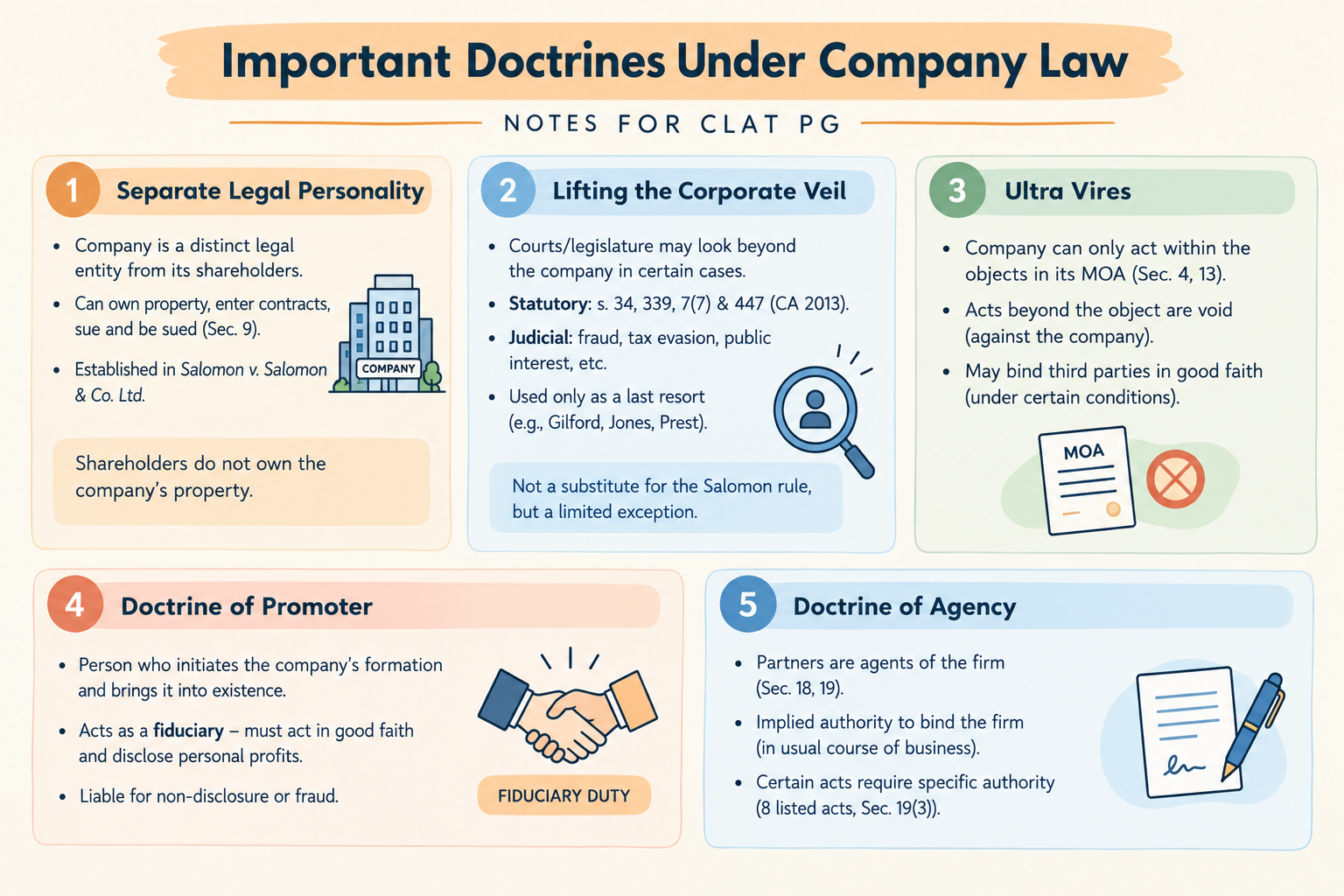
1. Doctrine of Separate Legal Personality
Upon incorporation a company is recognized as a separate legal personality from its shareholders. According to Section 9 of Companies Act of 2013, the company after incorporation shall have the perpetual succession and the ability to own property and take legal action. Hence, a company appears to have possession of its assets and liabilities.
This principle was first established in the case of Salomon v. Salomon & Co. Ltd. Mr. Salomon transferred his business to a company that he established and obtained a debenture. When the company fell bankrupt, the House of Lords observed that he is entitled to the repayment of his loan as a secured creditor.
Later rulings illustrate the extent of the rule. A case in point is Lee v. Lee’s Air Farming Ltd., where a single shareholder-director could also act as an employee of the company. In the Macaura case, a shareholder was unable to insure the assets of the company since he did not have any insurable interest in them.
Similar reasoning was adopted in the case of Bacha F. Guzdar v. CIT , in which the Indian Supreme Court ruled that shareholders do not own the property owned by the company.
2. Doctrine of Lifting the Corporate Veil
While the separate legal personality concept could be abused, there are rare occasions where courts and legislative bodies see behind the company and its operators. Such a concept can be divided into statutory and judicial removal of corporate personality exception. Both of them are relevant to the Salomon rule as its limitations rather than being substitutes. Statutory exceptions include section 34 of the Companies Act, 2013, whereby criminal liability arises for false statements made in prospectus, as well as section 339 that holds individuals responsible for fraudulent actions related to running the business of the company.
Additionally Section 7(7) exposes promoters to action under Section 447 where they incorporate a company by furnishing false information.
Judicial instances include Gilford Motor Co. v. Horne, [1933] Ch 935, in which an employee made use of a new firm to escape a restrictive covenant, and Jones v. Lipman, wherein a corporation was used as a disguise by the seller in order to avoid a specific performance.
In Daimler Co. Ltd. v. Continental Tyre Co. , the House of Lords inspected the nationality of the people in charge so as to find out if the company was the enemy. Eventually, in Prest v. Petrodel Resources Ltd., it was clarified that the veil can only be pierced under the evasion principle ( when a person is under an existing legal obligation and deliberately frustrates it by using a company insurance.)
In India, Life Insurance Corporation of India v. Escorts Ltd., concluded that the courts may break through the veil in cases like tax evasion, fraud and the safeguarding of public interest. Likewise, State of U.P. v. Renusagar Power Co. turned its gaze away from the separate identity of one of its subsidiaries towards its economic substance.
Vodafone International Holdings B.V. v. Union of India, then introduced a note of caution when it comes to the veil being lifted only for sham or tax avoidance arrangements and not for bona fide commercial transaction.
3. Doctrine of Ultra Vires
Companies can only perform those actions which have the authority allotted to them in the memorandum of association. Section 4 of the Companies Act, 2013 deals with the objects clause of the memorandum. In addition, Section 13 discusses how changes may be made to the memorandum.
Therefore, anything going beyond the object of the memorandum is said to be ultra vires and is not accepted in law, irrespective of the resolution passed by the members.
The best example of this is the case of Ashbury Railway Carriage, and Iron Co. Ltd. v. Riche. In this case, the company had an object clause describing its purpose as making and selling railway machinery.
However, any contracts made to finance a railway line was declared to be void because although all the shareholders had later approved the deal, that portion specifically was not allowed under its memorandum. In another case of Attorney General v. Great Eastern Railway Co it was allowed to perform acts of activities that are just incidental to the objects outlined by the company.
In India the case of A. Lakshmanaswami Mudaliar v. Life Insurance Corporation of India, adopted the rule of ultra vires in relation to company spending beyond the objects clause. The practical lesson for exams is that an ultra vires contract binds neither the company nor the outsider, whereas an act that is merely irregular can be cured.
4. Doctrine of Constructive Notice
The memorandum and articles are public documents filed with the Registrar. The law therefore treats every person dealing with the company as having read them, and as knowing the limits of the company’s and its officers’ powers. Section 10 of the 2013 Act reinforces this by making these documents binding on the company and its members.
The doctrine protects the company, and it has a hard effect on outsiders. A person who contracts beyond the powers shown in the documents cannot claim ignorance. Nevertheless, constructive notice covers only what the public documents say. It does not reach the company’s internal procedures, which brings in the next doctrine.
5. Doctrine of Indoor Management
Royal British Bank v. Turquand created the rule that outsiders may assume the company has complied with its internal procedures. The company’s directors lacked the resolution their articles required, but the bank could still enforce the bond, because it was entitled to presume the resolution existed.
Therefore this doctrine softens the harshness of constructive notice and protects people who deal in good faith.
The exceptions matter as much as the rule. The doctrine gives no protection where the outsider has actual or constructive knowledge of the irregularity, or where circumstances should arouse suspicion, as in Anand Bihari Lal v. Dinshaw & Co.
It also fails where the document is forged, as Ruben v. Great Fingall Consolidated , shows, since a forged document is a nullity. Likewise, Mahony v. East Holyford Mining Co., applied the rule where the outsider relied on documents signed by apparent officers.
6. Rule in Foss v. Harbottle
The legal case Foss v. Harbottle, advises that it is the company and not the members who should file a lawsuit against the wrongful act done to the company. The courts discourage from interfering in the issues that can be ratified by the majority and generally follow the rule of the majority in dealing with the internal affairs of the companies.
The ruling was applied in India in the case Rajahmundry Electric Supply Corporation v. A. Nageshwara Rao.
Nevertheless, there are some exceptions to the rule. A member may take action in case of ultra vires acts or illegal acts, fraud over minority, special majority needed but not obtained and other cases of infringement of personal rights. Certain aspects of the two last terms were demonstrated by the case Edwards v. Halliwell.
The Companies Act of 2013 has made available the remedies prescribed by law which lessen reliance on the common law exceptions.
Sections 241 and 242 allow for the complaints regarding oppression and mismanagement of affairs, while Section 245 allows for filing class actions in cases of large numbers of complainants. The case Needle Industries (India) Ltd. v. Needle Industries Newey (India) Holding Ltd. shows how the courts use the complaints of oppression to block the action of the majority.
Continue Reading the Company Law Series
For a full revision of company law, read the other case laws in this series:
- Read Part 1 of Company Law
- Read Part 2 of Company Law
- Read Part 3 of Company Law
- Read Part 4 of Company Law
Subscribe for updates
Join 10,000+ subscribers.
HA
Hanspal Bakul
Contributing author
Have a doubt about this?Ask Doubts