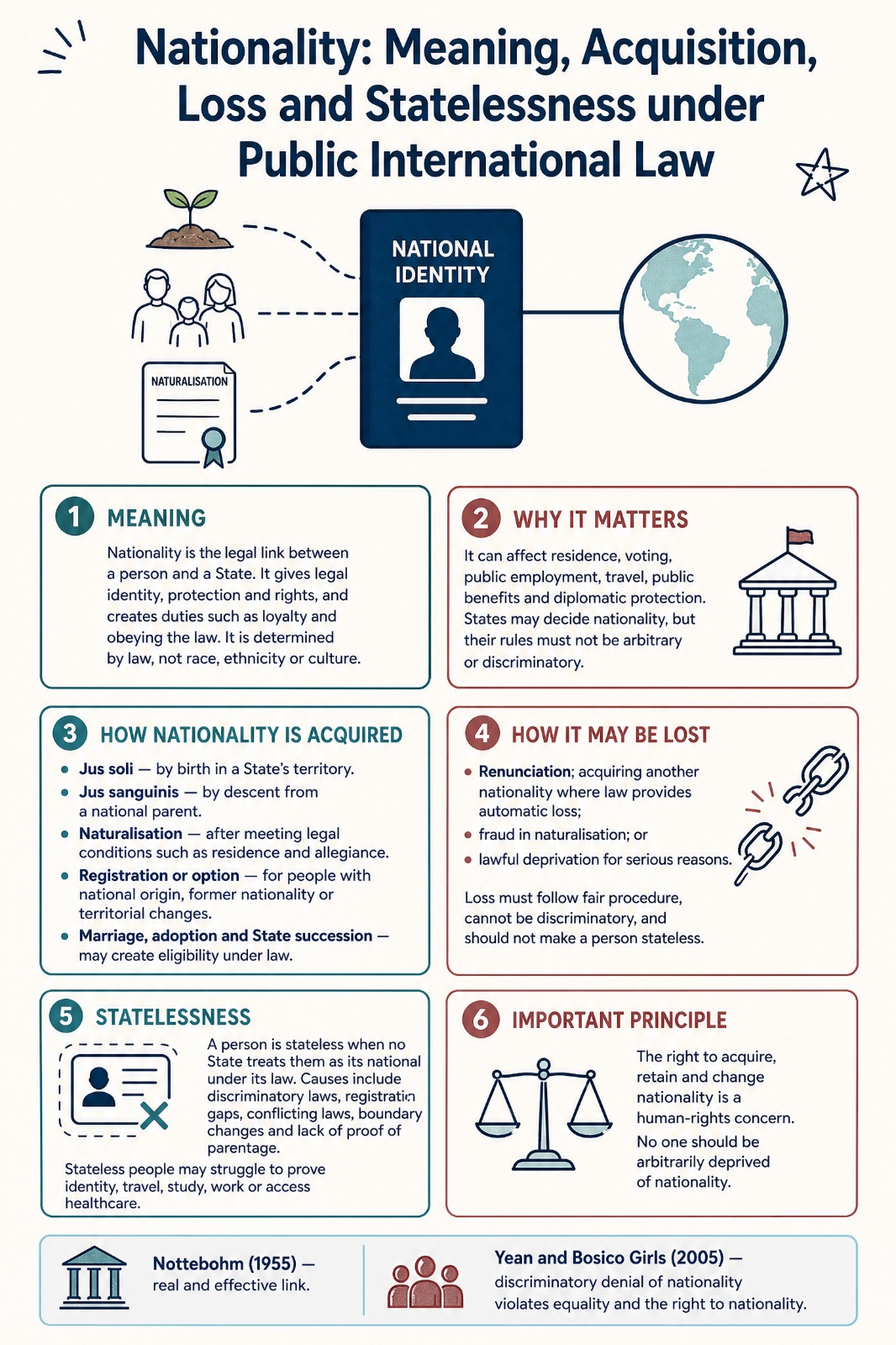
Nationality refers to the legal connection that exists between an individual and a state. It shows us from which state that person is affiliated with. This relationship confers on the individual certain rights, for example the right to have protection when abroad and access to public benefits, and at the same time imposes certain duties, such as the obligation of loyalty and obedience to the law.
For a state, this legal relationship is important since it enables it to identify the people towards whom it may claim protection on the international level.
Nationality was originally considered to be a matter for domestic concern, but it is now also regarded as a human rights issue. The article outlines the meaning, development, significance, how it is acquired, how it can be lost, and its relationship with statelessness.
Meaning and Definitions of Nationality
In simple terms, nationality is the legal status of a person as a member of a state. It should not be confused with race, ethnicity, or cultural identity. Although a person might have a cultural connection to a community, this is status is determined by law.
Different writers have explained the concept in slightly different ways:
Oppenheim defined nationality as a legal relationship existing between a person and a state, consisting of the person's allegiance and the state's obligation to provide protection.
Fenwick regarded nationality as the legal link which ties an individual to a particular State and thereby makes that person a member of its political community.
Brownlie stressed that nationality is a status established by municipal law, although its effects can have an impact in international law, in particular when a state exercises diplomatic protection.
A person's nationality therefore goes beyond simply having a passport. It can affect their ability to vote, to obtain public employment, to reside in a country, to receive diplomatic protection and other legal rights.
Nationality must also be separated from citizenship. Although in many countries the two terms are used interchangeably, in some legal systems nationality refers to the wider international relationship whereas citizenship refers to the full range of political rights within the state.
Development of the Law of Nationality
It has traditionally been the case that states have had a great deal of freedom in determining who their nationals are. Nationality has been regarded therefore as belonging to the field of domestic jurisdiction. The Advisory Opinion of the Nationality Decrees in Tunis and Morocco (1923) drew an important conclusion to this effect, namely that although nationality is generally a matter for the domestic sphere, state power is restricted by international obligations.
Following the World Wars, instances of displacement, the introduction of discriminatory laws, and the creation of new states demonstrated that people could be left stateless. It was therefore the case that nationality came to be linked with human dignity and equality.
International law today therefore adopts a balanced approach in that states are allowed to establish nationality laws but these laws must not be arbitrary, discriminatory or inconsistent with their human-rights obligations.
Importance and Significance
Nationality grants a person a legal identity and a sense of belonging. Otherwise, it may be difficult to get an education, open a bank account, secure formal employment, and travel.
Secondly, nationality provides the foundation for diplomatic protection. Where a national is the victim of an internationally wrongful act in a different country, their home state may bring the issue before that country, on the understanding of the rules of international law. The International Court of Justice stated in Barcelona Traction(Belgium v. Spain) (1970) how important nationality is when it comes to diplomatic protection claims involving companies.
Nationality can also have an effect on matters such as jurisdiction, extradition, military service, voting, and public employment. Nationality should not, at the same time, be used as a means of discrimination. The Office of the United Nations High Commissioner for Human Rights (OHCHR) regards the right to acquire, retain and change nationality as a basic human right.
Modes of Acquisition of Nationality
1. Acquiring nationality at birth, jus soli
It is obtained on the ground of having been born in the territory of a state under the principle of jus soli. Jus soli literally means the ‘right of the soil’ which means it is the territorial right of the person to the state nationality where he is born in.
The scope of this rule varies from country to country. In some states nearly all people who are born there are given nationality automatically, whereas in others conditions are imposed which relate to the parents or to the residence.
2. Nationality by descent, jus sanguinis
Jus Sanguinis literally means ‘right of blood’. Under this, it is obtained by reason of a parent who is already a national. This rule is generally adopted by states when they want to keep a continuous connection with people of national origin who are living outside the country. When nationality laws treat men and women differently, children can end up being stateless.
For this reason, modern human-rights law advocates for the equal transmission of nationality by men and women.
3. Naturalisation
The process by which a foreigner becomes a national after meeting the required legal conditions is known as naturalisation. It may involve residence for a certain period, knowledge of the language, a good character, taking an oath of allegiance and showing an intention to make the country one's permanent home. Although naturalisation is generally at the discretion of the authorities, the procedure must be fair and not discriminatory.
4. Registration or option
People who have a national origin, who were previously nationals, or who have been affected by a change in territory may obtain this status by registering or by selecting from the available options.
5. Marriage, adoption, and succession
Marriage may create eligibility for nationality, but modern law generally does not support automatic loss or change of nationality merely because a person marries a foreigner. Nationality may also be acquired through adoption or legitimation. When territory changes hands or a new State is created, nationality may be granted through rules of State succession.
Dual nationality can result from different rules. For example, a child can acquire nationality by birth in one country and by descent from a parent who has nationality in another.
Loss or Deprivation of Nationality
It can be lost in a number of ways-
if someone gives it up voluntarily, or
if they obtain a new nationality in a case where the law provides for such automatic loss, or
they may lose it having committed fraud during the naturalisation process.
In special cases, a state may take away a person's nationality for serious reasons. Loss or deprivation had to be carried out in accordance with fair law and procedure and must not be discriminatory or result in a person becoming stateless. It is important to have notice, a hearing, and access to a remedy as safeguards.
In the case of Nottebohm (Liechtenstein v. Guatemala) (1955), the International Court of Justice examined whether Liechtenstein could grant diplomatic protection to Friedrich Nottebohm against Guatemala. The Court stated that, for international purposes, nationality had to show a real and effective link in the particular circumstances of the case. The decision is significant in illustrating that a formal certificate does not necessarily resolve an international claim.
In the case of Yean and Bosico Girls v. Dominican Republic (2005), the Inter-American Court of Human Rights ruled that the discriminatory refusal to grant nationality to children amounted to a violation of the principle of equality and of the right. That case demonstrates that nationality laws must not be applied in a way that has an effect on racial or ethnic groups.
Statelessness
A person is considered stateless if no state regards that person as one of its nationals in accordance with its own laws. This is the definition given in the 1954 Convention concerning the Status of Stateless Persons.
Statelessness can be caused by discriminatory laws, gaps in the registration process, conflicting laws, changes in state boundaries, being born abroad, not having proof of parentage or suffering deprivation without being replaced. Women are particularly at risk in cases where they are not able to transmit nationality to their children as equally as men are.
A stateless person might not have a passport, could find it hard to prove their identity, may have limited access to education and healthcare, experience difficulties in obtaining employment or in marrying, and be subject to restrictions on their ability to move. This situation can be passed on to their children.
In order to avoid this issue, international law has introduced various safeguards. States must grant nationality to children who would otherwise have no nationality, such as orphaned children and those born in their territory whose parents are unable to pass on nationality to them. Moreover, they should prevent the discriminatory withdrawal of nationality and establish procedures for correcting wrongs in nationality records.
Conclusion
Nationality is the legal link that connects a person with a state. It gives a person a sense of identity, entitles them to protection and access to various rights.
CLAT PG students should remember two essential principles of birth - jus soli and jus sanguinis, along with naturalisation, registration, marriage, adoption and State succession. Nationality may be lost by renunciation, substitution, fraud or lawful deprivation, but such action should not be arbitrary or discriminatory.
Finally, statelessness is not merely the absence of a passport. It can exclude a person from ordinary social and legal life. The idea is simple i.e. a State has the power to define its nationals, but that power must be exercised responsibly and consistently with international human rights.