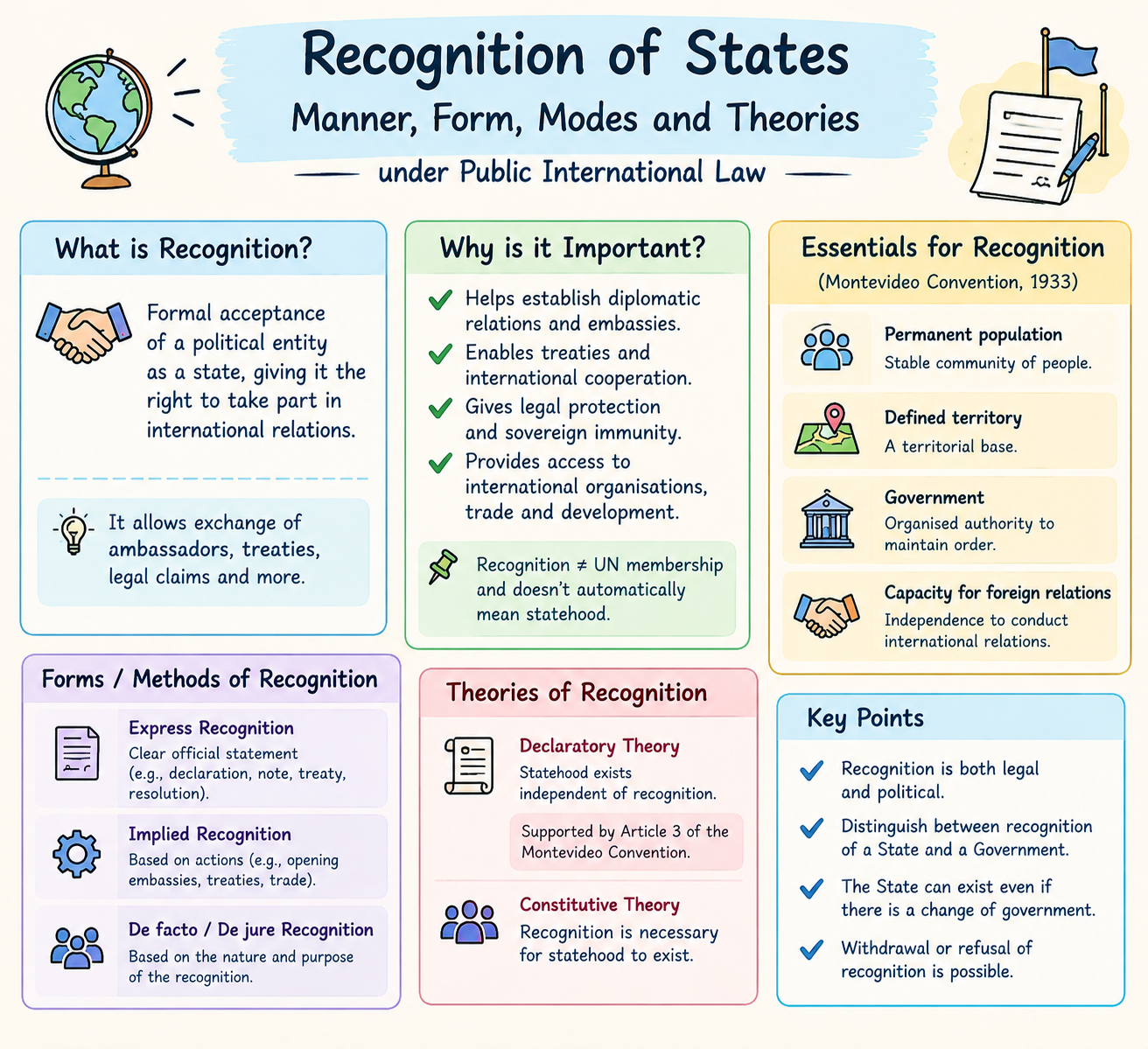
Recognition of state means that an existing state formally admits that a political entity has the attributes of statehood and therefore has the right to take part in international relations. This is not merely an act of diplomacy. The act of recognition determines whether or not the entity can exchange ambassadors, enter into treaties, claim immunity, approach foreign courts and take part effectively in the international community.
The article looks at the importance of recognition of state, the basic elements of statehood, the ways in which recognition is given, the different types of de facto and de jure recognition, the constitutive and declaratory theories, key judicial rulings, and the situation regarding the withdrawal or refusal of recognition.
Why is recognition of States important?
The international community is centred on sovereign states, since recognition of state helps to establish diplomatic relations, enables treaties to be made, supports international claims and allows participation in international organisations. It also provides practical legitimacy to the government of the entity in question.
Its importance can be understood through the following effects-
Recognition of state has a number of practical consequences -
It enables diplomatic relations, the establishment of embassies and formal communication.
It helps to conclude treaties, arrange for extradition, provide legal assistance and take part in international conferences.
It may allow a state to sue or be sued, to claim sovereign immunity, to protect its property abroad and to make diplomatic-protection claims.
It also grants access to diplomatic privileges, to international organisations, to trade and development agreements, and to peaceful methods of settling disputes.
However, recognition is not the same as being a member of the UN, although general recognition usually enhances an entity’s ability to apply for membership.
Recognition of state doesn't necessarily lead to statehood. An entity might meet the legal criteria for statehood before it is recognised, but in the absence of recognition it will encounter major practical difficulties.
Recognition thus has both a legal and a political aspect. It is also necessary to make a distinction between the recognition of a State and the recognition of a government. The State may still exist even if there is a revolution or a change of regime, while recognition of a government involves deciding which authority is entitled to represent that State.
Essentials for recognition as a State
The 1933 Montevideo Convention on the Rights and Duties of States lists four criteria relevant to recognition of state and statehood -
a permanent population,
a defined territory,
a government, and
the ability to establish relations with other states.
Essential
Explanation
Permanent Population
There must be a stable community of people.
Defined territory
Entities must possess a territorial base.
Government
Independence and permanence are also important for recognition of state. A territory which is entirely under the control of another state may not have the degree of independence necessary for statehood. Yet merely having a civil war or a period of temporary disorder does not automatically wipe out a state’s claim to statehood provided that its legal identity and governmental structure remain.
The declaratory theory is strongly supported by Article 3 of the Montevideo Convention, which states that the political existence of a State is independent of recognition and that even before recognition a State has the right to defend its integrity and independence.
The form or method of recognition
Express recognition
Recognition can be shown by means of a clear official statement. It might be contained in a government declaration, a diplomatic note, a formal notification, a treaty, a parliamentary resolution or a public announcement.
For example, if State A makes a formal declaration that it recognises Entity B as a sovereign and independent State, then the recognition is expressed. The declaration can be de facto or de jure according to its wording and purpose.
Implied or unofficial recognition
Recognition is based on actions rather than on an explicit statement. A State may set up diplomatic relations, swap ambassadors, sign a bilateral treaty or take some other action which clearly treats the entity as an international person. Simply negotiating, engaging in trade, having humanitarian contact or taking part in the same conference does not by itself count as recognition. It is necessary for the actions to show a clear intention to recognise.
Since implied recognition may lead to disputes, the courts look at the overall behaviour of the state which is acknowledging the state.
Conditional recognition
Recognition can include requirements concerning respect for existing borders, minority rights, human rights, democracy, non-proliferation or peaceful behaviour. While such conditions can promote lawful conduct, they might also be applied in a selective manner for political reasons. Recognition should not be used to give legal validity to a situation resulting from the use of unlawful force.
Modes of recognition
The two traditional modes of recognition of state are are de facto and de jure recognition.
De facto recognition
De facto recognition is temporary and based on fact. It is usually given when an entity exercises substantial control over a territory and its population, but the stability, permanence or future success of this situation is still in doubt. It can be seen as a practical way of testing that control.
In fact recognition is restricted, easier to take away and generally a precondition for de jure recognition. It does not always include the full set of diplomatic privileges.
De jure recognition
De Jure recognition means full legal recognition and is given when the state doing the recognition believes that the entity meets the conditions for statehood and has attained a sufficient degree of stability and permanence. It is generally meant to be final and entails various broader consequences, such as the establishment of more comprehensive diplomatic relations and the grant of immunities.
The example of the Soviet Union is that the United Kingdom granted it de facto recognition in 1921 and de jure recognition in 1924. Provisional in nature is de facto recognition while de jure recognition is full and has legal consequences.
In the case of Luther v. Sagor an English court validated the actions of the Soviet government after the British government had recognised it. The case demonstrates that recognition can decide whether domestic courts will accept the acts of a foreign power. It also shows the practical significance of the recognition of governments, in particular in cases involving property and official acts.
Theories of recognition
Constitutive theory
The constitutive theory of recognition of state is linked to philosophers like Oppenheim, Hegel and Anzilotti and holds that an entity acquires international personhood only upon being recognised by existing States. It is this recognition which confers or creates the entity’s international legal personality.
The fact is that it shows the practical importance of recognition, its drawback. However, is its reliance on political will and the uncertainty involved in the fact that some states recognise an entity while others do not.
Declaratory theory
The declaratory theory of recognition of state is linked to authors including Hall, Brierly, Fischer and Wengler. It states that an entity becomes a State when it actually meets the conditions required for statehood. All that recognition does is to declare or acknowledge a fact which is already there, it does not create the State. This view is expressed in Article 3 of the Montevideo Convention.
The benefit of this is that it stops politics from being the only basis of statehood. Its drawback is that the territory, the effective government or the independence themselves might be in dispute.
Modern practical approach
Current practice incorporates both theories. Although statehood is judged using objective legal criteria, recognition is still essential for the entity to function internationally. On this basis, the declaratory theory has the upper hand in principle, while recognition does have significant constitutive effects in practice.
When there was a change of government in Costa Rica, Great Britain claimed that the Tinoco regime was not entitled to act since it enjoyed no broad recognition. The arbitrator, William Howard Taft, concentrated on the regime's actual and effective control. The award demonstrates that a lack of recognition does not automatically render the acts of an effective government invalid and is in support of the declaratory theory.
The case was about the effect in England of the actions of the Soviet government. When the British government had recognised the Soviet government, the English courts then accepted the validity of its official acts. The decision shows the domestic legal consequences of the recognition of a government.
Legal Consequences of the Continued Presence of South Africa in Namibia, ICJ, 1971
The International Court of Justice stated that it was illegal for South Africa to remain in Namibia and that States had an obligation not to recognise the illegal situation or to help in keeping it. This case is important since it demonstrates that recognition is not in all cases a matter of free political choice, where a situation arises out of serious illegality, international law may oblige non-recognition.
Island of Palmas Arbitration, 1928
The disagreement was about opposing assertions of sovereignty with respect to an island. The tribunal emphasized that a continuous and peaceful exercise of state authority forms a key foundation of territorial sovereignty. Even though the case was mainly concerned with the question of title to the territory and not with the recognition of a new state, it does help to explain why effective control and peaceful administration are important when evaluating claims to statehood.
Nottebohm was more concerned with nationality and diplomatic protection than with the recognition of a state. The International Court of Justice stated that the nationality conferred by Liechtenstein was not closely enough linked to Nottebohm for Liechtenstein to use it against Guatemala. The case serves as a warning, merely because a state grants recognition or nationality does not mean that this will automatically bind other states.
The Court held that Kosovo’s declaration of independence did not breach the particular rules of international law which had been presented to it. It did not rule that Kosovo had automatically met all the criteria for statehood, nor did it establish a general right of secession. The opinion shows the difference between independence, statehood and recognition.
Withdrawal and non-recognition
To withdraw recognition is not the same as refusing to give recognition from the start. De facto recognition can be withdrawn if the authority loses effective control, fails to fulfill the agreed conditions, or seems unlikely to survive. Withdrawal of de jure recognition is however much rarer since it may damage stability and cause uncertainty in international relations.
To withdraw recognition from a government does not amount to denying that the State still exists. It is a different matter to withdraw recognition of the State itself, since this raises more fundamental questions concerning extinction, merger, dissolution or unlawful creation.
International law might also include the principle of non-recognition. As shown by the Namibia opinion and the international reaction to Iraq’s attempt to annex Kuwait, states should not recognise territorial arrangements established by unlawful force or other serious violations of basic international rules.
Conclusion
Recognition of state serves as the link between a political entity and its ability to take part in the international community. The Montevideo criteria offer the objective starting point, whereas recognition provides actual access to diplomacy, treaties, courts and immunities.
With regard to CLAT PG, it is important to remember that forms can be either express or implied, modes can be described as de facto or de jure, and the main theories are constitutive and declaratory.