Statehood & International Responsibility under Public International Law
Why the State matters
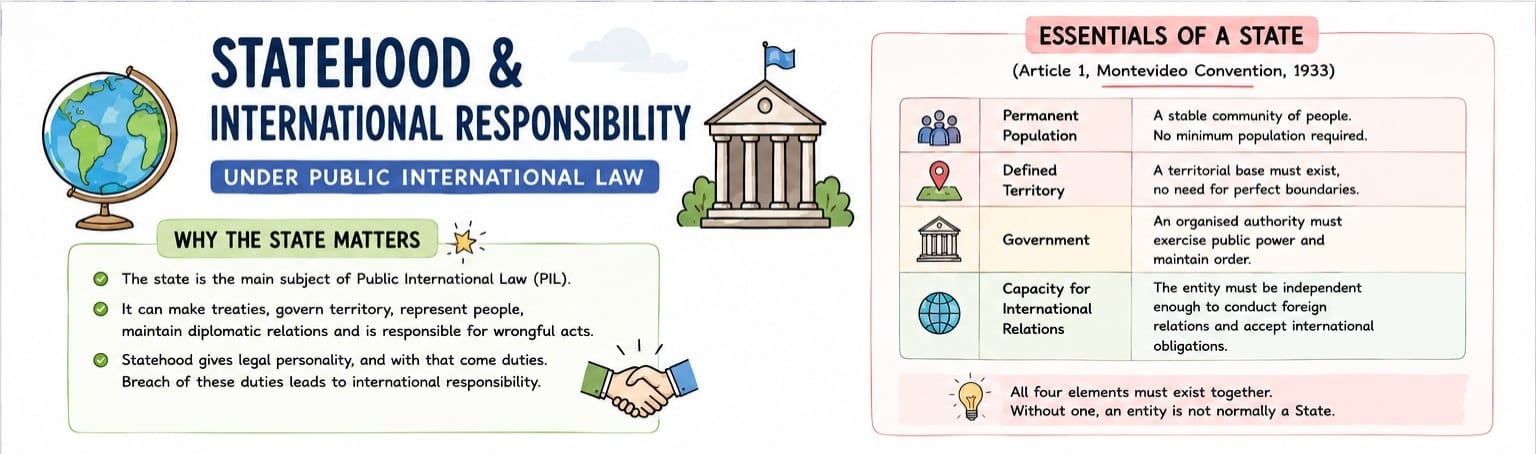
The state forms the fundamental component of Public International Law (PIL). It is able to enter into treaties, to administer territory, to represent populations, to maintain diplomatic relations and to accept responsibility for breaches. Although international organisations, individuals, corporations, non-governmental organisations and armed groups also have an influence on international affairs, their legal status is generally more restricted.
This article discusses statehood, the classification of states, non-state entities, state responsibility and state succession. Statehood confers personality and that personality gives rise to duties. A breach of these duties results in responsibility.
Meaning and essentials of a State
A State in international law is an organised political community which has a population, territory, a government and independence in its external relations. According to Article 1 of the 1933 Montevideo Convention on the Rights and Duties of States, a State must have four criteria-
- a permanent population,
- a defined territory,
- a government, and
- the ability to enter into relations with other States.
| Essential | Explanation |
| Permanent Population | There must be a stable community of people. No minimum population is required. |
| Defined Territory | A territorial base must exist, no need for perfect boundaries. |
| Government |
They should all be read together. A population lacking an organised government is not normally a State, and likewise a government which has no stable territorial base might be a government in exile but is not necessarily itself a State.
Statehood, sovereignty and independence
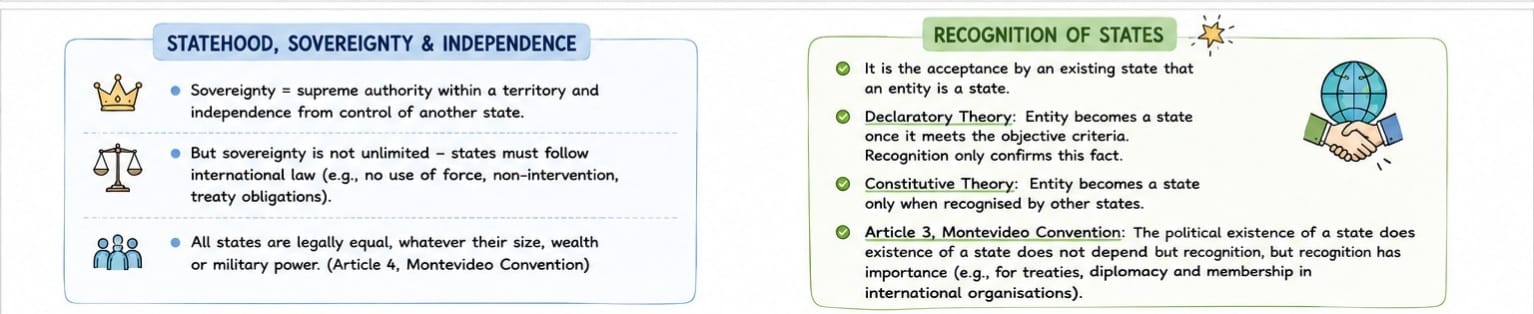
Sovereignty refers to having supreme authority within a territory and to being independent of the control of another state. It does not imply unlimited freedom. A sovereign state is required to respect its international obligations, such as the ban on the use of force, the principle of non-intervention and its commitments under treaties.
In the arbitration concerning the Island of Palmas, the tribunal linked territorial sovereignty with the right to exercise authority over the territory and at the same time regarded international law as the framework in which that authority operates.
The principle of the equality of States means that they are legally equal even if there is a great difference between them in terms of population, wealth and military strength. The distinction between legal equality and political inequality is expressed in Article 4 of the Montevideo Convention.
Recognition of States
Recognition refers to the formal or informal acceptance on the part of an existing State of the fact that an entity has international personality. According to the declaratory theory, an entity becomes a State when it meets the objective criteria for statehood. Recognition in this case simply confirms that fact.
On the other hand, the constitutive theory assigns a more significant role to recognition and holds that an entity acquires international personality as a result of being recognised by existing States.
The declaratory approach is supported by Article 3 of the Montevideo Convention, which states that the political existence of a state does not depend on recognition. Yet recognition still has great practical value since it enables diplomatic relations, treaty-making and membership of international organisations.
Types and classifications of States
Independent or fully sovereign States
A state which is independent has control over its internal matters and is able to carry out its foreign policy without suffering legal subordination. Since independent states are full parties to the PIL, they have the right to enter into treaties, to claim immunities, to bring forward international claims and to assume responsibility.
Dependent, protected and associated States
In the past a dependent state has been under the control of another state in matters relating to its external affairs. A protectorate can look after its internal administration but has to rely on the state that is acting as protector for defence or for diplomatic matters. An associated state may have self-government while at the same time handing over its external responsibilities. The relationship between the Cook Islands and New Zealand is frequently referred to in this context. Their status is determined by the establishing agreement.
Unitary and federal States
In a federal state the powers set out in the constitution are shared between the federal and provincial authorities, but international law generally regards the federation as a single international entity. This is supported by Article 2 of the Montevideo Convention.
Neutral and micro-States
A state that is permanently neutral agrees not to take part in certain wars on the basis of international law. Switzerland is the typical example. A micro-state such as Monaco or Liechtenstein has a small territory or a small population, but their small size does not mean that they lack statehood.
Fragile, failed and partially recognised States
A state which is described as 'fragile' or ‘failed' is one in which the government is unable to effectively control its territory or deliver services. It does not constitute a distinct legal category. A state may still have international personality even if there is a civil war. A state that is partly recognised might meet many of the criteria but will encounter political difficulties in regard to recognition.

Non-State entities
A non-state entity is not a sovereign state but might have certain rights, duties or legal capacity under a treaty, customary rule or institutional practice. It’s personality is generally functional, which means that it only exists to the extent needed for the entity’s recognised role.
International organisations
International organisations obtain their powers and personality from their constituent instruments. In Reparation for Injuries the International Court of Justice stated that the United Nations had international personality and could therefore claim compensation for injury suffered by one of its agents.
The United Nations, the World Health Organisation (WHO) and the World Trade Organisation (WTO) are universal or functional organisations. While the European Union, the African Union and South Asian Association for Regional Cooperation (SAARC) are regional examples.
Individuals
In the past people were mostly seen as objects within the scope of international law, but modern personal international law has made the system more human-oriented. Human rights treaties confer rights upon individuals, while international criminal law lays down direct duties.
Examples of individual responsibility for international crimes and violations of humanitarian law are provided by the Nuremberg trials, the Rome Statute and the case of Prosecutor v. Tadic.
Peoples and national liberation movements
The people may have the right of self-determination. National liberation movements, in certain limited cases, take part in negotiations concerning decolonisation or occupation, but their ability to do so depends on the particular issue in question.
NGOs, ICRC and multinational corporations
Organisations such as Amnesty International and Greenpeace have an impact on law by means of advocacy and monitoring. The International Committee of the Red Cross holds a particular status within the Geneva Conventions. Multinational companies affect trade, investment, labour and environmental standards and can obtain treaty rights, but they are not considered to be sovereign bodies with general law-making powers.
Armed non-state actors
Groups which are rebel, aggressor or terrorist are not usually considered to be States. Yet armed groups can be subject to international humanitarian law, in particular Common Article 3 of the Geneva Conventions and the customary rules that apply in non-international armed conflicts.
Their duties do not rely on them being recognised as States. Moreover, a State may also be held responsible if the group is acting under its instructions, direction or control.
State responsibility
State responsibility constitutes the legal result of an internationally wrongful act. The framework in the International Law Commission (ILC) Articles on the Responsibility of States for Internationally Wrongful Acts from 2001 is the principal one.
It is stated in Article 1 that each internationally wrongful act gives rise to the responsibility of that State. According to Article 2, two conditions must be met-
- the conduct in question must be attributable to the State, and
- it must amount to a breach of an international obligation which is binding on that State.
Attribution and direct responsibility
The actions of state bodies such as legislatures, governments, courts, the armed forces and local authorities are regarded as state actions. It is not normally possible for a state to avoid responsibility just because an official has gone beyond the scope of his or her authority when acting in an official capacity.
Moreover, the behaviour of a private individual can also be attributed in cases where that person is exercising governmental authority or is acting upon state instructions, directions or control.
Examples -
With regard to the Corfu Channel, the International Court of Justice assigned responsibility to Albania for not giving adequate warnings to the British ships about the mines located in its territorial waters. This case demonstrates the principle of due diligence and the obligation not to knowingly permit its territory to cause harm to other States.
The United States Diplomatic and Consular Staff in Tehran was initially held responsible for having failed to protect the US Embassy and later because the State authorities had approved and continued the occupation and detention of the hostages.
Breach and indirect responsibility
In the case of Nicaragua v. United States, the International Court of Justice concluded that the United States had violated its customary obligations not to use force or to intervene in the domestic affairs of another State. The case is still significant with regard to the principle of non-intervention, self-defence and attribution.
In Trail Smelter, Canada was obliged to pay compensation to the United States for the transboundary pollution, showing the duty to prevent considerable cross-border harm.
Consequences and remedies
The State responsible should stop the wrongful act, give assurances against repetition where appropriate and make full reparation by means of restitution, compensation or satisfaction. Restitution will restore the previous situation, compensation is for financial loss, and satisfaction might involve an acknowledgement or an apology.
State succession
State succession happens when one State takes the place of another as the party responsible for the international relations of a given territory. This is the technical definition given in Article 2(1)(b) of the Vienna Convention on Succession of States in Respect of Treaties of 1978.
It should be distinguished from a change of government, a revolution or a constitutional amendment. In such cases the same State generally goes on, even if its leaders change.
Forms of succession
Succession can take the form of the transfer of territory, secession, decolonisation, merger, dissolution or annexation.
Partial succession happens when a part breaks away while the predecessor remains, for example in the case of Bangladesh separating from Pakistan. Universal or complete succession takes place when the predecessor ceases to exist, such as in the case of the dissolution of Czechoslovakia.
It is the older theories that account for the debate. According to the theory of universal succession, the successor inherits the predecessor’s rights and obligations. Whereas the negative or clean-slate theory grants newly independent States more freedom from them. In current practice each matter is treated separately, such as treaties, property, archives, debts, nationality and organisational membership.
Legal effects
Boundary treaties usually continue since stability and clear territorial boundaries are important. Other political or economic treaties may, however, require new agreement. Public property and archives can be transferred to the successor state, while public debt is typically settled by means of agreement and fair distribution. Nationality issues have to be dealt with in such a way that people who are affected are not left stateless.
The example of the Gabcikovo-Nagymaros Project demonstrates that even when there are major political and factual changes those changes do not of themselves eliminate the obligations under a treaty. Thus, states are required to fulfill their ongoing obligations in good faith.
Conclusion
Owing to statehood, a country acquires full international legal personality, yet this does not mean that it is protected from being held responsible. For those revising the CLAT PG course, it is important to remember the four essential elements of a state, the declaratory and constitutive theories, the functional personality of non-state entities, Articles 1 and 2 of the ILC Articles, and the principles from the Corfu Channel, Nicaragua, Chorzów Factory and Reparation for Injuries cases.
Subscribe for updates
Join 10,000+ subscribers.
JU
Julie Nigam
Contributing author
Have a doubt about this?Ask Doubts
